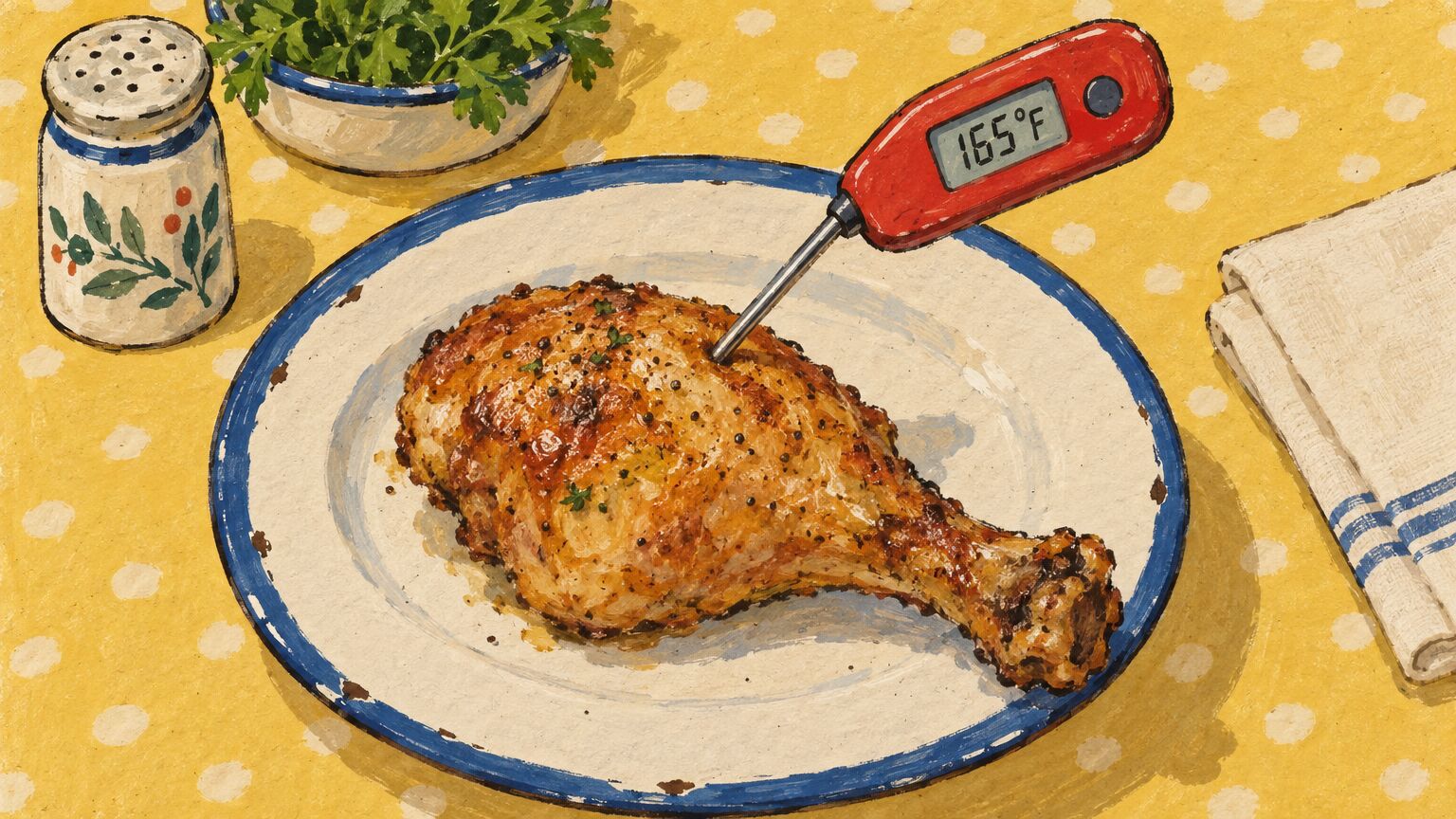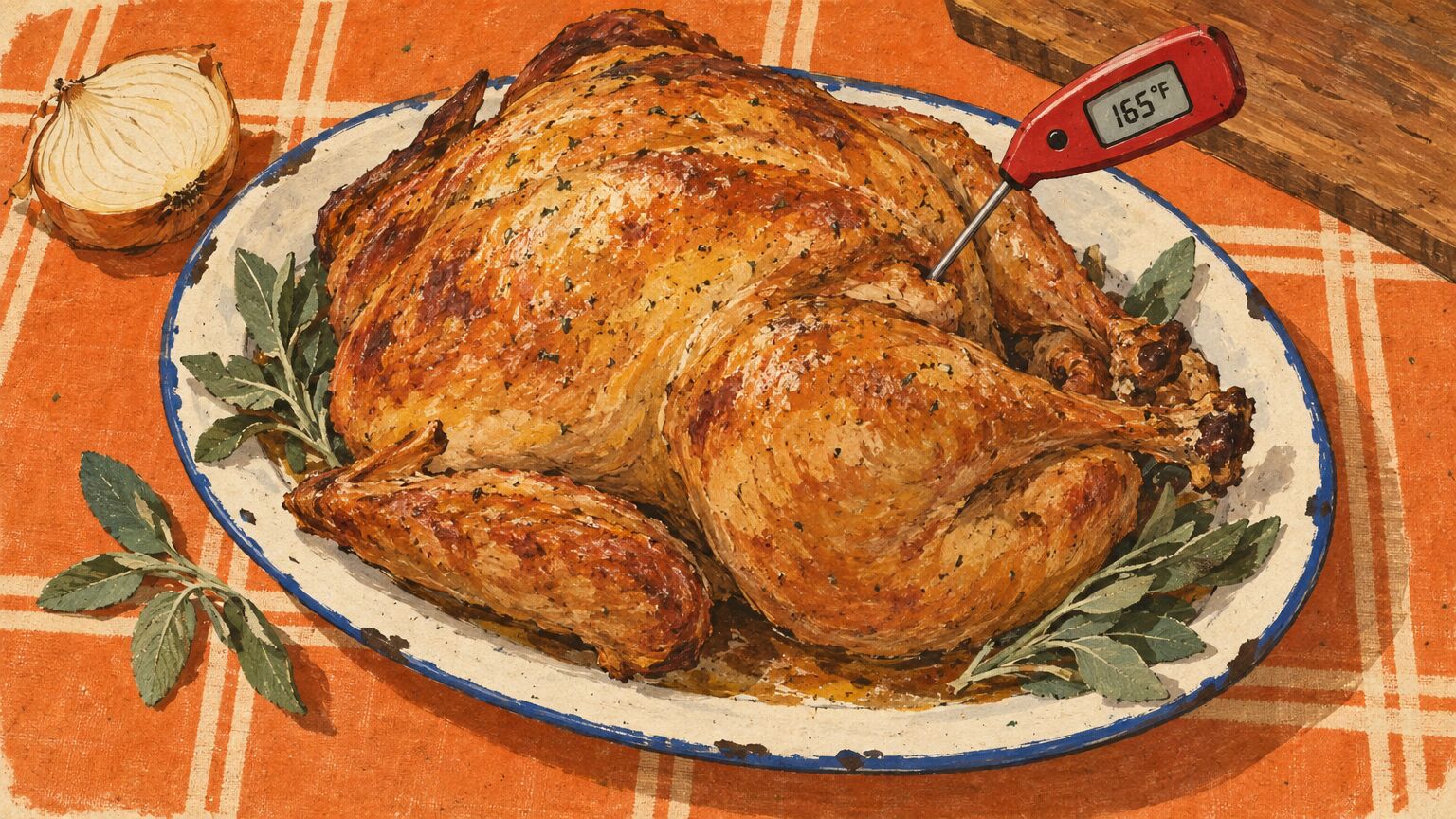
Cook turkey until a food thermometer reads 165°F (74°C) in three places: the innermost part of the thigh, the innermost part of the wing and the thickest part of the breast. That is the USDA's safe minimum for a whole turkey, and the same 165°F (74°C) covers turkey breasts, legs, ground turkey and stuffing. Higher numbers you may see, such as 180°F (82°C) in the thigh, mostly come from older USDA advice that was about texture, not safety.
Turkey temperatures at a glance
| What you are cooking | Safe minimum | Where to measure |
|---|---|---|
| Whole turkey | 165°F (74°C) | Innermost thigh, innermost wing and thickest part of the breast, all three |
| Turkey breast, bone-in or boneless | 165°F (74°C) | Thickest part, tip in the middle, off the bone |
| Legs, thighs and wings cooked as parts | 165°F (74°C) | Thickest part, off the bone |
| Ground turkey | 165°F (74°C) | Center of the thickest patty or meatball |
| Stuffing, in the bird or in a dish | 165°F (74°C) | Center of the stuffing |
| Smoked, grilled or fried whole turkey | 165°F (74°C) | Same three places as a roast |
| Leftovers | 165°F (74°C) | Center of the dish |
The numbers come from the USDA's safe minimum internal temperature chart. It lists 165°F (73.9°C) for all poultry, giblets and stuffing, and says to reach it "before removing food from the heat source." The USDA adds that cooks may choose to go higher for personal preference. Unlike beef and pork roasts, poultry has no rest-time allowance in the chart.
Where to put the thermometer in a turkey
Check the innermost part of the thigh, the innermost part of the wing and the thickest part of the breast, keeping the tip in meat and off the bone. The USDA's food thermometer guidance names those three spots for whole poultry, and every one of them must reach 165°F (74°C). If the bird is stuffed, the center of the stuffing is a fourth spot.
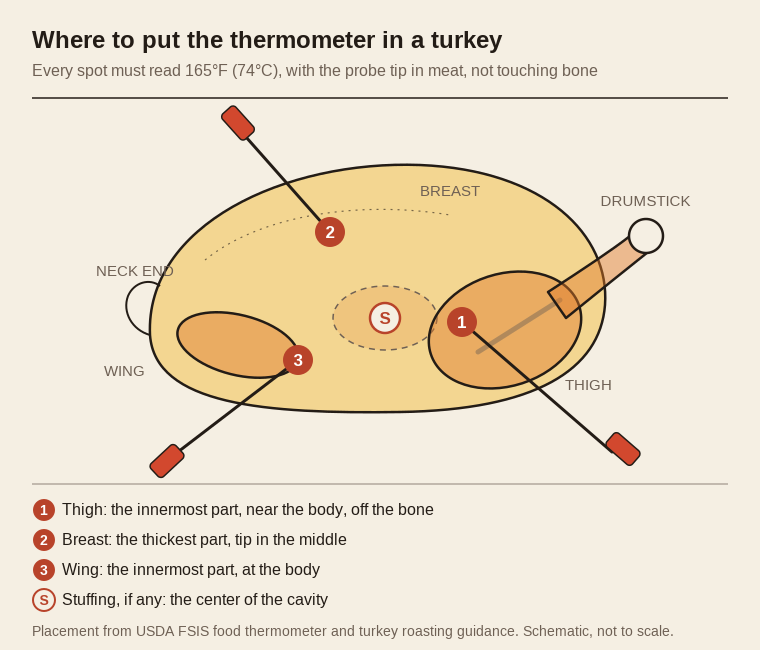
- Start with the thigh. If you use an oven-safe thermometer, the USDA's roasting guide says to put it in the thickest part of the inner thigh at the start. Once the thigh reads 165°F (74°C), check the wing and the breast with an instant-read thermometer.
- Find the middle of the breast. Aim for the thickest part, with the tip in the middle of the meat rather than near the surface or against the breastbone.
- Mind the stem on a dial thermometer. A bimetal dial thermometer averages the temperature along 2 to 2½ inches (5 to 6 cm) of its stem, so it must go in that deep. A digital instant-read thermometer senses near its tip, so it also works in thinner spots such as the wing.
- Allow for error. The USDA says most food thermometers are accurate to within 2 to 4°F (1 to 2°C). A thermometer that reads 32°F (0°C) after 30 seconds in a glass of ice water is reading true at that end of its scale. Our answer on how to calibrate a meat thermometer shows how to adjust one that doesn't.
- If one spot is short, keep cooking. Put the bird back in the oven and check that spot again.
The UK and Irish agencies point cooks to the thickest part of the bird, between the leg and the breast. That spot sits close to the USDA's innermost thigh, so checking it does no harm, but the USDA's three places cover more of the bird.
Why some charts say 180°F (82°C) for turkey
The 180°F (82°C) figure is the USDA's own old number. Its 2003 consumer sheet, Turkey Basics: Safe Cooking, said a whole turkey "must reach 180 °F in the innermost part of the thigh" and a turkey breast 170°F (77°C). In April 2006 the USDA set 165°F (74°C) as the single safe temperature for poultry, on the advice of its National Advisory Committee on Microbiological Criteria for Foods. The committee said 165°F (74°C) destroys Salmonella, "the most heat resistant pathogen of public health concern in raw poultry."
The same committee explained why the old sheet's 170°F (77°C) breast and 180°F (82°C) thigh numbers could stay in cooks' minds. It said cooks might still want those temperatures to get rid of "the pink appearance and rubbery texture," not for safety. That texture advice has lived on in recipes, and other sources set their own, higher numbers:
- Butterball tells cooks the turkey is done at 170°F (77°C) in the thigh and 170°F (77°C) in the breast, with 165°F (74°C) in the stuffing. That is its own doneness target, above the USDA's minimum.
- Health Canada sets 180°F (82°C) for whole poultry as its safe cooking temperature, measured in the thickest part of the breast, and 165°F (74°C) for pieces and stuffing. The USDA uses 165°F (74°C), checked in three spots.
Cooking a turkey to 180°F (82°C) is safe. By the USDA's numbers it is no safer than 165°F (74°C) in every spot, and the breast pays for it in moisture. Dark meat is different, as the next section explains.
What if the breast is done and the thighs are not?
Keep cooking until every spot reads 165°F (74°C). In a whole turkey the breast and the legs rarely finish together, and the USDA's rule is that the lowest of the three readings decides. If the breast is running ahead, cover it loosely with foil while the legs catch up; Butterball's roasting directions do this when the turkey is about two-thirds done.
Thighs that run past 165°F (74°C) are not a problem. Dark meat has more connective tissue than breast meat, and that tissue softens with heat and time. In chicken, America's Test Kitchen found thighs more tender at 175 to 195°F (79 to 91°C), as our chicken answer explains in its section on dark meat, and turkey legs are built the same way. ThermoWorks, for example, aims for the breast at 165°F (74°C) and the legs at 175 to 180°F (79 to 82°C). The breast is the part that dries out as it climbs.
Why 165°F (74°C) is the number, and why turkey isn't quite chicken
165°F (74°C) is the temperature at which turkey meat is safe the instant it gets there. Below that, bacteria still die, but they need time. The USDA's science for meat plants, the Revised Appendix A cooking guideline, lists how long turkey must stay at each temperature to cut Salmonella by 7 logs (99.99999 percent), the same kill 165°F (74°C) delivers instantly.
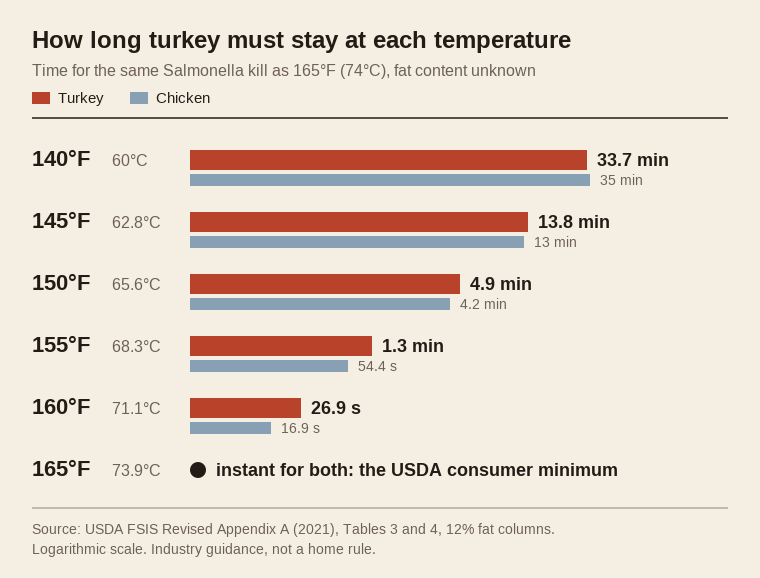
| Internal temperature | Lean turkey (2% fat) | Fat unknown (12% column) |
|---|---|---|
| 140°F (60°C) | 28.3 minutes | 33.7 minutes |
| 145°F (62.8°C) | 10.6 minutes | 13.8 minutes |
| 150°F (65.6°C) | 3.7 minutes | 4.9 minutes |
| 155°F (68.3°C) | 1.2 minutes | 1.3 minutes |
| 157°F (69.4°C) | 48.1 seconds | 50.4 seconds |
| 160°F (71.1°C) | 25.7 seconds | 26.9 seconds |
| 164°F (73.3°C) | 11.2 seconds | 11.7 seconds |
| 165°F (73.9°C) | Instant | Instant |
Turkey has its own table because, as the guideline puts it, "Salmonella heat tolerance depends on the poultry species." From 145°F (63°C) up, turkey needs a little longer than chicken at the same temperature. At 160°F (71.1°C) it needs 26.9 seconds against chicken's 16.9, and chicken becomes instant by 163°F (72.8°C) while turkey still needs a short hold until 165°F (73.9°C). The difference is seconds, and 165°F (74°C) covers both birds, which is why the USDA gives one number for all poultry.
This table is industry guidance written for plants that control humidity and how fast the meat heats. It also asks that the meat spend no more than 6 hours between 50 and 130°F (10 and 54°C), a condition nobody measures at home. It explains how a breast held at 150°F (66°C) for several minutes can be safe, and it is useful when a reading lands just short. For a home roast, 165°F (74°C) in every spot leaves margin for a probe a little off center or a thermometer that reads a few degrees high, and that is the number Soup Letters recommends.
Can you take a turkey out of the oven before it reaches 165°F (74°C)?
The USDA says no: its chart says to reach 165°F (74°C) before the food leaves the heat, and Soup Letters agrees. Carryover heat is real, because the outside of a big roast keeps pushing heat inward after it leaves the oven, but you can't count on it, as our chicken temperature answer says for chicken too. Some cooks rely on it anyway. ThermoWorks, which makes thermometers, pulls the breast at 157°F (69°C) in its test kitchen to allow for a rise of up to 12°F (7°C) while it rests, and takes the legs higher.
How much a turkey rises is not predictable. Thermapen's UK site roasted and rested three turkeys of 4 to 4.5 kg (8.8 to 9.9 lb) under a foil tent:
| Turkey | Out of the oven at | Peak during the rest | Rise |
|---|---|---|---|
| Cooked to the safe minimum | 165°F (74°C) | 176°F (80°C) after 13 minutes | 11°F (6°C) |
| Pulled early | 153°F (67°C) | 167°F (75°C) after 24 minutes | 14°F (8°C) |
| Cooked to the packet time | 207°F (97°C) | No rise | None |
The rises ran from nothing to 14°F (8°C) in birds of nearly the same size, and the test measured one spot per bird. Thinner parts such as the wing carry over less, and a bigger bird, a cooler room or no foil changes the result again. If you pull a turkey early anyway, it is safe only once your thermometer shows every spot reaching 165°F (74°C) during the rest. If one doesn't, the bird goes back in.
The same test makes another point: the bird cooked to the time on its packet reached 207°F (97°C), more than 40°F (22°C) past the safe minimum. Roasting charts are estimates. The thermometer decides.
Can you trust the pop-up timer in a turkey?
No: use a thermometer as well. A pop-up timer is a nylon plug with a spring held down by a material that dissolves at a set temperature. The USDA's thermometer page says they are reliable to within 1 to 2°F (about 1°C), but that placement matters. It adds that checking with a food thermometer "is always recommended." Its roasting guide says to check the thigh, wing and breast with a thermometer even when the bird has a pop-up.
Two problems show up in practice:
- Some pop too early. In 2014, Consumer Reports tested 21 pop-up timers in whole turkeys and turkey breasts against a calibrated reference thermometer. Most popped above 165°F (74°C), but three popped while the meat was still below it, one at 139.5°F (59.7°C).
- The usual setting is late. ThermoWorks says the timer that comes in a turkey is set to 180°F (82°C), the old thigh number. A timer that works as designed tells you the breast passed 165°F (74°C) some time ago.
A pop-up timer also reads one spot. The three-spot check is the one that counts.
Is it safe to cook stuffing inside the turkey?
It can be, but the USDA recommends baking stuffing in a separate dish. "For optimum safety, stuffing a turkey is not recommended," its roasting guide says. The meat can be done while the stuffing is not: the USDA warns that a stuffed bird can read 165°F (74°C) in the thigh, wing and breast while its stuffing is still too cool to kill bacteria. The USDA's stuffing guidance says "for optimal safety and uniform doneness, cook stuffing separately," and bake it to the same 165°F (74°C).
If you do stuff the bird, the USDA's rules for a stuffed turkey are:
- Cook any raw meat, poultry or shellfish in the stuffing first.
- Mix the wet and dry ingredients just before stuffing. Don't stuff the bird ahead of time, and don't stuff it with leftover cooked stuffing.
- Stuff loosely, about ¾ cup per pound of turkey (about 180 milliliters per 450 grams), and keep the stuffing moist: heat kills bacteria faster in a moist mix.
- Put the bird straight into an oven set no lower than 325°F (163°C).
- Check the center of the stuffing as well as the thigh, wing and breast. If the meat is done and the stuffing isn't, keep cooking. Don't scoop out undercooked stuffing to finish it separately, because it can contaminate the cooked meat.
- Let the bird stand 20 minutes, then take all the stuffing out before carving.
Don't stuff a turkey that will be grilled, smoked, fried or microwaved. A fried bird, for example, cooks so fast that the USDA says the center of the stuffing may not get hot enough. Don't buy a fresh turkey that was stuffed at the store. A frozen pre-stuffed turkey with a USDA or state inspection mark is safe if you cook it from frozen, following the package.
Is pink turkey safe to eat?
Pink turkey is safe when every spot has reached 165°F (74°C). The USDA's page on pink turkey says turkey "can remain pink even after cooking to a safe minimum internal temperature," and that the meat of smoked turkey is always pink. Gases in a gas or electric oven react with the pigment in the meat, young birds with thin skin show it most, and nitrites from feed or water can do the same.
Grilled and smoked turkey often has a pink ring about ½ inch (1.3 cm) wide under the surface, even when it is well above 165°F (74°C). The reverse also holds: turkey can look done before it is. Color tells you nothing either way; the thermometer does.
How long does a turkey take to thaw?
In the refrigerator, at 40°F (4°C) or below, allow about 24 hours for every 4 to 5 pounds (1.8 to 2.3 kg). In cold water, allow about 30 minutes per pound (a little over 1 hour per kilogram). Keep the bird sealed in leak-proof wrapping, change the water every 30 minutes, and cook it as soon as it is thawed. Those are the USDA's thawing times. A turkey thawed in the refrigerator keeps there for 1 to 2 more days.
| Weight | In the refrigerator | In cold water |
|---|---|---|
| 4 to 12 lb (1.8 to 5.4 kg) | 1 to 3 days | 2 to 6 hours |
| 12 to 16 lb (5.4 to 7.3 kg) | 3 to 4 days | 6 to 8 hours |
| 16 to 20 lb (7.3 to 9.1 kg) | 4 to 5 days | 8 to 10 hours |
| 20 to 24 lb (9.1 to 10.9 kg) | 5 to 6 days | 10 to 12 hours |
The turkey is still frozen on Thanksgiving morning
You can cook it from frozen. The USDA says it is safe to roast a frozen or partly frozen turkey, and that it takes at least 50 percent longer than a thawed one. Pull out the giblet packages with tongs or a fork once they loosen during cooking, and check all three spots at the end as usual.
| Thawed weight | Thawed, unstuffed, at 325°F (163°C) | Frozen, at least |
|---|---|---|
| 8 to 12 lb (3.6 to 5.4 kg) | 2¾ to 3 hours | 4 hours 10 minutes to 4½ hours |
| 12 to 14 lb (5.4 to 6.4 kg) | 3 to 3¾ hours | 4½ to 5 hours 40 minutes |
| 14 to 18 lb (6.4 to 8.2 kg) | 3¾ to 4¼ hours | 5 hours 40 minutes to 6 hours 25 minutes |
| 18 to 20 lb (8.2 to 9.1 kg) | 4¼ to 4½ hours | 6 hours 25 minutes to 6¾ hours |
| 20 to 24 lb (9.1 to 10.9 kg) | 4½ to 5 hours | 6¾ to 7½ hours |
The frozen column is the USDA's thawed time multiplied by 1.5, rounded up to the next 5 minutes. Treat it as a minimum, not a finish time.
How long does a turkey take to roast?
At 325°F (163°C), the USDA estimates 2¾ to 3 hours for an unstuffed 8 to 12 lb (3.6 to 5.4 kg) turkey, up to 4½ to 5 hours for 20 to 24 lb (9.1 to 10.9 kg). A stuffed bird takes up to 30 minutes longer. These times come from the USDA's roasting guide and, as its Turkey Basics page says, assume a fresh or thawed bird at refrigerator temperature, 40°F (4°C) or below.
| Weight | Unstuffed | Stuffed |
|---|---|---|
| Breast, 4 to 8 lb (1.8 to 3.6 kg) | 1½ to 3¼ hours | 2½ to 3½ hours (6 to 8 lb breast only) |
| 8 to 12 lb (3.6 to 5.4 kg) | 2¾ to 3 hours | 3 to 3½ hours |
| 12 to 14 lb (5.4 to 6.4 kg) | 3 to 3¾ hours | 3½ to 4 hours |
| 14 to 18 lb (6.4 to 8.2 kg) | 3¾ to 4¼ hours | 4 to 4¼ hours |
| 18 to 20 lb (8.2 to 9.1 kg) | 4¼ to 4½ hours | 4¼ to 4¾ hours |
| 20 to 24 lb (9.1 to 10.9 kg) | 4½ to 5 hours | 4¾ to 5¼ hours |
Start checking the thigh well before the low end of the range. Dark pans, an oven that runs hot or cold and a bird that isn't fully thawed all change the time; the USDA lists 11 such factors.
For the gravy from the drippings, our answer on how much flour to thicken gravy gives the amounts per cup and per quart.
What other countries say about turkey
| Authority | Whole turkey | Where to measure | Source |
|---|---|---|---|
| USDA FSIS (United States) | 165°F (74°C) | Innermost thigh and wing, thickest part of the breast | Let's Talk Turkey |
| Health Canada | 180°F (82°C); pieces and stuffing 165°F (74°C) | Thickest part of the breast | Poultry safety |
| Food Standards Agency (England, Wales, Northern Ireland) | No single number: 140°F (60°C) for 45 minutes, 149°F (65°C) for 10 minutes, 158°F (70°C) for 2 minutes, 167°F (75°C) for 30 seconds or 176°F (80°C) for 6 seconds | Thickest part of the leg, between the drumstick and the breast | Cooking your food |
| Food Standards Scotland | 167°F (75°C) | Thickest part of the leg, between the drumstick and the thigh | Food Standards Scotland cooking guide |
| safefood (Ireland) | 167°F (75°C) | Thickest part, between the breast and the leg | Check your turkey is cooked |
Scotland and Ireland use 167°F (75°C), a little above the USDA's 165°F (74°C), and Health Canada uses 180°F (82°C) for whole birds. Health Canada's other turkey page, Poultry facts, says to measure the breast or the thigh.
After the meal
The USDA's leftover rules are short:
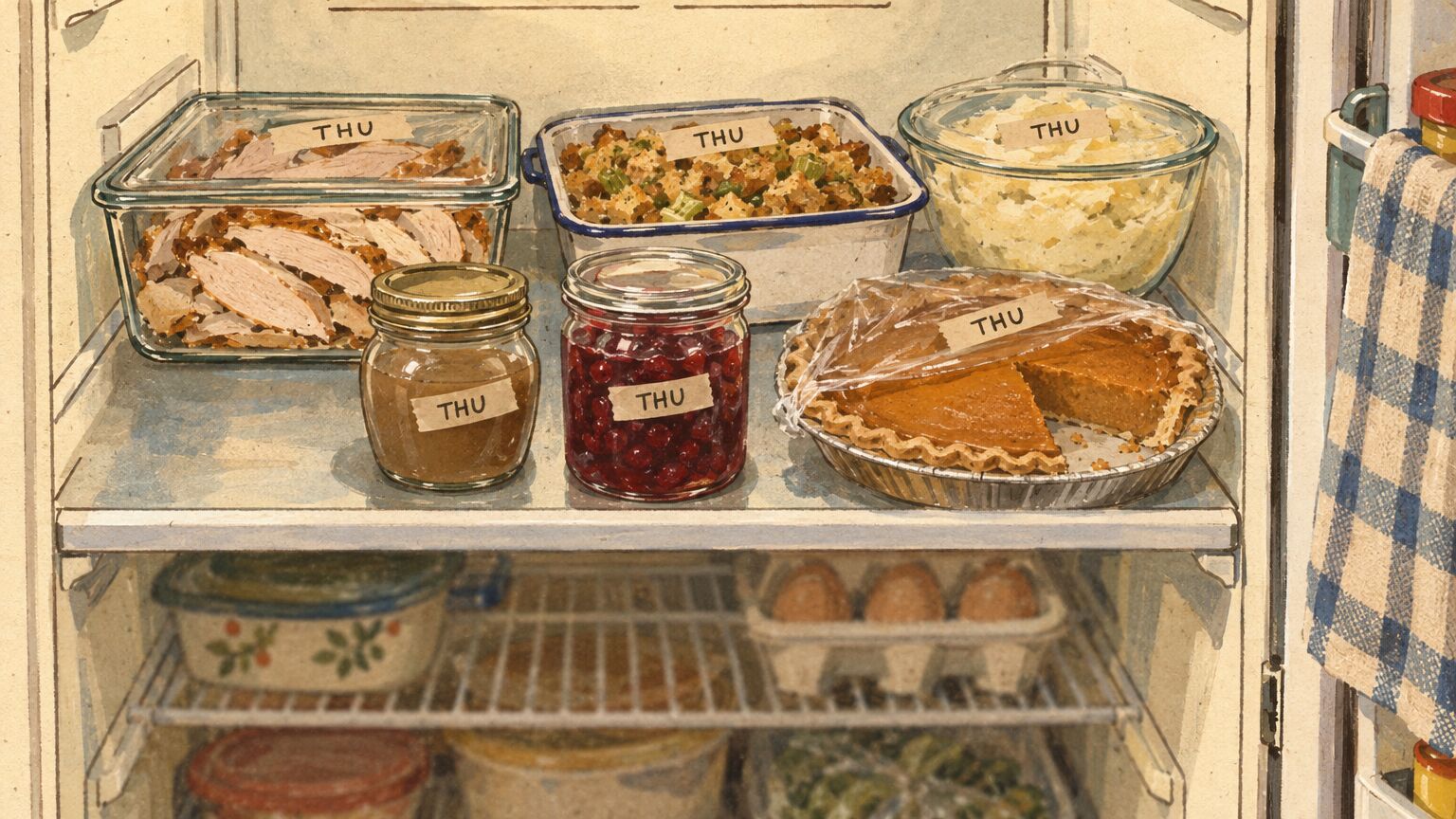
- Refrigerate turkey, stuffing and gravy within 2 hours of cooking, or 1 hour if the room is above 90°F (32°C). Throw out anything left out longer.
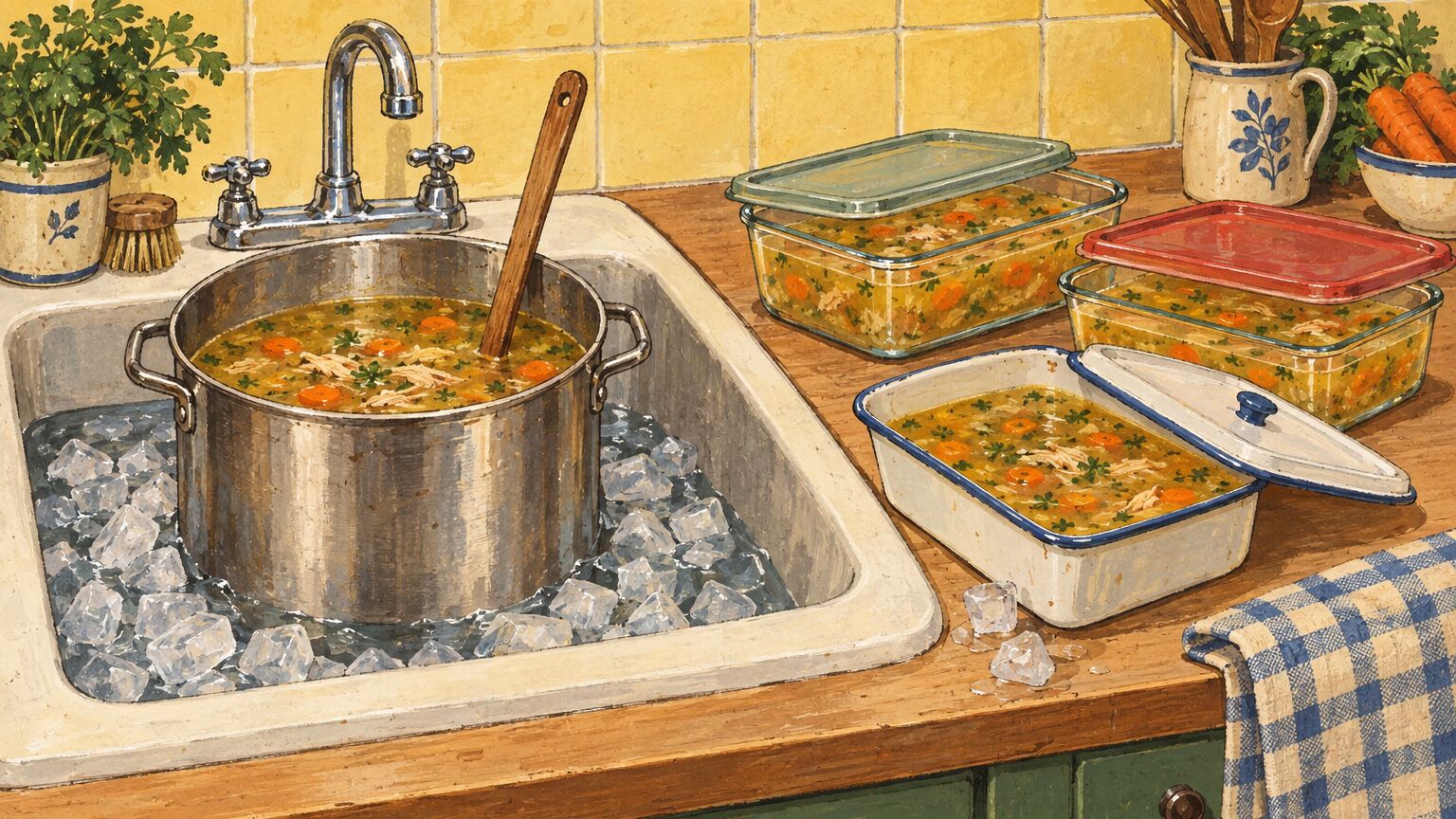
- Divide leftovers into smaller portions in covered shallow containers so they cool quickly; the same goes for gravy and any stock you make from the carcass, as our answer on putting hot soup in the fridge explains. Don't refrigerate a whole cooked turkey with the stuffing inside; the stuffing takes too long to reach 40°F (4°C).
- Eat refrigerated leftovers within 3 to 4 days, or freeze them. Gravy keeps only 1 to 2 days, on the FDA's refrigerator and freezer chart. Our answer on how long Thanksgiving leftovers last goes through the rest of the table dish by dish.
- Reheat turkey and stuffing to 165°F (74°C).
- Oil from a fried turkey can be strained and used again within 1 month in the fridge, the USDA's limit; our answer on reusing turkey frying oil covers how.
Why the number matters
Raw turkey can carry Salmonella. In a CDC outbreak investigation of raw turkey products that closed in 2019, 358 people in 42 states were infected with one multidrug-resistant strain, 133 were hospitalized and 1 died. Investigators found the strain in live turkeys and in many kinds of raw turkey products. Cooking every part of the bird to 165°F (74°C) kills it.
Turkey follows the same rules as chicken, which our chicken temperature answer covers cut by cut. For handling the raw bird before it goes in the oven, see our guide to preparing raw chicken: its cleanup and no-rinsing advice applies to turkey too.