There is no fixed number: strained oil from plain potatoes is still good after 8 or more batches, oil from breaded or battered chicken after 3 or 4, and oil from fish only for more fish. Whatever the count, throw the oil out when it smokes at normal frying heat, about 350°F (177°C), foams up or smells rancid, and use stored oil within 1 month in the fridge, the USDA's limit for turkey frying oil. After a turkey, that means straining the oil and frying with it again within the month: another turkey, fries or chicken.
The counts come from a test by America's Test Kitchen, which fried kettle potato chips and flour-dredged chicken thighs batch after batch in 2 quarts (1.9 liters) of canola oil. The testers strained the oil each time and checked it with an oil test kit. Food inspectors in much of Europe and in India don't count batches at all. They measure how much of the oil has broken down, and that measurement explains why the number of uses varies so much.
How many times to reuse oil, by what you fried
| What you fried | How many times to reuse the oil | Why it wears out at that pace |
|---|---|---|
| Plain potatoes (fries, chips) | 8 or more | Little crumb, fat or flavor left behind. America's Test Kitchen's chip oil stayed pale through 8 batches, when the testers stopped. |
| Breaded or battered chicken | 3 or 4 | The coating sheds crumbs that burn, and the chicken gives up fat and juices. The fifth batch in the same test tasted greasy and off. |
| Fish and seafood | Only for more fish, and not for long | Fish taste carries into the next food, oil used for fish broke down faster in one study, and fish and shellfish proteins stay in the oil. |
| Whole turkey, in peanut oil | Within 1 month, refrigerated | The usual rule is 3 or 4 turkeys, but the month runs out long before the oil does. |
America's Test Kitchen fried the chips and the chicken in the same canola oil, so its gap between 4 and 8 uses comes from the food. The testers also wrote that chip oil could go much longer if topped up with fresh oil.
Oil darkens with use, and darkening alone doesn't mean it is finished. The breaded-chicken oil in the America's Test Kitchen test got darker and stronger-smelling with every batch, yet fried perfectly well through four. Oil that is dark and murky, thick or smoky is another matter; see the signs below.
Fish wore oil out faster than fries in a 2012 study in the Journal of Food Science. With fresh oil added each day, the authors gave the oil 4 days of frying (4 hours a day) for fish nuggets against 8 for French fries.
The 3 or 4 turkeys figure is widely repeated and is usually credited to the Texas Peanut Producers Board, as SheKnows reports. It is a rule of thumb, not a measured result. The section on turkey oil below explains why storage time, not the count, usually decides it.
Why the number of uses is the wrong measure
Frying oil wears out mainly with hours at heat; the food, the temperature and how often you top it up change the pace. Heat, air and the water that escapes from food split and oxidize the fat. Food inspectors measure the result as total polar compounds: the share of the oil that has turned into broken-down and oxidized fat. Fresh oil starts below 10%; past the limit, the oil has to go.
| Where | Discard point for frying oil | What kind of rule |
|---|---|---|
| Switzerland | 27% polar compounds | Law, enforced by cantonal food inspectors |
| India | 25% polar compounds | Regulation, per FSSAI's guidance note on used cooking oil |
| Germany | 24% polar compounds | Guideline used by food inspectors, from the German fat science society and state food chemists |
| United States | No limit | The FDA Food Code 2022 sets none |
How long oil takes to reach those limits depends on the oil, the food and the hours. In a Portuguese home deep fryer study at 347°F (175°C), peanut oil and canola oil frying fresh potatoes reached 25% polar compounds after 18 to 20 hours of frying. Extra virgin olive oil had not reached it after 28 hours. In 46 Czech restaurants, the oil in 28 went past 24%, after 6 to 9 days of service. Zurich's inspectors checked 2,680 fryers in food businesses in 2025 and found 2.5% over the Swiss limit.
Topping up matters as much as the count. Spanish researchers frying potatoes found that oil without fresh additions broke down in a straight line with each frying, while oil topped up often with fresh oil rarely reached the 25% level and settled at a steady state. At home, that means adding fresh oil to the fill line each time you fry rather than running the pot lower and lower.
India's food regulator gives the strictest count of anyone. Its guidance tells households to avoid frying in the same oil again (it suggests using once-fried oil for curries instead) and tells small food businesses not to use the same oil more than three times. The US sets no count and no limit. Soup Letters follows the America's Test Kitchen counts, the USDA's storage times and the signs below.
Signs that frying oil is finished
Throw frying oil out when any of these happen, however few times it has been used. The USDA's deep-fat frying guidance names cloudiness, foaming and a foul smell or taste. India's food regulator adds blue-grey smoke, tough foam and oil that turns dark and murky.
- It smokes at normal frying temperature. Fresh peanut oil smokes at about 450°F (232°C), by the USDA's table. Breakdown products lower that point with every hour of frying, until the oil smokes at the temperature you fry at.
- It foams, and the foam doesn't settle. Polymers that build up in old oil make it foam and thicken, as Bavaria's food safety authority explains in its page on frying fat.
- It smells or tastes rancid, fishy or sharp. Bavaria's food safety authority treats a pungent smell and a rancid, scratchy or burnt taste as clear faults, and notes that lab tests usually confirm them.
- It is dark and murky, or thick, at room temperature. Judge it warm: cold oil from the fridge turns cloudy and can partly set, which clears as it warms.
- Fried food comes out greasy or tastes stale. That is where the America's Test Kitchen breaded-chicken oil gave out, on the fifth batch.
These signs are late warnings. Oil that fails one of them is finished. Oil that passes them is probably fine for a cook who fries now and then. Passing is not proof that it is under an inspector's limit, which is why Zurich's food laboratory says every food business with a fryer should own a meter.
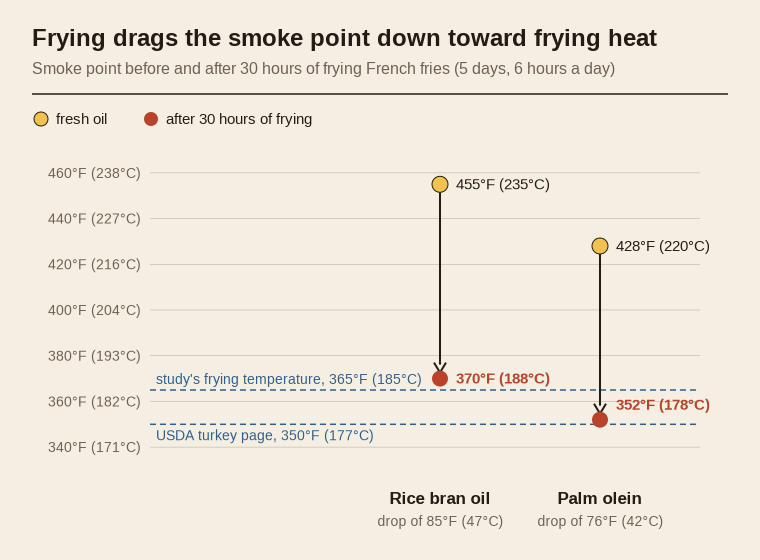
The chart shows why smoke is the clearest sign. In a 2013 frying study (abstract), palm olein lost 76°F (42°C) of its smoke point over 30 hours of frying French fries and ended at 352°F (178°C). That is below the 365°F (185°C) the oil was frying at, and 2°F (1°C) above the 350°F (177°C) the USDA's turkey page gives for frying a turkey. Rice bran oil, which started higher, ended just above its frying temperature.
Test strips and meters. Restaurants check oil with strips that measure free fatty acids, a different marker from polar compounds, such as 3M's oil quality strips, about $28 for 40 at a restaurant supplier. Inspectors carry handheld polar compound meters such as the Testo 270 BT, about $560 to $660. For a cook who deep-fries a few times a year, the signs above are enough; a meter earns its price only if you fry most weeks.
How to strain and store used frying oil
- Let it cool in the pot. The USDA's turkey guidance says to let used oil cool before pouring it into containers. Hot oil is a burn and fire risk, and a full turkey fryer takes hours to cool.
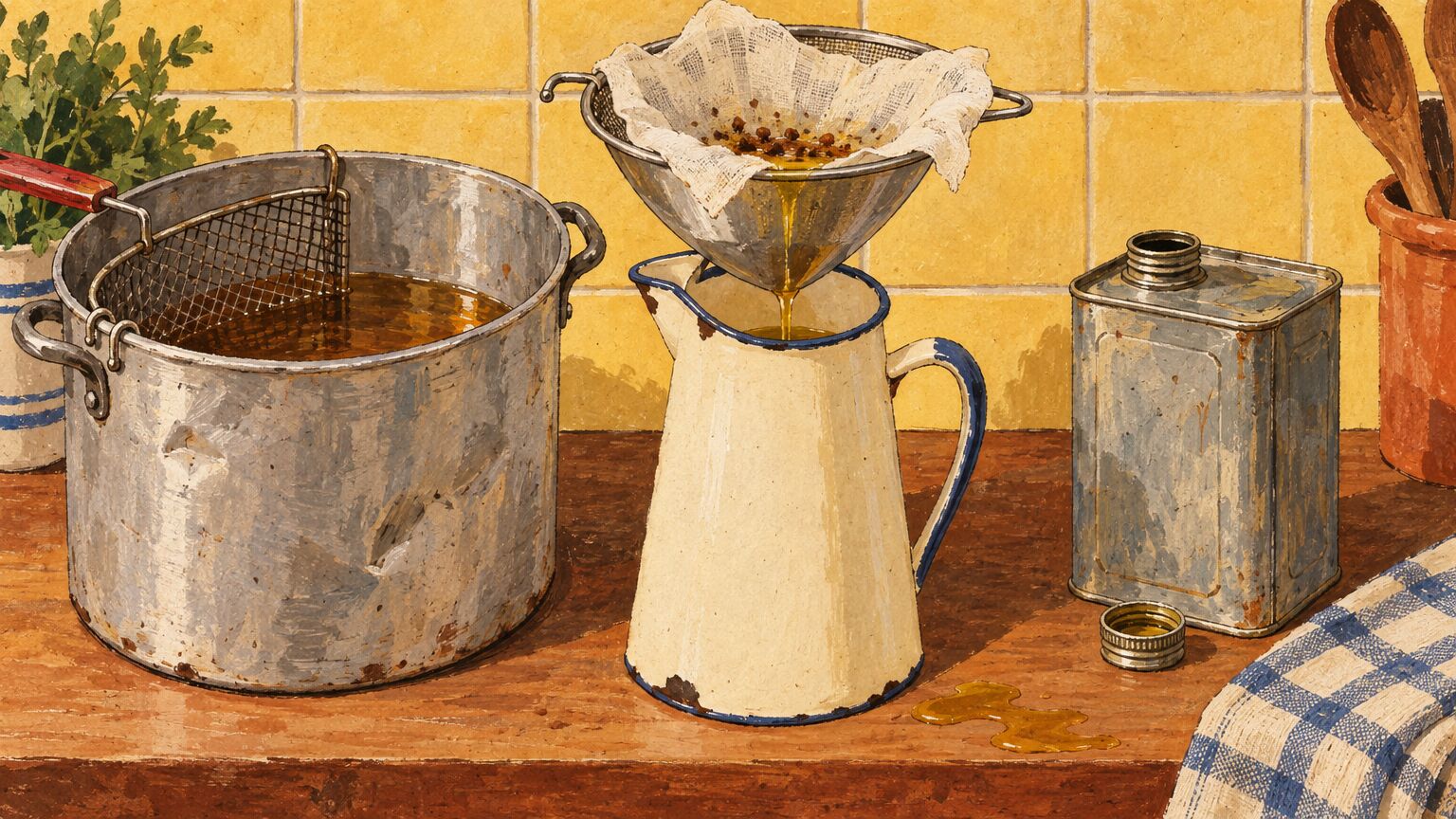
- Strain out every crumb. The USDA says to strain it through cheesecloth or a sieve; a fine sieve lined with cheesecloth, or a coffee filter, catches more. Crumbs left in the oil keep burning and darkening it the next time you fry.
- Seal it and keep it dark. Use a clean container with a tight lid, and keep it away from light.
- Refrigerate it. The USDA says to refrigerate used frying oil for best quality.
- Label it. Write the date, what you fried, and a running total of uses and rough hours of frying. Peanut and canola oil in the Portuguese home fryer study lasted 18 to 20 hours of frying potatoes.
- Use it within 1 month. That is the USDA's limit for turkey frying oil that is strained, covered and refrigerated.
- Top it up when you fry again. Add fresh oil to the fill line.
The agencies disagree on storage time. The USDA's general frying page allows strained oil up to 3 months in a sealed, light-proof container; its turkey page says within a month. India's FSSAI tells households to use used oil within a day or two, because used oil deteriorates faster than fresh. We go with the USDA's 1 month in the fridge: it is the stricter of the two US figures, and oil that goes rancid sooner will tell you by smell.
Can you leave frying oil out overnight?
Yes, covered, while it cools; strain it the next morning and then refrigerate it. No agency says this in so many words. It is our reading of the USDA's general frying guidance, which treats refrigeration as a step for best quality and allows strained oil in a sealed, light-proof container for up to 3 months. That allowance is for strained, sealed oil. What spoils first is food left in the oil, so don't leave unstrained oil with crumbs and bits of batter sitting in the pot for days.
A turkey fryer left outside needs its lid on. Rain or dew that gets into the oil sinks to the bottom, and water that meets hot oil flashes into superheated steam and spatters, a hazard the USDA's frying guidance warns about. Oil with water in it should be strained and left to separate, or thrown out.
Can you reuse oil after frying raw chicken or fish?
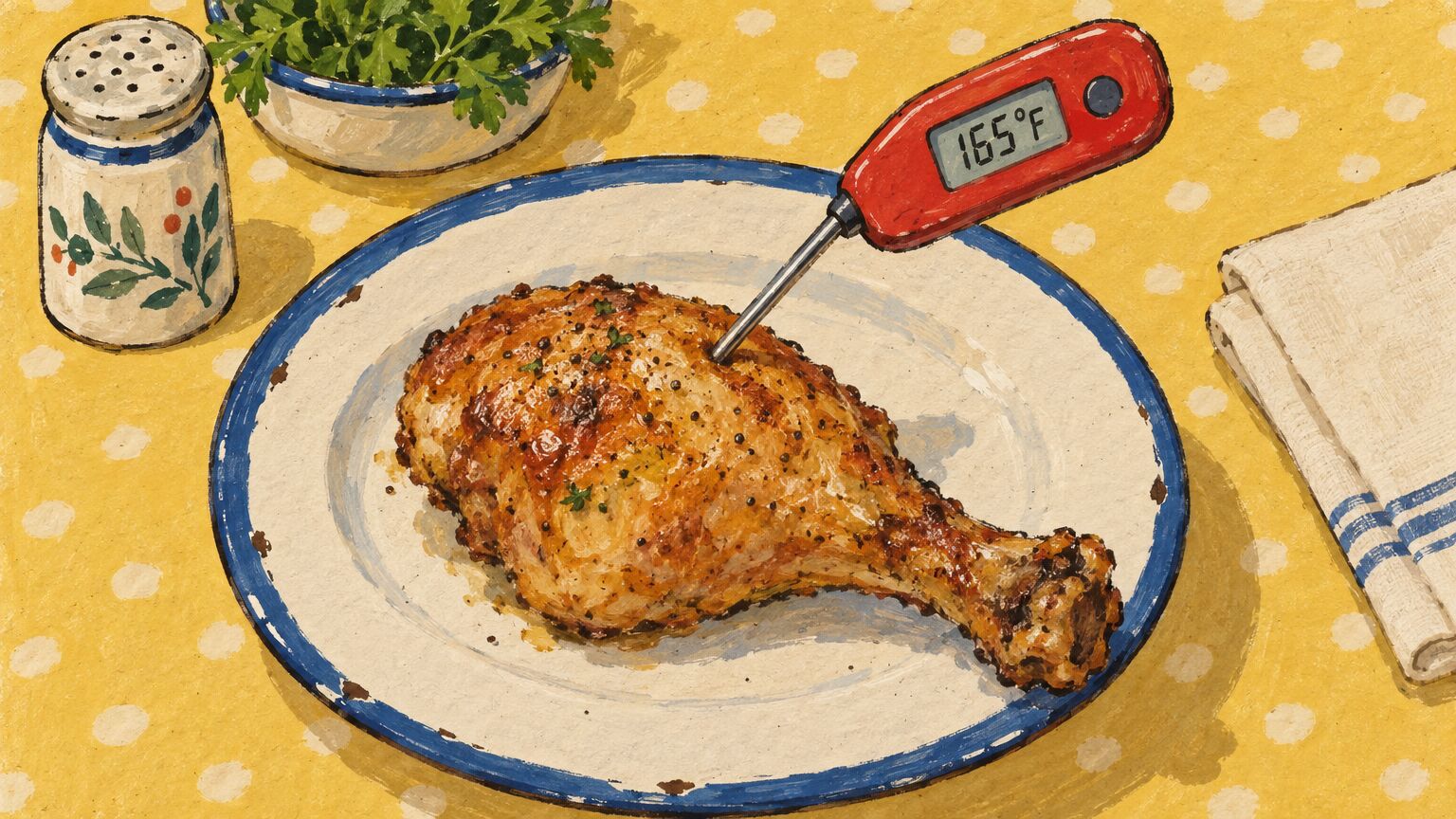
Yes for chicken; oil used for fish should be kept for fish. Germs from raw meat are not the problem. Frying oil sits near 350°F (177°C), far above the 165°F (74°C) that makes chicken safe, so bacteria don't survive in it. The problems are flavor and allergens.
Food proteins stay in frying oil and move into the next thing you fry. In a 2026 bench-scale study at the University of Nebraska, potato chips fried in oil that had cooked 15 batches of cashews picked up 193.5 parts per million of cashew protein. That is enough to be a risk to someone allergic to cashews. The test used 1 liter of oil per 100 g batch, at 280°F (138°C) and 334°F (168°C). Commercial filters that trap particles of 11 to 25 microns cut the oil's cashew protein to below 10 parts per million; whether a home sieve and cheesecloth do as well has not been tested. The allergy charity FARE lists fries made in a fryer after chicken tenders, and oil reused after fish, as cross-contact for the same reason. If anyone at the table has a fish, shellfish or other food allergy, fry their food in fresh oil.
Peanut oil itself is a separate question. The FDA excludes highly refined oils, meaning refined, bleached and deodorized ones, from its definition of a major food allergen. Peanut oil that is not highly refined, such as cold-pressed peanut oil, gets no such exclusion. Tell a guest with a peanut allergy which oil you used and let them decide.
Which frying oil lasts longest
Oils high in monounsaturated fat and low in polyunsaturated fat last longest. Bavaria's food safety authority says oils with at least 60% monounsaturated fat and less than 20% polyunsaturated are very heat-stable, which is the point of high-oleic sunflower and canola oils. In the Portuguese home fryer study, extra virgin olive oil outlasted peanut and canola oil.
How you fry matters too:
- Don't run it hotter than the food needs. Bavaria's food safety authority recommends frying no hotter than 347°F (175°C). US guidance runs a little hotter, 350 to 375°F (177 to 191°C) for a turkey depending on the USDA page, and heat above what the food needs speeds the breakdown. In the Czech restaurant study, the fat run hottest also broke down the most.
- Avoid long frying in bare cast iron. The USDA notes that cast iron breaks down oil faster than other metals.
- Shake off loose coating and pat food dry. Water drove oil breakdown faster than salt or sugar in a study of frying dough.
Reusing turkey frying oil: Thanksgiving to Christmas
A fried turkey uses up only part of the oil's life. The USDA's turkey page calls for a turkey of 12 pounds (5.4 kg) or less in oil held at 350°F (177°C) and estimates 3 to 5 minutes per pound, so the bird spends 36 to 60 minutes in the oil. (The USDA's general frying page lists 375°F (191°C) for turkey.) Peanut oil in the Portuguese home fryer study lasted 18 to 20 hours of frying before reaching the 25% limit. By polar compounds alone, that leaves room for many turkeys. But count the whole time the oil is hot: 3 gallons (11.4 liters) take a long time to heat and to cool, and drips from injected marinades and sugary or salty rubs burn in the oil. Treat the arithmetic as a rough guide, not a test.
What ends turkey oil is the calendar. The USDA says turkey oil can be reused if it is strained, covered and used within a month. Christmas falls 27 to 33 days after Thanksgiving, right at the edge of that month. In 2026, Thanksgiving is November 26 and Christmas is 29 days later, so strained, refrigerated oil from the Thanksgiving turkey is still within the month for a Christmas bird. In years when Thanksgiving falls on November 22, 23 or 24, the month runs out one to three days before Christmas. Oil kept for next Thanksgiving is about 12 months old, far past both the USDA's 1 month and its 3 months.
If 3 gallons won't fit in the fridge, strain the oil back into its original jugs or tins, seal them and keep them in a cool, dark place, such as a closed cupboard or a box in the garage. The USDA's general frying page allows sealed, light-proof storage for up to 3 months, with refrigeration only for best quality, but its turkey page asks for the fridge, so use oil stored this way sooner rather than later.
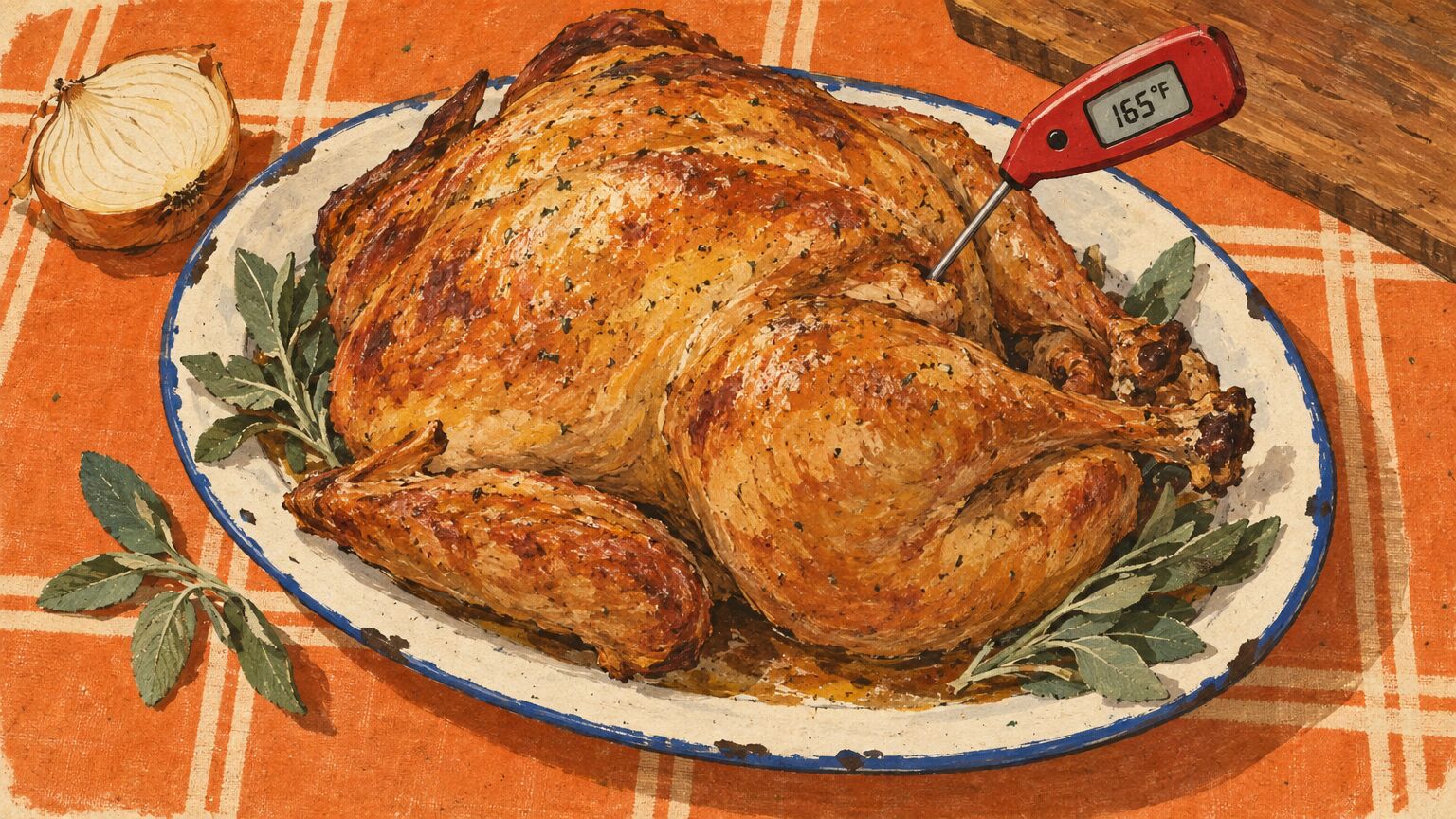
Before frying again, strain the oil once more, top it up to the fill line, and check it with a thermometer: no smoke at 350°F (177°C), no lasting foam, no rancid smell. Then fry the turkey to 165°F (74°C) in the thigh, wing and breast.
How to get rid of used frying oil
Never pour used frying oil down the sink. The USDA says oil congeals in the drain and can back up the sink, a septic system or the sewer. Let it cool, pour it into a sealable container such as a coffee can and put it in the trash, or take it to a recycling drop-off if your area has one. For small amounts, India's FSSAI suggests mixing the oil with something absorbent, such as sawdust, paper towels or food scraps, before it goes in the bin.
Is reused frying oil bad for you?
The breakdown products are why the limits exist. Zurich's food laboratory calls them hard to digest and undesirable for health, and the authors of the Czech restaurant study summarize rat studies that found harmful changes in animals fed oil high in polar compounds. In people the evidence is thinner and observational. A study in Pizarra, Spain, sampled the cooking oil in the kitchens of 538 people and found that more polar compounds went with a higher risk of high blood pressure, after allowing for age, sex, obesity and diabetes. That is an association, not proof that degraded oil causes harm. It is still a reason to throw oil out at the signs above rather than stretch it.