Cook chicken until the thickest part reads 165°F (74°C) on a food thermometer. That is the USDA's minimum for all poultry: breasts, thighs, wings, whole birds, ground chicken and stuffing. The same number applies to turkey, duck and every other bird. Thighs and drumsticks are safe at 165°F (74°C) too, but America's Test Kitchen found them more tender at 175 to 195°F (79 to 91°C).
Chicken temperatures by cut
| What you are cooking | Safe minimum | Where to measure | Notes |
|---|---|---|---|
| Breast | 165°F (74°C) | Thickest part, from the side | Lean, so it gains nothing from going hotter |
| Thighs, drumsticks, wings | 165°F (74°C) | Thickest part, off the bone | Most tender at 175 to 195°F (79 to 91°C) |
| Whole chicken | 165°F (74°C) | Inner thigh, wing and thickest part of the breast | Every spot must read 165°F (74°C) |
| Ground chicken | 165°F (74°C) | Center of the thickest patty or meatball | No pink-or-not judgment; always measure |
| Stuffing | 165°F (74°C) | Center of the stuffing | Stand 20 minutes before removing it from the bird |
| Leftovers | 165°F (74°C) | Center of the dish | Bring sauces and soups to a rolling boil |
The placement rules come from the USDA's food thermometer guidance and its stuffing guidance. The USDA sets the same 165°F (74°C) for white and dark meat. A higher number for thighs is about texture, not safety.
Why 165°F (74°C) is the number
165°F (74°C) is the temperature at which chicken becomes safe the instant it gets there. Bacteria die from time at temperature, not from one magic number. The USDA's own science for meat processors, the Revised Appendix A cooking guideline, lists how long chicken must stay at each temperature to cut Salmonella by 7 logs (99.99999 percent). That is the same kill 165°F (74°C) delivers instantly.
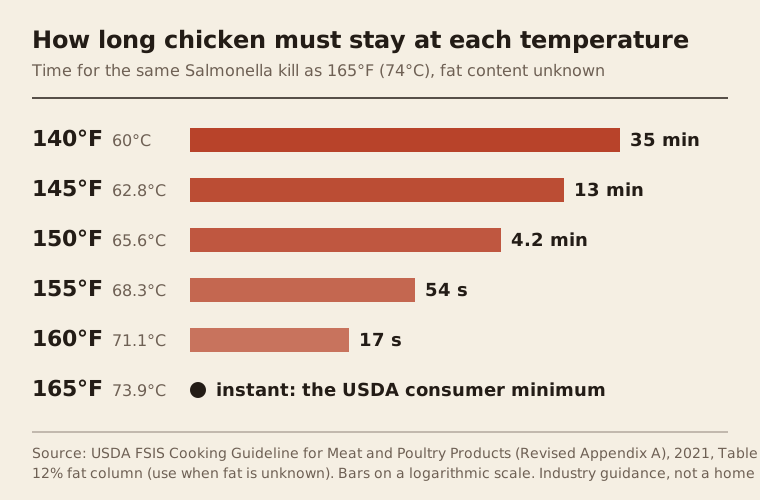
| Internal temperature | Lean chicken (2% fat) | Fat unknown (12% column) |
|---|---|---|
| 140°F (60°C) | 25.7 minutes | 35.0 minutes |
| 145°F (62.8°C) | 8.6 minutes | 13.0 minutes |
| 150°F (65.6°C) | 2.7 minutes | 4.2 minutes |
| 155°F (68.3°C) | 45 seconds | 54 seconds |
| 160°F (71.1°C) | 14 seconds | 17 seconds |
| 165°F (73.9°C) | Instant | Instant |
This table explains how sous vide chicken breast held at 145 to 150°F (63 to 66°C) can be safe: once the center of the meat reaches the bath temperature, the bath holds it there as long as the table requires. It is industry guidance, written with conditions a home kitchen can't easily check, such as limiting the time the meat spends between 50 and 130°F (10 and 54°C) to 6 hours. The USDA's advice to home cooks is still 165°F (74°C). Hold times leave no margin for a misplaced probe or a thermometer that reads a few degrees low. 165°F (74°C) does: even at 160°F (71°C), the hold the table asks for is 17 seconds or less. That is why Soup Letters recommends it for everyday cooking.
How to check chicken with a thermometer
Push the probe into the thickest part of the meat, not touching bone. For a whole chicken, the USDA says to check the innermost part of the thigh and wing and the thickest part of the breast. Every spot must reach 165°F (74°C).
- Thin pieces: slide the probe in from the side so the tip sits in the middle of the meat.
- Dial thermometers: these read along the stem, so they need 2 to 2½ inches (5 to 6 cm) of meat. Use a digital instant-read thermometer for breasts and thighs.
- Accuracy: the USDA says most food thermometers are accurate to within 2 to 4°F (1 to 2°C).
- Calibration: stir the probe in a glass of crushed ice and water for 30 seconds. It should read 32°F (0°C). If it doesn't, adjust it or allow for the difference.
Take the reading before the chicken comes off the heat. The USDA chart says to reach the minimum before removing food from the heat source. Unlike beef and pork, chicken gets no rest-time allowance. Don't pull chicken at 160°F (71°C) and count on carryover heat to finish the job. Carryover varies with the size of the piece and the heat it came from, so you can't count on it.
Is pink chicken safe?
Pink chicken is safe when every part has reached 165°F (74°C). The USDA says safely cooked poultry can be white, pink or tan. Grilled and smoked chicken can stay pink well above 165°F (74°C), because gases from the fire react with the pigment in the meat. Young birds can have dark, reddish bones from pigment in the marrow, which is harmless.
The opposite also holds: chicken that looks done may not be. The USDA's 2024 Salmonella framework proposal summarizes the consumer research. In one study, 40 percent of the chicken that home cooks judged done was below 165°F (74°C). In another survey, only 26.3 percent of people who owned a food thermometer used it on chicken breasts or parts. Most of those who checked another way cut into the meat to look for pink.
The UK's Food Standards Agency still tells home cooks to check that the juices run clear and that no pink meat remains. That is the best you can do without a thermometer, but the study above shows how often looking gets it wrong. With a thermometer, the number settles the question and color does not.
Why chicken thighs taste better at 175 to 195°F (79 to 91°C)
Dark meat has more connective tissue than breast meat, and that tissue softens with heat and time. Collagen, its main protein, starts to shrink and break down between about 127 and 145°F (53 and 63°C), according to a review of heat and meat proteins. With more heat and time it dissolves into gelatin, which is what makes a well-cooked thigh feel silky rather than rubbery.
America's Test Kitchen cooked thighs to several temperatures and rated 165°F (74°C) good, 175°F (79°C) very good and 190 to 195°F (88 to 91°C) better still. Past about 210°F (99°C), the meat turned stringy. Breast meat has little connective tissue, so it only dries out as it climbs past 165°F (74°C).
What other countries say
| Authority | Chicken pieces | Whole bird | Source |
|---|---|---|---|
| USDA FSIS (United States, home cooks) | 165°F (74°C) | 165°F (74°C) | Safe temperature chart |
| FDA Food Code (United States, restaurants) | 165°F (74°C), instant | 165°F (74°C), instant | Food Code 2022 |
| Health Canada | 165°F (74°C) | 180°F (82°C) | Safe cooking temperatures |
| Food Standards Agency (UK) | No single number: 140°F (60°C) for 45 minutes, 149°F (65°C) for 10 minutes, 158°F (70°C) for 2 minutes, 167°F (75°C) for 30 seconds or 176°F (80°C) for 6 seconds | Same | Cooking your food |
Some articles say the Food Code requires 165°F (74°C) for 15 seconds. The current code says instant for poultry; the 15-second hold applies to reheating food for hot holding. Health Canada's 165°F (74°C) for pieces matches the USDA's.
Is chicken safe at 160°F (71°C)?
Yes, if every part stays there long enough. The USDA table above asks for 14 to 17 seconds at 160°F (71°C), so chicken that holds 160°F (71°C) for that long is as safe as chicken taken to 165°F (74°C). The risk is the reading itself: a probe a little off center, or a thermometer that reads a few degrees high, can mean the coolest part is well below 160°F (71°C). If a reading comes up short, put the chicken back on the heat and check again in the thickest part.
Why the number matters
Chicken is a major source of food poisoning in the United States. The CDC estimates that about 1 million people a year get sick from contaminated poultry, and that 1 in 25 packages of chicken at the grocery store carry Salmonella. Ground chicken carries it more often than whole pieces. In FSIS data on raw product cited in the 2024 proposal, 27.1 percent of ground chicken samples carried Salmonella, against 6.7 percent of chicken parts. Those were samples taken at processing plants, so they don't line up exactly with the CDC's grocery store figure.
Cooking to 165°F (74°C) kills what is on the chicken; handling decides whether it reaches anything else first. Our guide to preparing raw chicken covers storing, thawing, cleaning up and salting it.