Keep raw chicken at 40°F (4°C) or colder and cook it within 1 to 2 days, or freeze it. Thaw it in the refrigerator, never on the counter. Don't rinse it: rinsing spreads bacteria around the sink without making the chicken safer. Salt it hours ahead, pat the skin dry, and cook it until the thickest part reads 165°F (74°C). Everything else on this page is about doing those steps well.
The short version
| Step | What to do | Why |
|---|---|---|
| Buy | Pick it up last, check it feels cold, bag it separately | Keeps it cold and its juices off other food |
| Store | Bottom shelf of the fridge at 40°F (4°C) or colder, in a sealed container | Drips can't reach food that won't be cooked |
| Use or freeze | Within 1 to 2 days raw; frozen at 0°F (-18°C) it stays safe indefinitely | The USDA's storage limits |
| Thaw | In the fridge, in cold water changed every 30 minutes, or in the microwave | Limits the time the surface spends between 40 and 140°F (4 and 60°C) |
| Rinse | Don't | Rinsing spreads bacteria; cooking kills them |
| Clean up | Wash surfaces, then sanitize them | Soap and water alone leave bacteria behind |
| Salt | Dry brine 6 to 24 hours, or wet brine ½ to 1 hour | Seasoned, juicier meat |
| Dry | Pat the skin dry before cooking | Wet skin steams instead of browning |
| Cook | To 165°F (74°C) in the thickest part | The temperature that makes it safe |
Buying and storing raw chicken
The USDA's Chicken from Farm to Table guide says to make the grocery store your last stop, choose chicken that feels cold to the touch, and put the package in a disposable bag so it can't leak onto other groceries. The CDC adds that the package should ride on the bottom of the cart, and that at home it belongs on the bottom shelf of the fridge in a sealed container.
The fridge should run at or below 40°F (4°C) and the freezer at 0°F (-18°C), according to the FDA, which recommends an appliance thermometer to check both.
| Chicken | Refrigerator, 40°F (4°C) | Freezer, 0°F (-18°C) |
|---|---|---|
| Whole chicken | 1 to 2 days | 1 year |
| Parts (breasts, thighs, wings) | 1 to 2 days | 9 months |
| Ground chicken or giblets | 1 to 2 days | 3 to 4 months |
| Cooked chicken | 3 to 4 days | 4 months |
The freezer times are for quality. The USDA says chicken kept frozen at 0°F (-18°C) is safe indefinitely, though it slowly loses texture and flavor.
Whole birds usually come with a bag of giblets (the heart, liver and gizzard) and the neck tucked inside the cavity. Pull them out before cooking; you can cook them separately or save them for stock. The USDA says giblets vary in color and that is normal, but a green liver has absorbed bile and should not be eaten.
The pink liquid in the package is not blood. The USDA says it is mostly water the chicken absorbed during chilling at the plant.
Sell-by and use-by dates
In the United States, a date on raw chicken is usually about quality, not safety. The USDA's page on food product dating says a sell-by date is not a safety date, and that federal law does not require dates on most food. Go by the 1 to 2 days in the fridge counted from when you bought it.
When to throw it out
Throw raw chicken away if it has been in the fridge longer than 1 to 2 days, or out of the fridge for more than 2 hours (1 hour above 90°F (32°C)). The USDA also says food that has developed an off odor, flavor or texture from spoilage bacteria should not be eaten, whatever the date says. Spoilage bacteria are not the ones that make people sick, so the reverse does not hold: chicken that smells fine can still carry Salmonella.
The UK works differently. There, a use-by date tells you when food is no longer safe to eat. Chicken can still be cooked or frozen on or before that date. Once frozen chicken thaws, the UK says to eat it within 24 hours.
How to thaw chicken
There are three safe ways to thaw chicken, according to the USDA's Big Thaw guide. Never thaw it on the counter or in hot water: the USDA says neither is safe. The outside warms into the range where bacteria multiply, 40 to 140°F (4 to 60°C), while the middle is still frozen.
| Method | How long | After thawing |
|---|---|---|
| Refrigerator | About a day for 1 pound (450 g) of boneless breasts; whole birds 1 to 2 days or longer | Keeps another 1 to 2 days; can be refrozen raw |
| Cold water | About 1 hour for 1 pound (450 g); 2 to 3 hours for 3 to 4 pounds (1.4 to 1.8 kg) | Cook right away |
| Microwave | Depends on the microwave; use its defrost setting | Cook right away |
For cold water, seal the chicken in a leak-proof bag, submerge it in cold tap water, and change the water every 30 minutes so it stays cold. Chicken thawed in cold water or the microwave has to be cooked before it can be refrozen.
You can also cook chicken from frozen in the oven or on the stove. The USDA says it takes about 50 percent longer. The USDA says not to cook frozen chicken in a slow cooker or in the microwave.
Should you wash raw chicken?
No. The CDC says raw chicken is ready to cook and doesn't need to be washed first. Rinsing does not remove bacteria well enough to make the chicken safe; cooking to 165°F (74°C) does that. What rinsing does reliably is spread the bacteria around your sink.
The USDA tested this in 2019. In its observational study, home cooks prepared chicken thighs coated with harmless tracer bacteria, along with a salad, in a test kitchen:
- 60 percent of the people who washed their chicken had bacteria in the sink afterward.
- 14 percent still had bacteria in the sink after they tried to clean it.
- 26 percent of washers got bacteria from the chicken onto their salad lettuce.
The same study found something easy to miss. 31 percent of people who did not wash their chicken also contaminated their lettuce, mostly through their hands and the surfaces they touched. The peer-reviewed report concluded that the sink and hands matter more than splashing, and that advice should focus on handwashing and sanitizing.
Soaking chicken in salt water, vinegar or lemon juice does not destroy bacteria either, the USDA says. If you need to remove bits of bone or fat, trim them. If there is liquid from the package on the surface, pat it off with a paper towel, throw the towel away, and wash your hands.
Clean, then sanitize
Cleaning and sanitizing are two different steps. The USDA's page on washing food says cleaning physically removes dirt and food but does not kill germs. That matters because Campylobacter can survive on kitchen surfaces for up to 4 hours and Salmonella for up to 32 hours.
A study of 60 home kitchens after chicken preparation found Salmonella and Campylobacter spread widely across 13 sites they tested. Cleaning with detergent and hot water did not significantly reduce the number of contaminated sites. Adding a bleach-based sanitizer did.
- Wash your hands with soap and water for 20 seconds after touching raw chicken, the CDC says.
- Clean the board, knife, counter and sink with hot, soapy water to remove the residue.
- Sanitize with a solution of 1 tablespoon of unscented liquid chlorine bleach in 1 gallon of water (15 mL in 3.8 L). Let it stand on the surface for several minutes, then rinse with plain water and air dry or pat dry with clean paper towels.
Use one cutting board for raw meat and poultry and a separate one for produce and bread. The USDA's cutting board guidance says wood and plastic are both acceptable. Solid wood and plastic boards can go in the dishwasher, but laminated boards may crack. Replace any board with deep grooves that are hard to clean.
The USDA suggests paper towels for wiping up after raw chicken. If you use dishcloths, wash them often in the hot cycle of the washing machine.
Cut it to an even thickness
A boneless chicken breast can be twice as thick at one end as the other, and that is why the thin end dries out while the thick end is still underdone. Heat moves into meat by conduction, and the time it takes to reach the center grows with the square of the thickness. So a 2 inch (5 cm) end needs roughly four times as long to heat through as a 1 inch (2.5 cm) end. That figure is a Soup Letters calculation from the physics of heat conduction, not a measured cooking time.
There are two ways to even it out:
- Pound it. Put the breast in a zip-top bag and pound the thick end with a meat mallet or the bottom of a heavy pan until the whole piece is the same thickness.
- Slice it. Cut the breast horizontally into two thinner cutlets. America's Test Kitchen shows a method that turns one breast into three even pieces.
Salt it ahead
Salting chicken ahead of cooking seasons it more deeply and helps it hold on to moisture. A USDA meat scientist explains in the agency's brining guide that salt dissolves some of the protein in muscle, and the salt and protein together reduce moisture loss during cooking.
There are two ways to do it. A dry brine is salt rubbed onto the chicken, then rested in the fridge. A wet brine is a soak in salt water. America's Test Kitchen's salting and brining guide gives these amounts:
| Chicken | Dry brine (Diamond Crystal kosher salt) | Wet brine (table salt) |
|---|---|---|
| Whole chicken | 1 teaspoon (about 2.8 g) per pound (450 g), about 6 g per kg, rest 6 to 24 hours | ½ cup (about 145 g) in 2 quarts (1.9 L) of water, 1 hour |
| Bone-in pieces | ¾ teaspoon (about 2.1 g) per pound (450 g), about 4.6 g per kg, rest 6 to 24 hours | ½ cup (about 145 g) in 2 quarts (1.9 L) for 4 pounds (1.8 kg), ½ to 1 hour |
| Boneless breasts (up to 6) | Not given | 3 tablespoons (about 54 g) in 1½ quarts (1.4 L), ½ to 1 hour |
America's Test Kitchen writes its recipes for Diamond Crystal. With Morton kosher salt, use about ¾ teaspoon per pound for a whole chicken and about ½ teaspoon per pound for pieces, following the test kitchen's conversion of 3 teaspoons Diamond Crystal to 2¼ teaspoons Morton. Gram figures are Soup Letters conversions from the salt weights below.
The USDA's figures are milder: ¾ cup of table salt per gallon of water for a wet brine, or 1 tablespoon of kosher salt for every 5 pounds (2.3 kg) of poultry for a dry brine. Keep brining chicken in the refrigerator, and throw the brine away afterward.
Two cautions from the test kitchen. Brining longer than recommended makes chicken too salty. And a wet brine adds water to the skin, which makes it harder to brown and crisp. If you want crisp skin, dry brine on a wire rack in the fridge, uncovered, so the skin dries out at the same time.
Salt by weight, not by spoon
"A teaspoon of salt" means very different amounts depending on the salt. Table salt has fine, dense grains. Kosher salt has larger flakes with air between them, and the two big brands are shaped differently.
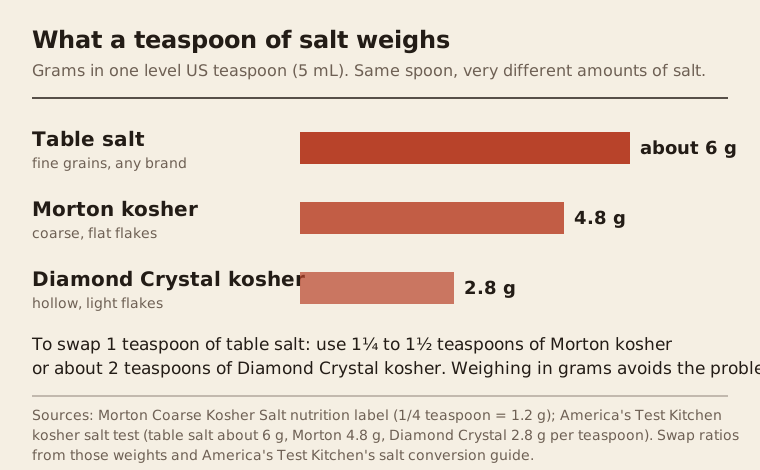
Morton's nutrition label lists ¼ teaspoon of its coarse kosher salt at 1.2 grams, which is 4.8 grams per teaspoon. America's Test Kitchen's kosher salt test puts table salt at about 6 grams and Diamond Crystal at 2.8 grams per teaspoon. A recipe written for Diamond Crystal will be more than twice as salty made with the same spoonful of table salt. The conversion in America's Test Kitchen's salting guide is 3 teaspoons of Diamond Crystal to 2¼ teaspoons of Morton to 1½ teaspoons of table salt. When a recipe gives grams, weigh the salt.
Marinades
Marinate chicken in the refrigerator, for up to 2 days, the USDA says. Never use a marinade that touched raw chicken as a sauce unless you boil it first, and throw away any uncooked leftovers. The USDA also warns that too much acid, such as vinegar or hot sauce, can make the meat stringy and tough.
Marinades mostly flavor the surface. America's Test Kitchen soaked chicken breasts in four marinades for 18 hours, cooked them, then trimmed off the outer ⅛ inch (3 mm). Tasters could not tell the marinated breasts from plain ones. The test kitchen's conclusion is that marinade flavors don't get past the first few millimeters of the meat.
Dry the skin before cooking
Pat chicken dry with paper towels before it goes into a hot pan or oven. While the surface is wet, evaporating water holds it near 212°F (100°C), the boiling point of water. The skin steams instead of browning until that water is gone. Drying it first means it starts browning sooner, before the meat underneath overcooks.
For the crispest skin, leave salted chicken uncovered on a rack in the fridge for several hours or overnight. The cold, dry air of the fridge does the drying for you.
Don't leave it out to come to room temperature
Raw chicken shouldn't sit out for more than 2 hours, or 1 hour if the room is above 90°F (32°C), according to the FDA. Some recipes tell you to let meat sit out to take the chill off. That barely changes its temperature. America's Test Kitchen left 1 inch rib-eye steaks out and found their centers went from about 40°F (4°C) to only 52°F (11°C) after an hour, and 62°F (17°C) after two hours. That test used beef, and we found no equivalent test on chicken, but there is no reason to expect a similar piece of chicken to warm much faster. The meat spends that time in the range where bacteria grow, 40 to 140°F (4 to 60°C), and gains little for cooking.
Cook it to 165°F (74°C)
All the steps above make chicken taste better or keep its bacteria from spreading. Only cooking makes it safe. Cook chicken until the thickest part reads 165°F (74°C) on a food thermometer. For a whole bird, check the inner thigh, the wing and the thickest part of the breast. Don't brown or partly cook chicken to finish later: the USDA says partial cooking is safe only right before the chicken goes onto a hot grill or into the oven. Our answer on what temperature chicken should be cooked to explains where to put the probe, why thighs taste better hotter, and why pink chicken can be fully cooked.
Common claims that are wrong
| Claim | What the evidence says |
|---|---|
| Rinsing chicken washes off the bacteria | It spreads them. In the USDA study, 60 percent of washers had bacteria in the sink afterward |
| If you don't rinse it, your kitchen stays clean | 31 percent of non-washers still contaminated their salad, through hands and surfaces |
| Vinegar or lemon juice kills the bacteria | The USDA says soaking in salt water, vinegar or lemon juice does not destroy bacteria |
| Soap and hot water are enough for the counter | Cleaning removes residue; a sanitizing step is what cut the contamination in home kitchens |
| The pink liquid in the package is blood | It is mostly water absorbed during chilling |
| A sell-by date is the last safe day | In the US, it is not a safety date; go by 1 to 2 days in the fridge |
| Marinades soak deep into the meat | Flavor stays within the first few millimeters |
| Letting chicken sit out helps it cook evenly | In America's Test Kitchen's steak test, an hour out warmed the center only from about 40°F (4°C) to 52°F (11°C), while the meat sat between 40 and 140°F (4 and 60°C) |
| Plastic cutting boards are safer than wood | The USDA says both are acceptable; deep grooves matter more than the material |
Why this matters
The CDC estimates that about 1 million people in the United States get sick from contaminated poultry every year, and that about 1 in 25 packages of chicken at the grocery store contain Salmonella. Most of the work of handling chicken safely happens before it reaches the pan: keeping it cold, keeping its juices away from food that won't be cooked, and cleaning up properly afterward.