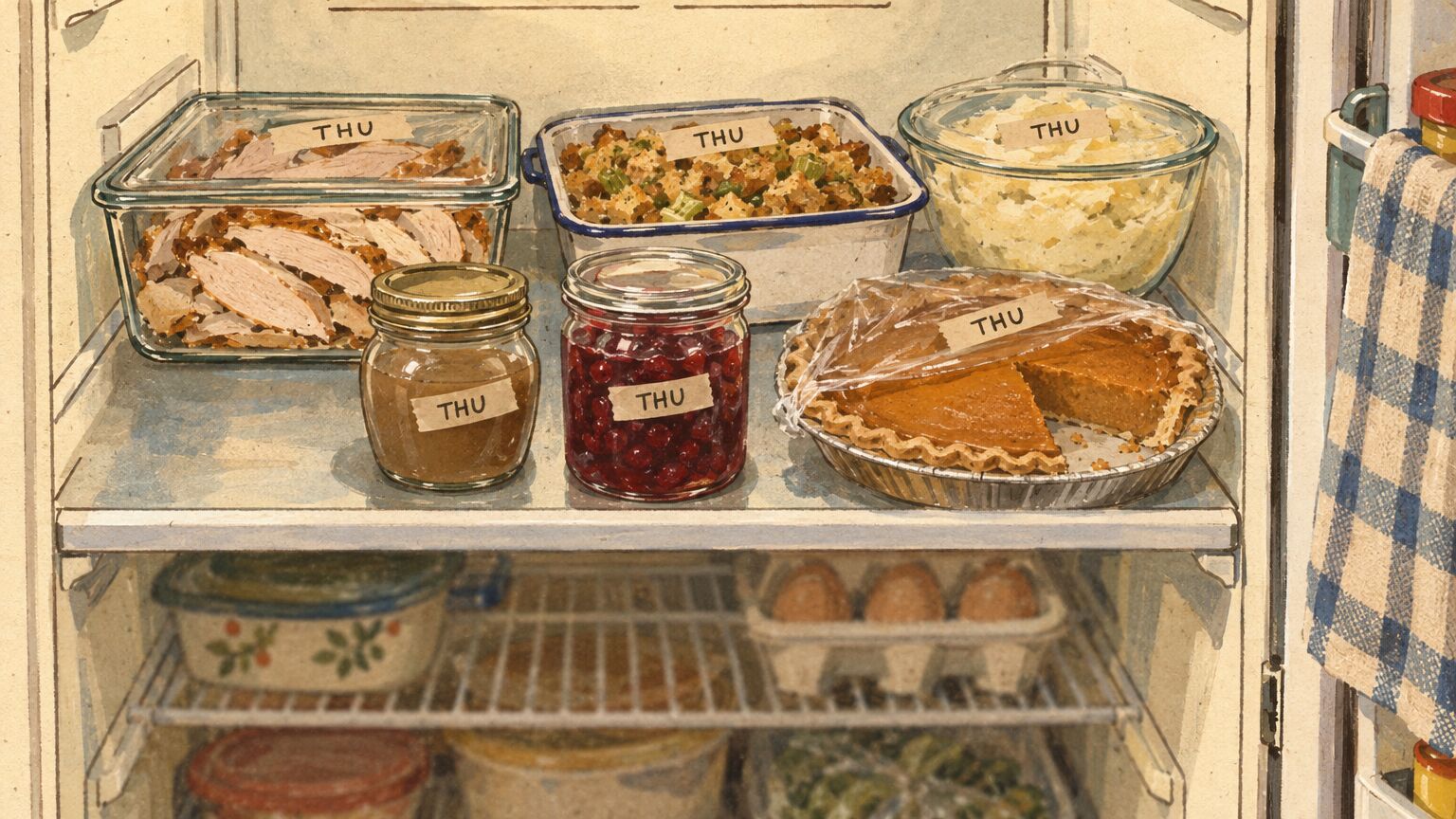
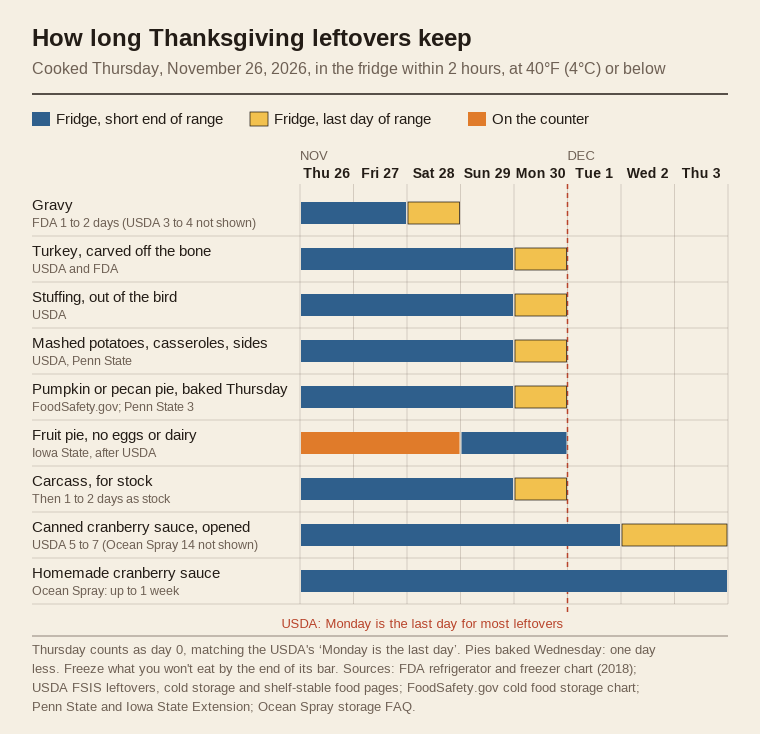
Most Thanksgiving leftovers keep 3 to 4 days in a fridge at 40°F (4°C) or below. Food cooked on Thursday is good through Sunday, and Monday is the last day to eat it or freeze it, according to the USDA's Thanksgiving leftovers advice. Gravy is the exception: eat it within 1 to 2 days, by Saturday, or freeze it. Homemade pumpkin and pecan pie belong in the fridge too. Turkey, stuffing, gravy, sides and custard pies that sat out for more than 2 hours go in the trash.
Thanksgiving leftovers, dish by dish
Every fridge time below assumes the food went into a fridge at 40°F (4°C) or below within 2 hours of coming off the heat, split into shallow containers so it cooled fast. Count the day it was cooked as day 0, and for pies, the day they were baked. Freezer times are for quality only: food kept at 0°F (−18°C) stays safe indefinitely, the FDA's chart says, but it dries out and loses flavor.
| Dish | Fridge | Freezer, for best quality | Reheat |
|---|---|---|---|
| Turkey, carved off the bone | 3 to 4 days | 4 months; 6 months covered in broth or gravy | To 165°F (74°C) |
| Stuffing, taken out of the bird | 3 to 4 days | 1 month | To 165°F (74°C) |
| Gravy | 1 to 2 days (the USDA says 3 to 4) | 2 to 3 months | To a rolling boil |
| Mashed potatoes, sweet potatoes, green bean casserole, mac and cheese | 3 to 4 days | 2 to 3 months | To 165°F (74°C) |
| Ham, fully cooked, sliced | 3 to 4 days | 1 to 2 months | To 165°F (74°C) |
| Cranberry sauce, homemade | Up to 1 week from making | Not recommended | Serve cold |
| Cranberry sauce, canned, after opening | 5 to 7 days | Not recommended | Serve cold |
| Pumpkin or pecan pie, homemade or from a bakery | 3 to 4 days from baking | 1 to 2 months | Serve cold, or warm briefly |
| Pumpkin pie sold unrefrigerated | Follow the label; refrigerate once cut | 1 to 2 months | Serve cold |
| Apple, cherry or other fruit pie | 2 days on the counter, then 2 in the fridge | Up to 4 months | Warm in the oven |
| Cream, custard or chiffon pie | Up to 4 days | Doesn't freeze well | Serve cold |
| Dinner rolls | Keep on the counter in a closed bag, not in the fridge | Freeze any you won't eat soon | Warm in the oven |
| Turkey carcass, for stock | 3 to 4 days | Freeze it in pieces | Goes into the pot from frozen |
| Stock made from the carcass | 1 to 2 days from making | 2 to 3 months | To a rolling boil |
Where the numbers come from:
- Turkey, stuffing, sides and gravy: the USDA's Turkey Basics: Handling Cooked Dinners and cold storage chart, the FDA's refrigerator and freezer chart (also the source of the ham row) and Penn State Extension. The charts don't name mashed potatoes or green beans; the USDA and Penn State give cooked side dishes 3 to 4 days. The stuffing freezer time is the USDA chart's; other USDA pages and Penn State say 4 to 6 months.
- Pies: the FoodSafety.gov cold storage chart and Iowa State Extension's pie storage guide.
- Cranberry sauce: the USDA's figure for opened high-acid canned food. No agency gives a figure for homemade sauce, so the week is Ocean Spray's, for sauce kept in an airtight container. Ocean Spray says its own canned sauce keeps up to 2 weeks once opened, and advises against freezing either kind because it turns watery.
Check that the fridge is cold enough: an appliance thermometer should read 40°F (4°C) or below, the USDA's number, and a fridge packed full after the holiday can run warmer.
How long is leftover gravy good for?
Eat leftover gravy within 1 to 2 days, or freeze it. That is the FDA's figure: its refrigerator and freezer chart gives "gravy & meat broth" 1 to 2 days, against 3 to 4 days for cooked turkey and for soups and stews. Bring it to a rolling boil when you reheat it, as the USDA advises for sauces, soups and gravies.
The agencies don't agree on gravy, and most leftover charts online give it the same 3 to 4 days as everything else:
| Source | Gravy in the fridge |
|---|---|
| FDA, refrigerator and freezer storage chart (March 2018) | 1 to 2 days |
| USDA FSIS, cold storage chart | 3 to 4 days |
| USDA FSIS, Turkey Basics: Handling Cooked Dinners | 3 to 4 days |
| Penn State Extension | 3 to 4 days |
| UK Food Standards Agency, all leftovers | 2 days |
Soup Letters goes with the shortest US figure, as it does for stock from the carcass, because a safety number should never be rounded in the unsafe direction. Gravy has a reason to be the cautious case. Clostridium perfringens survives cooking as spores, and the FDA's Bad Bug Book names "meat-containing products (e.g., gravies and stews)" among its main vehicles. As cooked food cools, the FDA says, this germ "can reach levels that cause food poisoning much more quickly than can other bacteria," and a deep pot of gravy cools slowly. The CDC says its outbreaks happen most often in November and December, many linked to holiday foods such as turkey.
One oddity is worth knowing. The same FDA chart gives turkey pieces "covered with broth, gravy" 3 to 4 days in the fridge and 6 months in the freezer. It doesn't explain the difference, so Soup Letters doesn't read it as a way to keep gravy longer; eat the gravy itself within 2 days and freeze the rest in small containers.
Gravy left out overnight goes in the trash, and boiling it again doesn't make it safe. Boiling kills bacteria but not the heat-stable toxins some of them leave behind, as our answer on a turkey carcass left out overnight explains.
Does pumpkin pie need to be refrigerated?
Homemade pumpkin pie does. It is an egg and milk custard, so it goes in the fridge within 2 hours of coming out of the oven, as Iowa State Extension advises for egg pies. It keeps 3 to 4 days from baking, the FoodSafety.gov chart says; Penn State says 3. Pecan pie and sweet potato pie are egg custards too, and follow the same rule. A pie baked on Wednesday runs out a day earlier than one baked on Thursday.
Treat a pie from a bakery as homemade. Store-bought pies can sit out only because they are made with preservatives; NC State Extension says pies without them are better kept refrigerated, and a local bakery pie is unlikely to have them.
For a store-bought pie, the label decides. If it says "keep refrigerated" or "perishable", refrigerate it as soon as you get home, wherever the store displayed it. Some pies sold from unrefrigerated displays carry exactly that instruction: Washington State University Extension notes that pies shown at room temperature in Washington must carry a date and a storage warning, and advises refrigerating them once bought. If the label gives no instruction and the pie came off a room-temperature shelf, it was made to be shelf-stable. Iowa State Extension says such pies have shelf-stable ingredients and antimicrobial preservatives and can wait until they are cut, though refrigerating one is never wrong. Once it is cut, it goes in the fridge, Iowa State says in its advice on freezing pumpkin pie. Soup Letters hasn't seen a current label for every big-store pie, Costco's included, so read the box in your kitchen rather than going by the brand.
A homemade pumpkin pie left out overnight goes in the trash. The USDA's emergency food chart says to discard custard, cheese-filled and chiffon pies held above 40°F (4°C) for more than 2 hours, while fruit pies are safe.
Fruit pies can sit out. Apple, cherry and other fruit pies made without eggs or dairy can stay loosely covered on the counter for up to 2 days, Penn State says, and then go in the fridge. Iowa State gives them 2 more days there.
How long can Thanksgiving food sit out?
2 hours, or 1 hour if the room is above 90°F (32°C). After that, throw it away. The USDA wants leftovers refrigerated within 2 hours of cooking, so the meal, the second helpings and the washing up all count. A turkey that came out of the oven at 3 p.m. and sat on the counter until 6 has had 3 hours, and Penn State says turkey, stuffing and gravy left out longer than 2 hours should be discarded.
To stretch the meal past 2 hours, keep the food out of the danger zone of 40°F to 140°F (4°C to 60°C). Hold hot food at 140°F (60°C) or above, in a warm oven, a slow cooker or a chafing dish, and cold food at 40°F (4°C) or below, on ice. Otherwise put the leftovers away and bring them back out later.
Food left out all afternoon or overnight can't be rescued by reheating, for the same toxin reason as the gravy. A cold porch or garage isn't a fridge unless you know it stayed at 40°F (4°C) or below.
Why some sources say 4 hours or 7 days
Some pages say food can sit out for 4 hours, or that refrigerated food, pies included, keeps for 7 days; NC State's pie advice gives refrigerated pies up to 7 days at 41°F (5°C). Both numbers come from the FDA's Food Code, the model rulebook for restaurants. It allows a business to keep dated, ready-to-eat food up to 7 days at 41°F (5°C) (section 3-501.17), and to hold food without temperature control for up to 4 hours under written procedures before throwing it away (section 3-501.19). For a home kitchen, the USDA's numbers are 2 hours out and 3 to 4 days in the fridge, and those are the numbers on this page.
Can you freeze Thanksgiving leftovers?
Yes, almost all of them. Freeze anything you won't eat by its last fridge day, and freeze it early rather than on day 4 for the best texture. The USDA says frozen leftovers stay safe indefinitely but lose moisture and flavor over time.
- Turkey: slice it off the bone and freeze it in shallow containers. Covered with broth or gravy, it keeps its quality for 6 months, against 4 months plain, on the FDA chart.
- Gravy and stuffing: freeze them in small containers, so you only thaw what you need.
- Pies: pumpkin and pecan pies freeze for 1 to 2 months after baking (FoodSafety.gov); Iowa State warns that the crust can turn soggy. Fruit pies freeze for up to 4 months. Cream, custard and chiffon pies don't freeze well.
- Cranberry sauce: keep it in the fridge instead. Ocean Spray advises against freezing it, because it can turn watery after thawing, and it already keeps longer than anything else on the table.
- Rolls: freeze them in a bag. Bread goes stale fastest at fridge temperature: in one study, starch retrogradation, the change behind staling, was fastest at 39°F (4°C) of the temperatures tested, which included room temperature and freezing.
Thaw frozen leftovers in the fridge, in cold water or in the microwave, or reheat them straight from frozen, which the USDA says is safe. Leftovers thawed in the fridge can go back in the freezer without reheating, though they lose some quality. Food thawed in cold water or the microwave should be cooked before it is refrozen (USDA FSIS).
How to reheat Thanksgiving leftovers
Reheat turkey, stuffing and sides to 165°F (74°C), and bring gravy to a rolling boil (USDA FSIS). Check with a thermometer you trust; our guide to calibrating a meat thermometer takes a few minutes with a glass of ice water.
- Carve before reheating. The USDA doesn't recommend reheating a whole turkey; cut the meat into smaller pieces first.
- In the microwave, cover the dish and turn it, then check the temperature in several places after a short rest, because microwaves heat unevenly.
- Not in a slow cooker. The USDA says reheating leftovers in a slow cooker is not recommended. Use the stove, the oven or the microwave.
- Reheating doesn't add days. The USDA's Monday deadline counts from Thursday's cooking, whether or not the turkey was reheated on Friday. Put anything left after reheating back in the fridge promptly.
How to tell if leftovers have gone bad
Count days; don't sniff. The germs that cause food poisoning "do not generally affect the taste, smell, or appearance of a food," the USDA says (Refrigeration and Food Safety), so turkey on day 6 can smell fine and still make someone sick. Write the day on each container when it goes into the fridge, and when the days run out, throw it away. Mold is the one sign that does mean something: throw away moldy bread, rolls and cooked leftovers whole, because mold roots run below the surface of soft foods (USDA FSIS, Molds on Food).
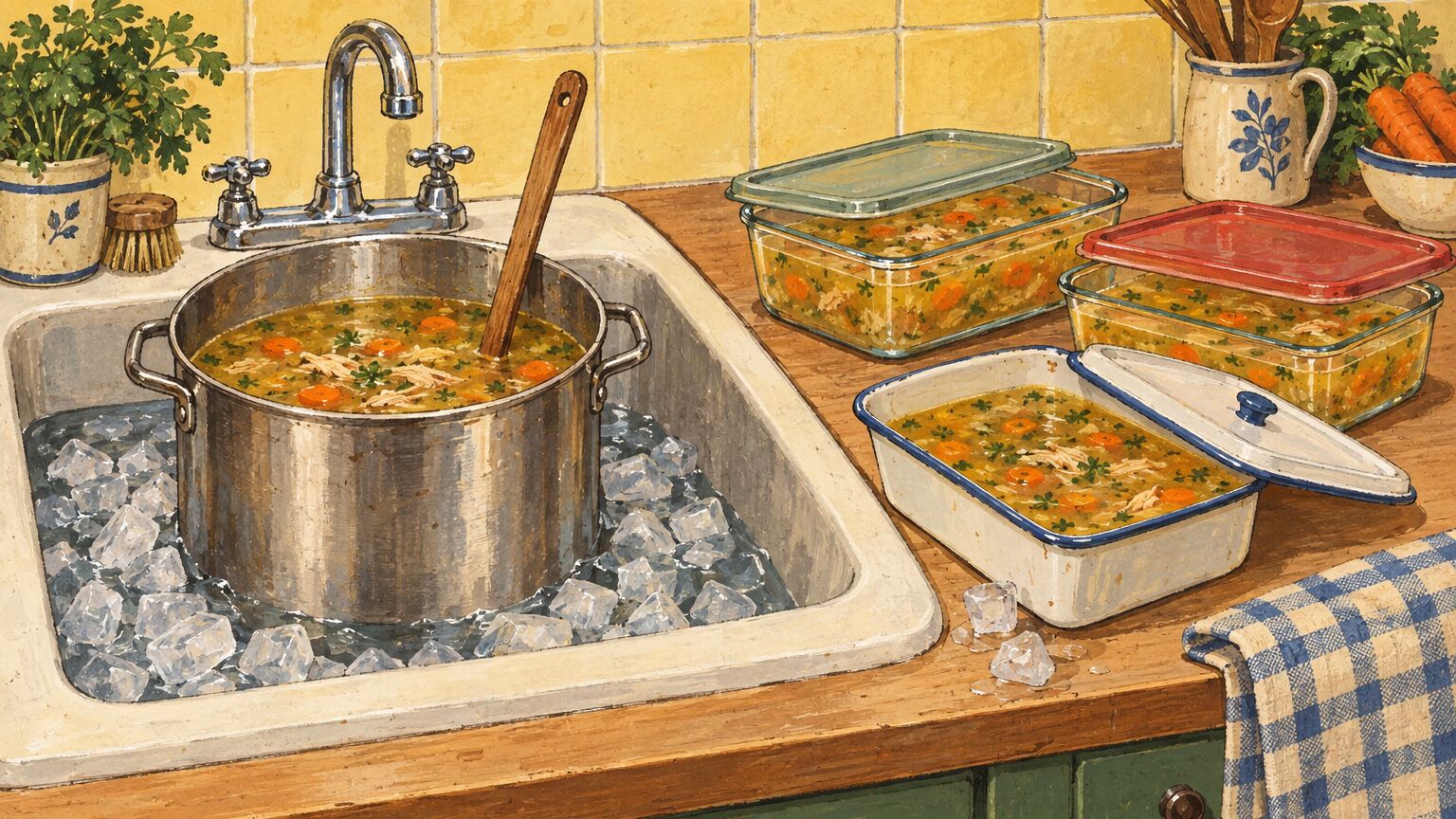
For the big pots of the weekend, our answer on putting hot soup in the fridge explains how to cool them in time, and the turkey temperature answer covers the bird itself.