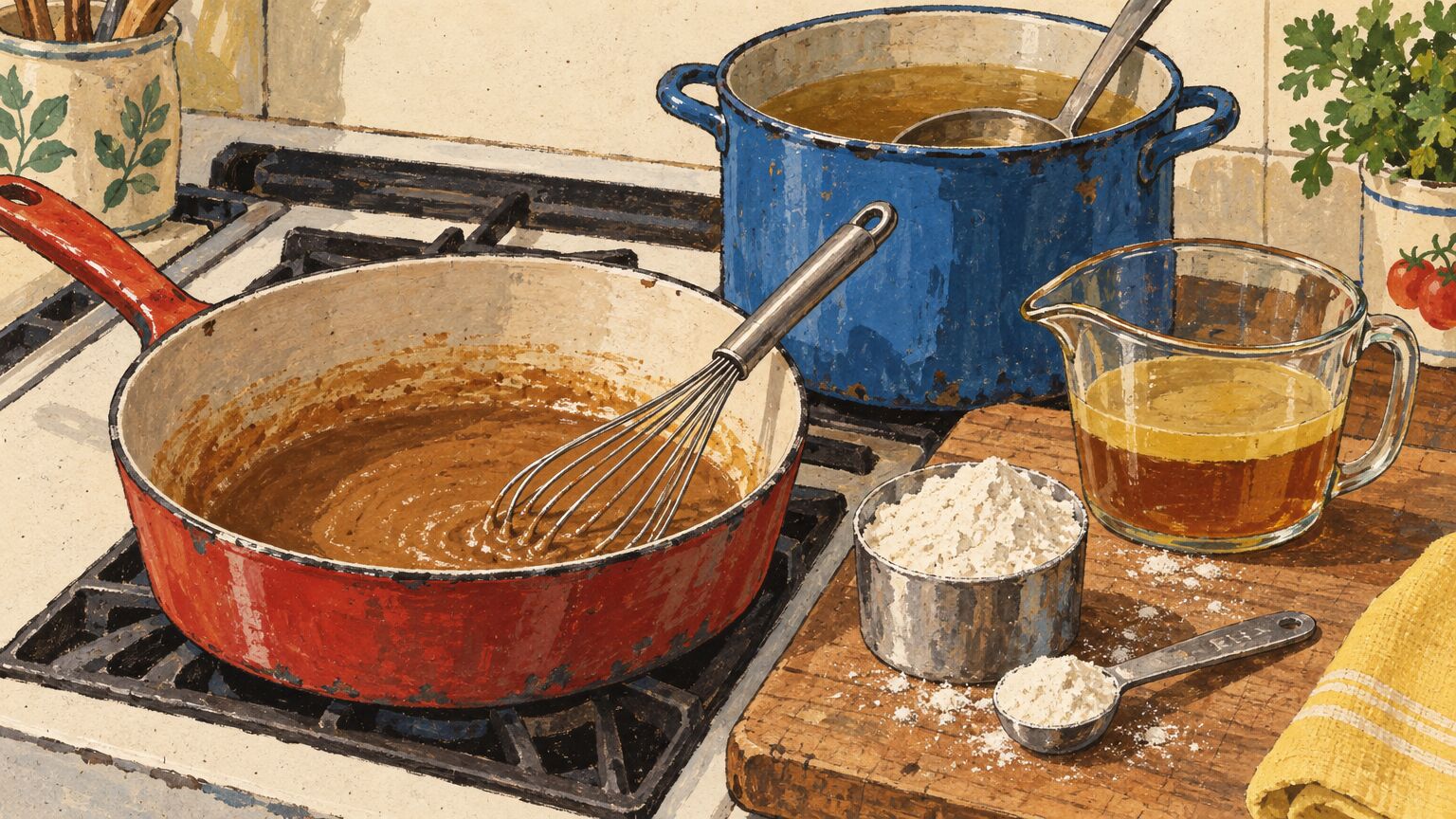
For a gravy that coats a spoon, use about 2 tablespoons (16 g) of all-purpose flour for every cup (240 ml) of liquid, cooked first in 1 to 2 tablespoons of fat. For a thin, pourable gravy use 1 to 1½ tablespoons per cup; for a thick one, 3. A quart (950 ml) of stock and pan juices needs about ½ cup (62 g) of flour for the spoon-coating kind. If you cook the roux to peanut-butter brown or darker, add about a quarter more flour, because a browned roux thickens less.
How much flour per cup, per quart and per liter
The amounts are for all-purpose flour cooked in fat as a white or blond roux (pale, just past raw). Count the liquid you will have when the gravy is done: if you plan to simmer it down for flavor, work out the flour on the amount you'll end with.
| Gravy | What it looks like | Flour per cup (240 ml) | Per quart (950 ml) | Per liter |
|---|---|---|---|---|
| Thin | Pours freely and soaks into mashed potatoes; most America's Test Kitchen turkey gravies sit here | 1 to 1½ tbsp (8 to 12 g) | 4 to 6 tbsp (31 to 47 g) | 33 to 50 g |
| Medium | Coats the back of a spoon; a classic sauce consistency | 2 tbsp (16 g) | ½ cup (62 g) | 66 g |
| Thick | Mounds slightly; for biscuits, or to thin later with stock | 3 tbsp (23 g) | ¾ cup (94 g) | 99 g |
Fat: between half and the same volume as the flour, so 1 to 2 tablespoons per cup for a medium gravy. A classic roux uses equal weights of butter and flour, which is about 1 tablespoon of butter for every 2 of flour. McGee's pan gravy uses equal volumes. America's Test Kitchen's turkey gravies fall in that range, at ½ to 1 tablespoon of fat per tablespoon of flour. Less fat makes a less greasy gravy.
The grams use the USDA's FoodData Central weights for all-purpose flour (125 g per cup, so about 7.8 g per level tablespoon), butter (14.2 g per tablespoon) and turkey fat (12.8 g per tablespoon). Spoon the flour into the measure and level it; a tablespoon scooped from the bag holds more.
Milk gravy follows the same table: America's Test Kitchen's Cream Gravy thickens 1½ cups of broth and 1½ cups of milk with 3 tablespoons each of butter and flour, the thin row. For how much to make, America's Test Kitchen's Best Turkey Gravy makes about 6 cups (1.4 liters) to serve 10 to 12 with leftovers, which works out to about ½ cup (120 ml) per person.
Step by step: a quart of turkey gravy
- Separate the drippings. Pour the roasting pan's drippings through a strainer into a fat separator or a glass measuring cup and let the fat rise to the top. Pour or spoon the fat off and keep both parts.
- Deglaze the roasting pan. Set the pan over two burners on medium-high, add 1 cup (240 ml) of stock or wine and scrape up the browned bits as it boils. America's Test Kitchen's Best Turkey Gravy boils it down by half, about 5 minutes. The browned bits carry much of the gravy's flavor.
- Make up the liquid. Combine the deglazing liquid, the defatted juices and enough stock to make 4 cups (950 ml), and bring it to a simmer in a pot.
- Make the roux. In a saucepan over medium heat, melt 4 to 8 tablespoons of the turkey fat (top up with butter if you're short), then whisk in ½ cup (62 g) of flour. Cook, stirring, to the color you want: in America's Test Kitchen's roux test, white took 1 minute, blond 3 and peanut butter 5. For a peanut-butter roux, use 10 tablespoons (78 g) of flour.
- Whisk in the hot liquid gradually, whisking hard the whole time, so no clumps of roux are left.
- Simmer and wait. Bring it to a boil, then simmer, stirring now and then, for at least 5 minutes before you judge the thickness. A roux gravy doesn't thicken fully until it nears the boil.
- Adjust and season. Thin it with hot stock, or thicken it with a slurry (see the fixes below). Taste for salt only now, at the end.
No drippings? Use butter for the fat and all stock for the liquid; America's Test Kitchen's Our Favorite Turkey Gravy is made that way. No fat at all? Whisk the same amount of flour into twice its volume of cold water, so ¼ cup (60 ml) of water for 2 tablespoons of flour, and stir it into the simmering liquid. A flour-and-water gravy needs a longer simmer to lose its raw-flour taste.
How to measure the fat in turkey drippings
Separate the drippings before you make the roux, so you know how much fat you have and how much liquid. Then count both parts:
- The fat goes into the roux, between half and the same volume as the flour. If you are short, make up the difference with butter, as America's Test Kitchen's Make-Ahead Turkey Gravy does. Leave any extra out: flour holds fat in suspension, and a gravy made from liquid that wasn't degreased turns "greasy" with "a muddy texture and flavor," says the open culinary textbook Flavors of the Saucier.
- The defatted juices count as liquid. Add them to the stock before you work out the flour.
A hypothetical example: the pan gives 1½ cups (355 ml) of drippings that settle into ½ cup (120 ml) of fat and 1 cup (240 ml) of juices. With 3 cups (710 ml) of turkey stock, that is 4 cups (950 ml) of liquid. A medium gravy needs ½ cup (62 g) of flour, or about 10 tablespoons (78 g) for a peanut-butter roux. The ½ cup of fat in the separator covers either at equal volume, and anything left over can go.
The juices can be salty if the turkey was brined or came injected with a salt solution, so taste them before you add salt. If the stock is homemade, leave it unsalted until the gravy is finished; our guide to making stock explains why a stock from roasted bones suits gravy best.
A darker roux thickens less, so a brown gravy needs more flour
The browner you cook the roux, the less it thickens. Heat splits some of the starch's long chains into short, branched pieces, which thicken liquid less well. "The darker the roux, the more starch chains are modified in this way, and so the more roux is required to create a given thickness," McGee writes (On Food and Cooking, "Improvements in Flavor, Color, and Dispersability").
America's Test Kitchen measured how much. It cooked three roux, each of 4 tablespoons of butter and ¼ cup of flour, and whisked each into 2 cups of water, which is 2 tablespoons of flour per cup. After a 20 minute simmer it read their thickness on a laboratory viscometer (Why Color Matters for Roux):
| Roux | Cooked | Thickening power |
|---|---|---|
| White | 1 minute | The baseline |
| Blond | 3 minutes | 14 percent less |
| Peanut butter colored | 5 minutes | 26 percent less |
The test stopped at peanut butter. Turkey gravy recipes often go darker for flavor. America's Test Kitchen's own Best Turkey Gravy cooks its roux "until nutty brown and fragrant, 10 to 15 minutes"; its Our Favorite Turkey Gravy goes to "deep golden brown." Soup Letters rounds the test result to a simple adjustment. For a roux cooked to peanut butter or darker, add about a quarter more flour than the table says: 2½ tablespoons (20 g) per cup for a medium gravy. Thickness doesn't rise in step with the amount of flour, so treat that as a starting point and adjust at the end. Thinning a gravy with a splash of hot stock takes seconds; thickening it takes a slurry and another simmer.
A darker roux has two upsides. It tastes toastier, and its short starch pieces are slower to bond into a network as the gravy cools, so the gravy is less likely to congeal on the plate, McGee says.
Why gravy gets lumps
Lumps form when dry flour meets hot liquid. Starch granules barely change in cold water. Once the water reaches their gelation range, which for most starches begins around 120 to 140°F (50 to 60°C), they swell, take up a great deal of water and turn into gel (On Food and Cooking, "Swelling and Gelation"). Drop a spoonful of flour into a simmering pan and the granules on the outside of each clump gel first, into a sticky skin that keeps the liquid out. The middle stays dry powder, and the clump becomes a lump that whisking only moves around.
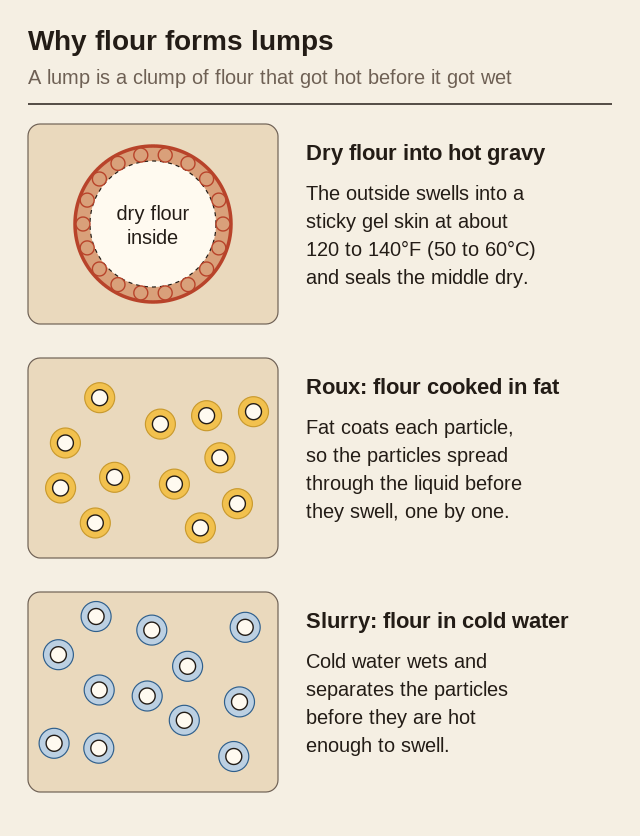
Every lump-free method keeps the particles apart until they are wet:
- Roux. Cooking flour in fat coats each particle so the particles "disperse evenly in the liquid and not aggregate into dry lumps," America's Test Kitchen says (How to Make Roux). Add the hot liquid gradually: in the test kitchen's Best Turkey Gravy, "vigorous and constant whisking at this point is key to avoiding lumps."
- Slurry. Whisking flour or starch into cold water wets and separates the granules "before they encounter gelation temperatures" (On Food and Cooking, "Slurries, Beurre Manié, Floured Meat"). Stir in the slurry, not dry flour.
- Beurre manié. Flour kneaded into an equal weight of soft butter, whisked into a simmering gravy a little at a time. The butter melts and releases the coated particles gradually, which suits last-minute thickening.
- Quick-mixing flour. Gold Medal sells Wondra as a "fast-dissolving flour" for "sauces and gravies without lumps." It is the one flour sold for sprinkling straight into a simmering gravy while you whisk.
Fixing gravy that is thin, thick, lumpy, greasy or salty
| Problem | Usual cause | Fix |
|---|---|---|
| Too thin, or not thickening | Not yet at a simmer; too little flour; a dark roux | Bring it to a simmer and wait 5 minutes. Still thin? For each cup, whisk 1 tablespoon (8 g) of flour into 2 tablespoons (30 ml) of cold water and stir it in. Or use 1½ teaspoons (4 g) of cornstarch in 1 tablespoon (15 ml) of cold water. Simmer again before judging |
| Too thick | Too much flour, or simmered too long | Whisk in hot stock or water, a few tablespoons at a time |
| Lumpy or grainy | Dry flour hit hot liquid | Whisk hard, then pour it through a fine-mesh strainer, or blend it smooth with an immersion blender |
| Tastes of raw flour | The flour hasn't cooked long enough | Simmer it longer, up to 30 minutes, tasting as you go; next time cook the roux a few minutes before the liquid goes in |
| Greasy, with fat pooling on top | More fat than the flour can hold | Skim with a wide spoon or ladle; next time, separate the drippings and use less fat |
| Watery and split after thawing | Freezing breaks the starch gel | Bring it to a full boil and whisk hard |
| Too salty | Salty drippings, a brined bird, or reduced salted stock | Add unsalted stock or water and thicken it again |
Roux "does not begin to thicken a sauce until the sauce is almost at the boiling point," notes Flavors of the Saucier. A gravy that looks thin before it simmers usually isn't finished yet, rather than short of flour.
Flour also tastes floury until it has cooked long enough. The same textbook says flour develops "a strong floury taste after 2 minutes of cooking." That taste "begins to disappear as the cooking progresses, usually after 30 minutes," it adds. Toasting the flour in fat first, McGee writes, "cooks out the raw cereal flavor," which is one reason a roux gravy tastes better sooner than a slurry stirred in at the last minute. Flour is also a raw ingredient. The FDA says most flour "hasn't been treated to kill any bacteria," names Salmonella and E. coli among those found in it, and says cooking kills them (Flour Is a Raw Food and Other Safety Facts). A gravy that simmers is cooked.
The thawed-gravy fix comes from America's Test Kitchen, which froze gravies thickened with flour and with cornstarch: both wept on thawing, and both came back together when brought "to a full boil" and whisked (Rescuing Frozen Gravy).
Salt doesn't boil off, so salty gravy only gets saltier as it reduces. Dilution is the fix, and our answer on turkey carcass stock shows how to spot a pre-salted turkey on the label before the drippings and stock go into the gravy.
Where these amounts come from
The table follows the classic roux proportions in Wayne Gisslen's Professional Cooking, rounded to kitchen spoons. Professional Cooking is a widely used culinary-school textbook. Its roux table thickens 1 gallon (3.8 liters) of liquid with 6 ounces (170 g) of flour for a thin sauce, 8 ounces (227 g) for a medium one and 12 ounces (340 g) for a thick one. Each is cooked in the same weight of butter. Divided by the 16 cups in a gallon, that is 1.4, 1.8 and 2.7 tablespoons of flour per cup, or about 45, 60 and 90 g per liter. (The book's metric column rounds these to 190, 250 and 375 g per 4 liters.)
Harold McGee's On Food and Cooking gives a similar, slightly thinner range for a pan gravy. Cook the fat with "an equal volume of flour" until the flour loses its raw smell, then add about a cup (250 ml) of liquid "for every 1–2 tablespoons/10–20 gm flour" (On Food and Cooking, "Gravy"). McGee counts a tablespoon of flour as about 10 g, a little more than the USDA's 7.8 g.
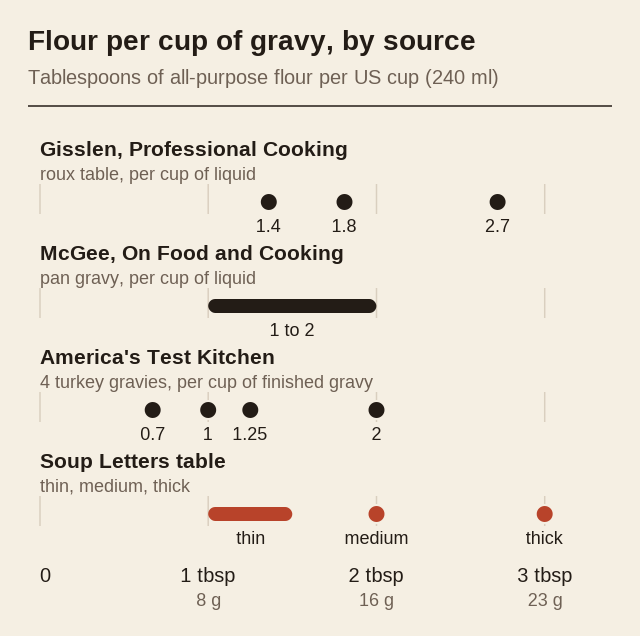
Why recipes give 1, 2 or 3 tablespoons per cup
Recipes disagree mainly because they aim at different gravies and cook the roux to different colors. Four of America's Test Kitchen's own turkey gravies show the spread, counted as flour per cup of finished gravy:
| America's Test Kitchen recipe | Flour | Gravy made | Per cup | Roux |
|---|---|---|---|---|
| Best Turkey Gravy | ¼ cup | About 6 cups | 0.7 tbsp | Nutty brown, 10 to 15 minutes |
| Turkey Gravy for a high-roast turkey | ¼ cup | About 1 quart | 1 tbsp | Honey colored, "slightly thickened" |
| Our Favorite Turkey Gravy | 5 tbsp | 4 cups | 1.25 tbsp | Deep golden brown, 5 to 8 minutes |
| Make-Ahead Turkey Gravy | 1 cup | About 2 quarts | 2 tbsp | Well browned, simmered until "very thick", thinned with broth as needed |
Three things move the number:
- The thickness you want. A gravy that pools on the plate and one that clings to a biscuit are both gravy. The test kitchen's turkey gravies aim thinner than a classic medium sauce; the table above names each target so you can pick a row.
- The color of the roux. A browned roux thickens less, so a brown gravy needs more flour for the same body. Three of these four recipes cook the roux golden or darker.
- Gelatin in the stock. Stock made from bones, a carcass or giblets brings gelatin, which gives a gravy body of its own, so a rich homemade stock needs a little less flour than a thin boxed broth. Flavors of the Saucier credits gelatin with a "lightly syrupy consistency."
The medium row, 2 tablespoons per cup, is a little thicker than most of these recipes on purpose. A gravy that comes out too thick is fixed in seconds with hot stock; one that comes out too thin needs a slurry and another simmer.
Cornstarch, potato starch and arrowroot instead of flour
Cornstarch, potato starch and arrowroot are nearly pure starch and thicken about twice as much liquid as the same amount of flour, which carries protein along with its starch (Flavors of the Saucier). Use half as much, mixed into cold water as a slurry, never cooked in fat first:
| Gravy | Cornstarch, potato starch or arrowroot per cup (240 ml) | Per quart (950 ml) |
|---|---|---|
| Thin | 1½ to 2¼ tsp (4 to 6 g) | 2 to 3 tbsp (16 to 24 g) |
| Medium | 1 tbsp (8 g) | ¼ cup (32 g) |
| Thick | 1½ tbsp (12 g) | 6 tbsp (48 g) |
The weights use the USDA's 128 g per cup for cornstarch. Whisk the starch into about twice its volume of cold water or stock, stir it into the simmering gravy and cook it gently until it turns glossy and loses its raw starch taste, usually about 5 minutes, the textbook says. What changes:
- The look. Pure starches make a shiny, translucent gravy; flour gives the matte, opaque look most people expect from turkey gravy.
- The staying power. Cornstarch and potato starch break down and lose thickness with long heating, and the textbook advises against reheating cornstarch-thickened dishes; arrowroot holds up somewhat better. Flour is the steadier choice for gravy made ahead or kept warm. America's Test Kitchen likewise says cornstarch can turn long-simmered sauces "gummy and gelatinous" (How to Make Roux).
- The name. In the UK, "cornflour" means cornstarch, so a British recipe's cornflour amounts belong in this table. American corn flour is finely ground whole corn, a different product.
For a gluten-free gravy with a roux, America's Test Kitchen's gluten-free turkey gravy swaps a gluten-free all-purpose flour blend for the wheat flour, tablespoon for tablespoon, and warns against blends made with beans.
How long gravy keeps, and freezing it
Use refrigerated gravy within 1 to 2 days, and frozen gravy within 2 to 3 months for best quality. Agencies differ on the fridge time. The FDA's refrigerator and freezer chart gives gravy 1 to 2 days; the USDA's Turkey from Farm to Table and Penn State Extension give it 3 to 4. Soup Letters goes with the FDA's shorter figure, and freezes whatever won't be eaten in 2 days.
- Refrigerate it within 2 hours of cooking, or within 1 hour if the room is above 90°F (32°C) (USDA FSIS, Leftovers and Food Safety). Penn State says to discard gravy left out longer than 2 hours. Pour it into shallow containers so it cools fast; our answer on hot soup in the fridge explains why a deep pot cools too slowly, and our turkey answer's section on leftovers covers the rest of the meal.
- Reheat it to a rolling boil. The USDA says to reheat "sauces, soups and gravies" by bringing them to a rolling boil (Leftovers and Food Safety). Whisk in a little stock as it heats, since cold gravy sets thicker.
- Frozen gravy weeps when it thaws, whether it was thickened with flour or cornstarch, and a full boil with hard whisking brings it back. If you cook gravy to freeze, waxy rice flour (sold as sweet or glutinous rice flour) is worth knowing about. A 1951 study by Hanson, Campbell and Lineweaver found that flour caused the separation in frozen sauces. Of the many thickeners they tried, waxy rice flour gave the most stable gravies, which held for about a year at 0°F (−18°C). The study, published in Food Technology, is summarized in the ASHRAE Refrigeration Handbook's chapter on poultry products. Soup Letters hasn't found a tested home amount for it.