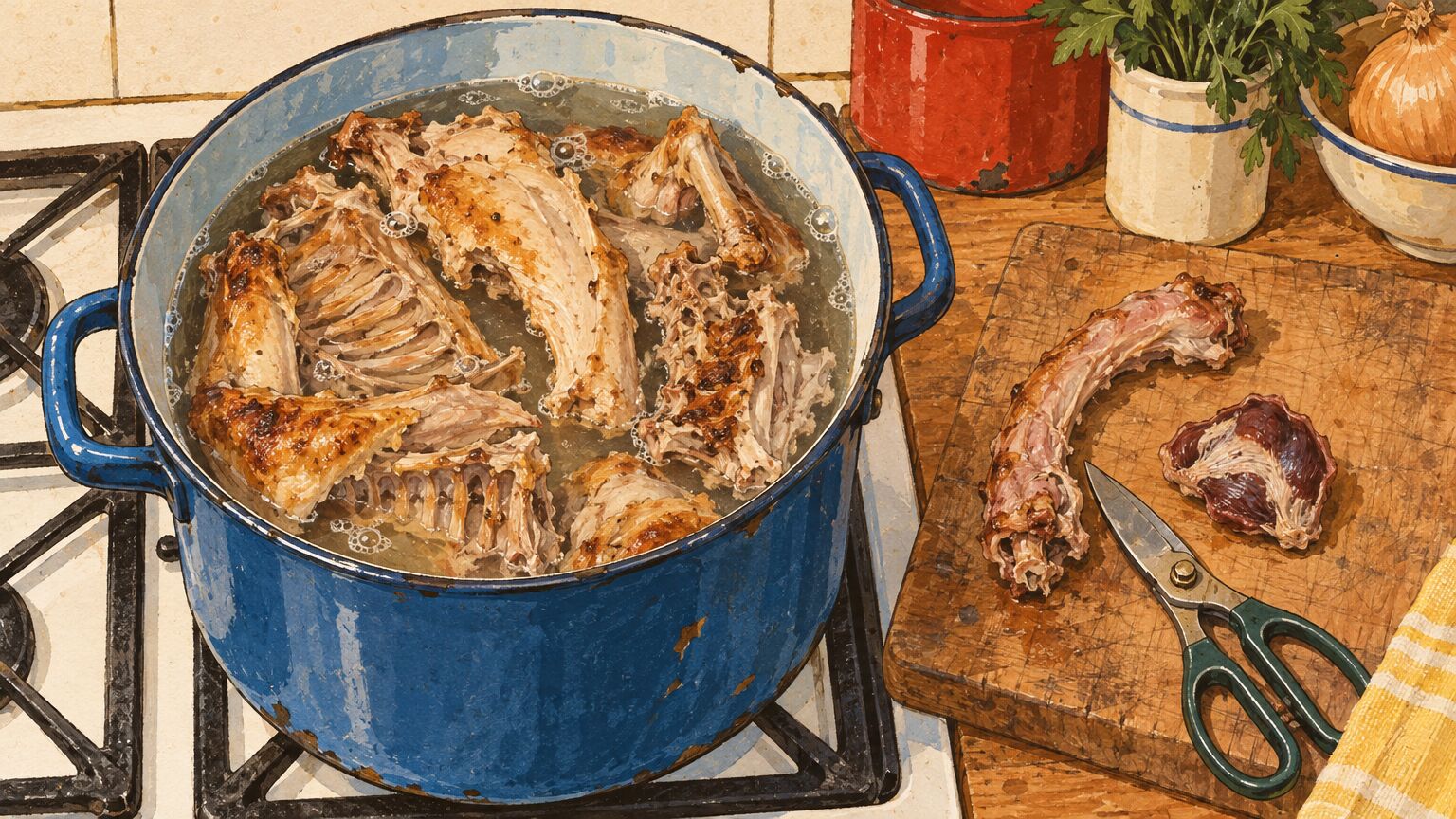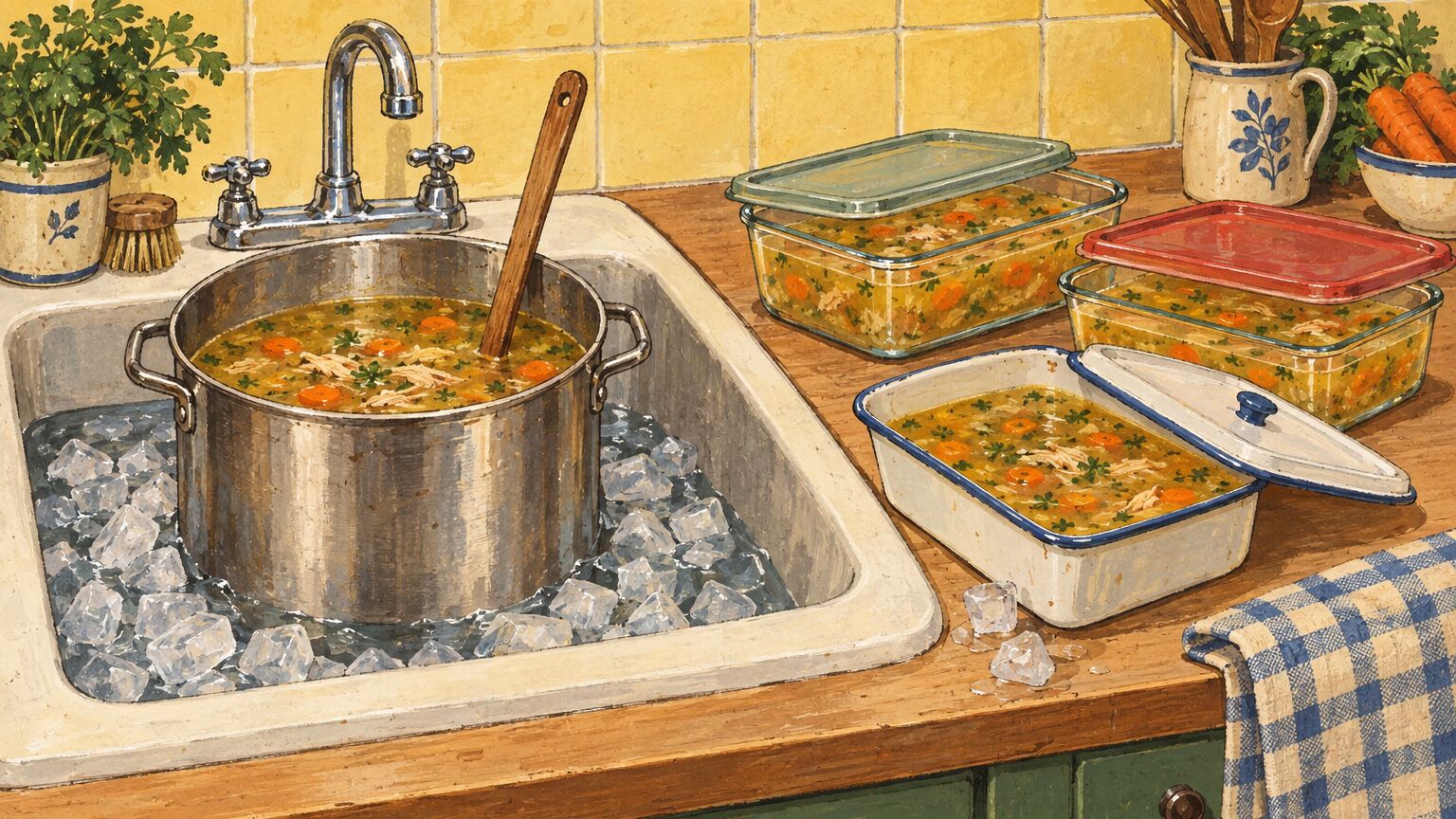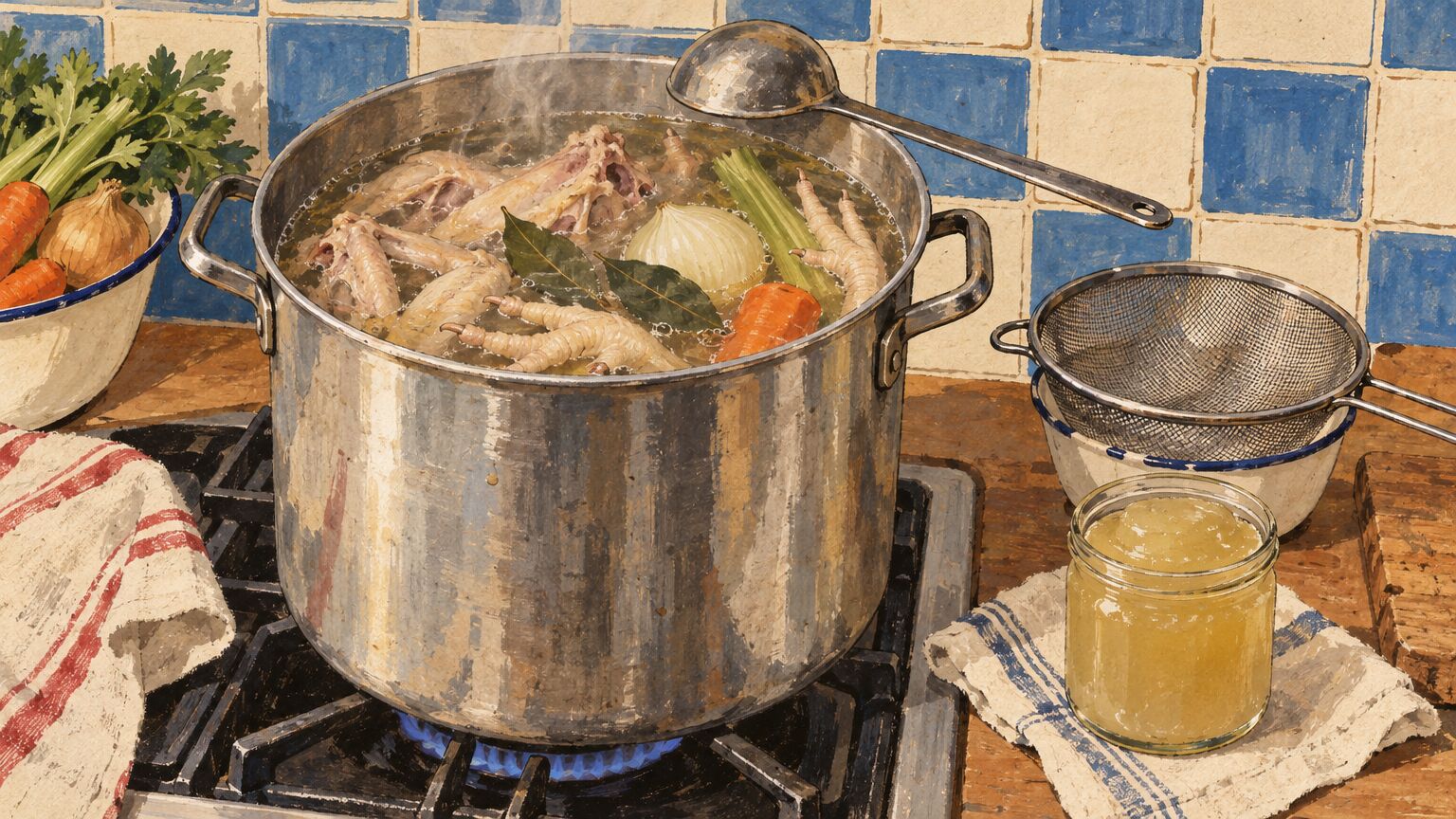
Put the bones in a pot with about 3/4 quart of cold water per pound of bones (1.6 liters per kilogram), which is roughly enough to cover them. Bring it slowly to a bare simmer, skim the foam, and keep it just below a boil. Simmer fish bones 30 to 45 minutes, chicken 3 to 4 hours, and beef or veal 6 to 8 hours, or pressure-cook chicken for about 1 hour. Strain it, get it into the fridge within 2 hours, and use it within 1 to 2 days or freeze it.
The short version
| Bones | Water | On the stove | In a pressure cooker | Notes |
|---|---|---|---|---|
| Chicken: backs, necks, wings, feet or a cooked carcass | 3/4 to 1 qt per lb (1.6 to 2.1 L per kg) | 3 to 4 hours | About 1 hour | Wings and feet set best; no livers |
| Turkey carcass | Enough to cover, broken up | 3 to 4 hours | As for chicken, if it fits | See stock from a turkey carcass |
| Beef or veal: back, neck and shank bones | About 3/4 qt per lb (1.6 L per kg) | 6 to 8 hours | No tested home time; see the beef study below | Roast first for brown stock |
| Lean white fish: frames and heads | 5/8 to 3/4 qt per lb (1.3 to 1.6 L per kg) | 30 to 45 minutes | Not worth it | No oily fish |
The stovetop times come from the white stock and fish stock recipes in Zeringue and Thibodeaux's open culinary textbook. The pressure-cooker time for chicken is America's Test Kitchen's, from its stovetop pressure-cooker broth and its Instant Pot broth. A stock that sets to jelly when cold comes from collagen-rich parts and not too much water, not from simmering longer. The sections below give the reasons, and the studies that back or limit each number.
Which bones make the best stock
Stock gets its flavor from meat and its body from collagen. Collagen is the protein in skin, tendons, cartilage and the joints between bones, and long, gentle heat turns it into gelatin, which is what makes cold stock set. Plain bone with nothing attached gives little of either. The same slow change is why beef stew meat stays tough until it has had hours near a simmer.
- Chicken: the textbook names the neck and back as the best bones. America's Test Kitchen built its pressure-cooker test on wings, which it calls "both flavorful and loaded with collagen," and its stock notes say "necks, backs, wings, wingtips, and feet are all high in connective tissue."
- Raw or cooked: America's Test Kitchen's all-purpose chicken stock takes "any combination of raw or cooked chicken bones," plus necks, hearts and gizzards, but not livers, which give the stock a liver flavor. Its slow-cooker stock puts 3 to 4 rotisserie carcasses at about 2.5 pounds (1.1 kg).
- Beef and veal: the textbook names back, neck and shank bones, and prefers bones from younger animals because they carry more cartilage and connective tissue. That is why veal is the classic choice for a stock with body.
- Fish: use frames and heads from lean white fish such as sole, flounder, whiting or turbot. The textbook rules out oily fish such as salmon, tuna and mackerel for their fat and strong flavor.
Saving bones in the freezer until you have enough works well. The FDA's storage chart gives raw chicken parts 9 months in the freezer for quality, and frozen bones can go straight into the pot.
How much water to use for stock
Use about 3/4 quart of water per pound of bones (1.6 liters per kilogram), or about 3 parts water to 2 parts bones by weight. Independent sources land close together:
| Source | Bones | Water | Water per pound of bones |
|---|---|---|---|
| Michael Ruhlman's ratio in his book Ratio (2009), as summarized on NPR | 2 parts | 3 parts | About 0.72 quart (1.5 L per kg), reading the parts as weights |
| Textbook white stock | 16 pounds (7 kg) | 3 gallons (11 L) | 0.75 quart (1.6 L per kg) |
| Textbook fish stock | 8 pounds (3.6 kg) | 5 quarts (4.7 L) | 0.63 quart (1.3 L per kg) |
| America's Test Kitchen chicken stock | 3 pounds (1.4 kg) | 3 quarts (2.8 L) | 1 quart (2.1 L per kg) |
For 3 pounds (1.4 kg) of chicken backs and wings, that means 2 1/4 to 3 quarts (2.1 to 2.8 liters) of water. In practice it is about the amount that just covers the bones in a pot that fits them snugly. The textbook goes further: for all but very long simmers, it fills only three-quarters of the way up the solids. Bones settle as they cook, and a pot topped up at the start ends up thin.
The textbook warns that "many beginning cooks completely cover the solid ingredients" and end up with thin stock. Doubling the water halves the gelatin and the flavor. If your stock never sets, too much water is the first thing to check.
How long to simmer stock
Simmer chicken stock for 3 to 4 hours, beef or veal stock for 6 to 8 hours, and fish stock for 30 to 45 minutes. Those are the times kitchens use to get a good stock for the hours spent, not the point where extraction stops. Protein keeps coming out of beef bones for many hours at a simmer. What longer cooking costs is aroma, off-flavors and attention.
The sources do not fully agree on chicken. The textbook's white stock recipe gives 3 to 4 hours for chicken bones, while the same chapter elsewhere says 5 to 6, and America's Test Kitchen finds its covered chicken stock "full-flavored" after 2 hours. Three to 4 hours sits in the middle.
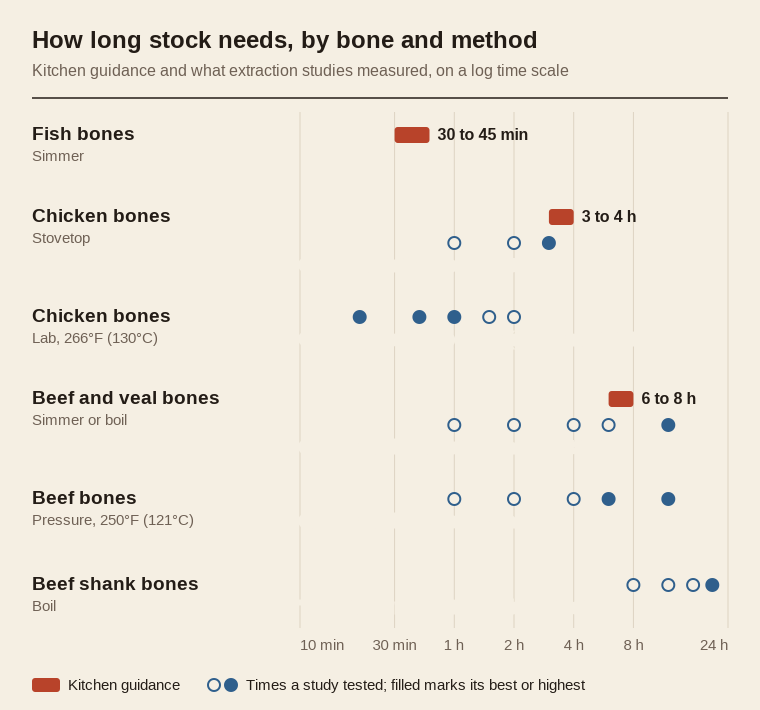
- Chicken on the stove: in Masood and Chen's 1995 study, chicken broth cooked for 1, 2 and 3 hours had the most gelatin at 3 hours, the longest time tested. So gelatin was still rising at 3 hours; the study can't say whether it kept rising after that.
- Chicken under pressure, in a lab: Yue and others (2017) extracted chicken bones at 266°F (130°C), hotter than any home pressure cooker, and made gelatin gels from the extracts. Hydroxyproline, the marker of collagen, was highest at 120 minutes, but the gelatin from the 20, 40 and 60 minute extracts gelled better than the gelatin from 90 and 120 minutes. The authors tied that to how much of the protein had broken into small fragments. It shows that more protein is not always better gelatin; it does not give a home stock time.
- Beef at a boil and under pressure: Moon and others (2015) cooked beef bones in twice their weight of water for 1 to 12 hours. At normal pressure, collagen protein kept rising and was highest at 12 hours, the longest time tested. At 250°F (121°C) under pressure, it stopped rising after 6 hours, while the off-odors and sulfur notes the trained panel picked up grew stronger with time. In Park's 1986 study, beef shank bones boiled 8 to 20 hours gave nearly twice as much total nitrogen at 20 hours as at 8; the author judged that past 12 hours the nutritional gains, mainly minerals, were small.
- Chicken white soup: Guan and others (2024) stewed chicken frames at about 208°F (98°C) to make a milky white soup and found its total nutrients highest at 3 hours of the 3.5 tested. That is a different dish from clear stock, but the timing lands in the same place.
When the textbook warns against over-reducing stock, it gives a flavor reason: many flavors "are aromatic and evaporate when simmered over a prolonged period," leaving the stock flat. A recipe that asks for a 24 or 48 hour simmer buys more protein with lost aroma, and none of the studies on this page tested that long.
There is also a safety reason not to simmer overnight. The US Fire Administration finds unattended equipment the leading factor in home cooking fires that spread, at 37 percent, and its advice is to turn the burner off when you leave the kitchen. If you want stock to cook while you are out or asleep, a slow cooker is built for that; a pressure cooker gets chicken stock done in about an hour.
Simmer stock, don't boil it
Keep stock at a bare simmer, with a bubble breaking the surface every second or two. The textbook puts a simmer at about 185°F (85°C); our answer on what temperature is a simmer gives the full range and how to hold one on a stove. A rolling boil churns melted fat and fine protein into the liquid and keeps them suspended, which the textbook says makes stock cloudy with a "dull, muddy, greasy flavor" that gets worse when the stock is reduced for a sauce. Making pot-au-feu, America's Test Kitchen found that at a simmer the scum "simply settled to the bottom of the pot."
Cloudy stock is safe, and some cloudy broths are cloudy on purpose: milky Chinese chicken white soup and similar broths are cooked at or near a boil for hours to emulsify the fat, as Guan and others describe. For a clear soup or a sauce, simmer.
A lid changes how much the stock reduces. America's Test Kitchen simmers its all-purpose stock covered and gets about 3 quarts (2.8 liters) from 3 quarts of water. The textbook's white stock turns 3 gallons (11 liters) of water into 2 gallons (8 liters) over 6 to 8 hours. Uncovered stock ends up more concentrated; covered stock keeps more of its volume. Either is fine, as long as the bones stay under the liquid.
Should you start stock in cold water?
Start in cold water if you want a clear stock; it makes no difference to flavor. America's Test Kitchen made the same chicken stock twice, once with cold tap water and once with boiling water, and simmered both for 3 hours. The cold-start stock was more transparent and the hot-start stock slightly cloudy, but tasters "couldn't detect any significant differences" in flavor. The reason, in the textbook's terms: in cold water, blood and soluble proteins dissolve and then clump slowly as the water heats, rising as foam you can skim. Plunged into hot water, they set at once in fine particles that stay suspended.
Should you skim stock?
Skim for clarity, not for safety. The gray foam that rises in the first hour is coagulated protein from the meat and blood, not dirt. Reporting its cold-start test, America's Test Kitchen's science editor said the clouding proteins "don't contribute any taste," so leaving them costs only clarity. The textbook's routine is to skim every 5 to 10 minutes for the first hour, then every 30 to 60 minutes. Fat is easier to deal with later: chill the strained stock and lift off the hardened layer.
Should you roast the bones?
Roast the bones when you want a brown stock: darker, deeper and better suited to gravy, stews and pan sauces. Leave them raw for a white stock, which is paler and cleaner for soups. The textbook roasts bones and vegetables in a 400°F (204°C) oven, turning them until evenly browned, then deglazes the pan with water so the browned juices go into the pot. Burnt bits make stock bitter, so stop at deep brown. For the gravy, our answer on how much flour to thicken gravy gives the amounts per cup and per quart.
Browning works in a pressure cooker too: America's Test Kitchen browns its chicken pieces and onion in the pot before sealing it.
Some chefs blanch bones first (boil, drain and refill) for a whiter, clearer stock. The textbook notes that chefs disagree, since blanching also pours away some flavor. At home it is optional.
Vegetables, herbs and salt in stock
- Vegetables: a classic mirepoix is 2 parts onion, 1 part carrot and 1 part celery by weight, at about 1 pound of vegetables per 8 pounds of bones (1 kg per 8 kg) in the textbook's recipe. Cut them small for short stocks (fish) and large for long ones (beef), so they give up their flavor in the time they have.
- Herbs: a few parsley stems, a bay leaf, thyme and peppercorns. America's Test Kitchen adds the parsley and thyme to its turkey stock halfway through, so they don't cook for the full 4 hours.
- Salt: leave it out. The textbook's reason: stock has many uses, and "salt is not lost through reduction," so a salted stock reduced for a sauce ends up too salty. America's Test Kitchen leaves salt out of its all-purpose stock for the same reason. Boil a lightly salted stock down by half and its salt doubles. Season the soup or sauce you make from it instead. A cooked or rotisserie carcass already carries salt, and a brined or pre-salted turkey carries a lot; stock from a turkey carcass covers how to read the label.
Pressure cooker, slow cooker or stovetop?
All three make good stock. They differ in time, color and flavor.
| Method | Temperature | Chicken stock time | What you get |
|---|---|---|---|
| Stovetop | About 185°F (85°C) at a simmer | 3 to 4 hours | Cleaner, purer chicken flavor; clearest result |
| Pressure cooker, stovetop model at 15 psi | About 250°F (121°C) | About 1 hour | Darker, meatier, more extraction per hour |
| Electric pressure cooker on high | Depends on its pressure; check the manual | About 1 hour | Similar |
| Slow cooker on high | Varies by model | 8 to 10 hours | Hands-off; America's Test Kitchen's version uses roasted bones |
The pressure temperatures come from the University of California's pressure canning table: 10 psi holds about 239°F (115°C), 11 psi about 241°F (116°C) and 15 psi about 250°F (121°C) at sea level. Electric cookers often run at a lower pressure than stovetop models, so check your cooker's manual for its pressure and use the table to find its temperature.
America's Test Kitchen compared 3 pounds (1.4 kg) of chicken wings in 3 quarts (2.8 liters) of water, simmered for 2 hours in a Dutch oven or pressure-cooked for 1 1/2 hours. The pressure-cooked stock was darker "with a more complex, meaty flavor"; the Dutch oven stock had "a cleaner, purer chicken taste." Its verdict: the pot for a simple chicken soup, the pressure cooker for stews and braises.
Not every pressure cooker gives the same result. In Dave Arnold's blind tastings at Cooking Issues, a conventional stock beat pressure-cooked stock from a jiggle-top cooker that vents steam, while stock from his sealed, spring-valve cooker won. He suspects the escaping steam affects the taste. Moon and others' beef study found a similar trade: pressure extracted more collagen and some minerals, its trained panel found stronger off-odors in the pressure broths, and the authors judged traditional boiling better for flavor.
Two practical points. Don't fill a pressure cooker past the maximum line in its manual; America's Test Kitchen notes that its 3 quart batch fills a 6 quart cooker two-thirds full. And a pressure cooker does not make stock cloudy by boiling it. Arnold points out that the liquid inside is no more agitated than in a pot. In Moon and others' beef study, the pressure-cooked broths did not grow cloudier with time, while the boiled ones did.
Why stock doesn't gel, and how to fix it
Stock sets when it holds enough gelatin. For scale, Knox says one envelope of its unflavored gelatin, sold in 7 g packets, will gel 2 cups (500 mL) of liquid. That is about 1.4 percent gelatin by weight, a dessert-jelly set. A stock that wobbles softly in the fridge holds less, but it still needs a real amount. Judge the set only once the stock is fully chilled, ideally overnight.
Stock fails to set for three reasons, most common first:
- Too much water. The gelatin is there but diluted. Use 3/4 to 1 quart of water per pound of bones (1.6 to 2.1 liters per kilogram).
- Too little collagen. Breast meat and clean, bare bones give flavor but little gelatin. Add wings, feet, necks or a split veal or pork foot.
- Too short a cook. Collagen takes hours to dissolve at a simmer. In Masood and Chen's study, chicken broth gelatin was still rising at 3 hours; beef takes longer.
One lab result is worth knowing if you pressure-cook: Yue and others found that gelatin from chicken bones extracted at 266°F (130°C) gelled better from 20 to 60 minute extracts than from 90 to 120 minute ones. That is hotter than a home cooker, and America's Test Kitchen's 1 hour pressure-cooker broths are a safer guide.
To fix a stock that won't set, reduce it. Simmer 3 quarts (2.8 liters) down to 2 quarts (1.9 liters) and the gelatin, flavor and any salt all become 1.5 times as concentrated. Or add gelatin: when America's Test Kitchen doctors store-bought broth in its quick chicken broth, it adds 8 teaspoons of unflavored gelatin to 2 quarts (1.9 liters) of liquid, or 1 teaspoon per cup (240 mL). Knox counts one envelope as a tablespoon, so that is about two-thirds of its dessert-jelly rate: a firm set. For a softer set, start with 1/2 teaspoon per cup. Sprinkle the gelatin over a little cold stock first so it doesn't clump, then stir it into the hot stock.
A stock that doesn't set is still good stock. Gel is body, not flavor, and for a soup with noodles or vegetables it matters far less than for a sauce that has to coat a spoon.
Cooling and storing stock
Strain the stock, then get it cold fast. A big pot of hot stock cools slowly, and Clostridium perfringens, the bacterium the CDC links to large batches of food held at the wrong temperature, grows between 40 and 140°F (4 and 60°C). The CDC notes that it forms spores with protective coatings, which is why the long simmer doesn't settle the matter: the risk is the slow cool afterward.
- Refrigerate it within 2 hours. The CDC says to refrigerate cooked food at 40°F (4°C) or colder within 2 hours. Some recipes, including America's Test Kitchen's all-purpose stock, let stock cool on the counter for about 2 1/2 hours first; get it into the fridge sooner. The FDA Food Code that restaurants follow is more exact: from 135°F to 70°F (57°C to 21°C) within 2 hours, and down to 41°F (5°C) within 6 hours in total.
- Speed it up. The Food Code's methods: shallow pans, smaller portions, an ice-water bath with stirring, or adding ice. A full stockpot set straight in the fridge is the slow way. Can you put hot soup in the fridge? covers how fast each method works.
- Use it within 1 to 2 days. The FDA's storage chart gives 1 to 2 days in the fridge for "gravy & meat broth", against 3 to 4 days for finished soups and stews. Other sources run longer: America's Test Kitchen's stock recipes say anything from 2 to 5 days and the textbook says a week. Go by the agency, and freeze what you won't use in 2 days.
- Freeze it for longer. The FDA gives 2 to 3 months in the freezer for best quality, and food kept at 0°F (-18°C) stays safe indefinitely. Freeze in portions you will use: 1 or 2 cup containers, or an ice cube tray for small amounts.
- Reheat to 165°F (74°C) before serving, as the CDC advises, which in practice means bringing the stock back to a boil.
The fat that sets on top of chilled stock does not preserve it. The textbook claims a fat layer "helps preserve the stock" for up to a week, but the FDA chart makes no such exception: 1 to 2 days for meat broth, fat or no fat. Lift the fat off and use it for cooking, or discard it.
Stock from a turkey carcass
A roast turkey carcass makes a good stock by the same rules: break it up so it fits snugly, cover it with water, and simmer 3 to 4 hours (America's Test Kitchen's turkey stock takes 4). Two questions are specific to the day after Thanksgiving: whether a carcass left out overnight can still be used, and how a brined or pre-salted bird changes the salt. Stock from a turkey carcass answers both, and how long Thanksgiving leftovers last covers the rest of the fridge.
Common claims about stock that are wrong
- "Simmer bones for 24 to 48 hours to get all the gelatin out." No study cited here tested that long. Beef bones keep giving protein for many hours (Park's 1986 study measured nitrogen still rising at 20 hours), but chicken stock is full-flavored in 2 to 4 hours, and every extra hour costs aroma.
- "Starting with hot water ruins the flavor." America's Test Kitchen found a hot start made stock slightly cloudier and tasted no difference.
- "The scum is impurities that make stock unsafe." It is coagulated protein. Skimming is for clarity.
- "A layer of fat keeps stock good for a week." The FDA's limit for meat broth is 1 to 2 days in the fridge, fat or no fat.
- "Pressure-cooked stock is cloudy because it boils." The liquid in a pressure cooker isn't agitated more than in a simmering pot, and in Moon and others' beef study the pressure broths were no cloudier.
- "Stock that doesn't gel was made wrong." It was most likely made with more water or fewer wings and feet. It is still stock, and reduction or a teaspoon of gelatin per cup fixes the body.