Beef stew meat is tough because it hasn't cooked long enough yet, and it isn't ruined. The connective tissue that makes chuck chewy only melts into gelatin after hours near a simmer. The USDA gives 1 to 1 1/2 inch (2.5 to 4 cm) stew pieces 2 to 3 hours, and America's Test Kitchen's stew of chuck-eye roast takes about 2 1/2 hours in a 300°F (150°C) oven. If the meat is chewy, put the lid back on and keep cooking, checking every 30 minutes. If it is soft but dry and stringy, the cut was too lean or it cooked past tender, and more time won't help.
The recipe's time is an estimate. The meat is done when a fork slides in with little resistance, not when the timer goes off.
Tough or dry: what your stew meat is telling you
| What you find | What it means | What to do |
|---|---|---|
| Chewy, springy, hard to pierce with a fork | The collagen hasn't melted yet | Keep cooking: check every 30 minutes on the stove or in the oven, every hour in a slow cooker |
| Some pieces tender, others chewy | Mixed cuts or mixed sizes in the pot, as in a pre-cut "stew meat" pack | Lift out the tender pieces and finish the rest; next time, cut a chuck-eye roast yourself |
| Soft and falling apart, but dry and stringy in the mouth | A lean cut such as round, or meat cooked well past tender | Shred it into the sauce; more cooking makes it worse |
| Still tough after a full day in a slow cooker | The cooker may run too cool on low | Test it with a pot of water and a thermometer (below); replace it if it fails |
| Tough after the Instant Pot beeps | Too little time under pressure for the size of the pieces | Lock the lid and cook a few more minutes at high pressure |
Why stew meat is tough at 2 hours and tender at 3
Two things happen to beef as it cooks, and they run on different clocks.
The muscle fibers tighten and squeeze out juice, and that happens fast. As the meat heats, its fibers shrink across their width from about 113 to 140°F (45 to 60°C), pushing water out. From about 140 to 194°F (60 to 90°C) they shrink along their length too, according to the review in a 2024 Massey University thesis on cooking brisket. The study it cites found juiciness fell most sharply between 145 and 163°F (63 and 73°C). Small chunks in simmering liquid pass all of those temperatures in the first part of the cook.
The collagen melts into gelatin, and that takes hours. Collagen, the main protein in the connective tissue that wraps every bundle of fibers, unravels and shrinks between about 127 and 145°F (53 and 63°C). If it isn't held together by heat-stable cross-links, it then dissolves into gelatin with further heating, as Eva Tornberg's review of heat and meat proteins explains. America's Test Kitchen puts the start of that breakdown at 140°F (60°C) and says it goes most efficiently around 200°F (93°C). Muscles that worked hard build up more cross-links, which is why America's Test Kitchen says brisket, from the chest that carries much of the animal's weight, takes about twice as long as other braising cuts.
So stew meat goes through a tough stage. Early in the cook, the fibers have already tightened and lost juice, but the collagen holding them together is still intact: the meat is at its chewiest. Over the next hours the collagen dissolves, the fibers come apart easily, and the meat turns tender. The juice the fibers lost doesn't come back, which is why stew meat that has turned tender doesn't also turn juicier.
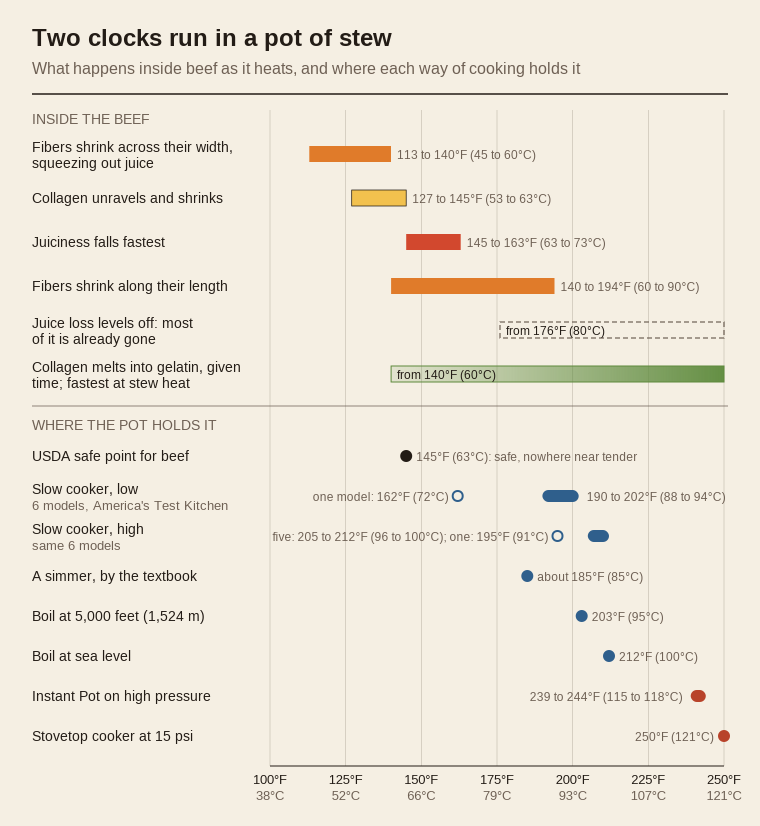
A thermometer can't tell you when stew is done. The USDA counts beef safe at 145°F (63°C) with a 3 minute rest, and stew meat passes that long before it is tender. Use a fork.
How long beef stew meat takes to get tender
Time depends on the cut, the size of the pieces and the heat. These are the USDA's times and America's Test Kitchen's recipe times for chuck-eye roast.
| Method | How hot the stew gets | Time to tender | Source |
|---|---|---|---|
| Simmered on the stove | About 185°F (85°C), the simmer temperature in our stock guide | 2 to 3 hours for 1 to 1 1/2 inch (2.5 to 4 cm) pieces of any stew beef | USDA FSIS beef chart |
| Dutch oven in a 300°F (150°C) oven | Below the boil | About 2 1/2 hours for 1 1/2 inch (4 cm) pieces | America's Test Kitchen's Best Beef Stew |
| Slow cooker on low | 190 to 202°F (88 to 94°C) in most tested models | 9 to 10 hours for 1 1/2 inch (4 cm) pieces | America's Test Kitchen's slow-cooker beef stew |
| Slow cooker on high | 205 to 212°F (96 to 100°C) in most tested models | 6 to 7 hours for 1 1/2 inch (4 cm) pieces | Same recipe |
| Instant Pot on high pressure | 239 to 244°F (115 to 118°C) | 30 minutes for 1 1/2 inch (4 cm) pieces, then quick release | America's Test Kitchen's Instant Pot stew |
At stew temperatures, hotter is faster, but it costs juice. In the Massey thesis, brisket cooked in sealed bags reached a consumer tenderness threshold after 20 hours at 140°F (60°C), losing 33.8 percent of its weight. At 158°F (70°C) it took longer, 26 hours, and lost 43.6 percent, so the speedup isn't steady at low temperatures. At 176°F (80°C) it took 12 hours and lost 44.0 percent; at 194°F (90°C), 8 hours and 45.6 percent. Every way of making stew sits at that hot, fast end, so all stew meat loses a lot of juice. What keeps a good stew from tasting dry is the cut, which the section on cuts below covers.
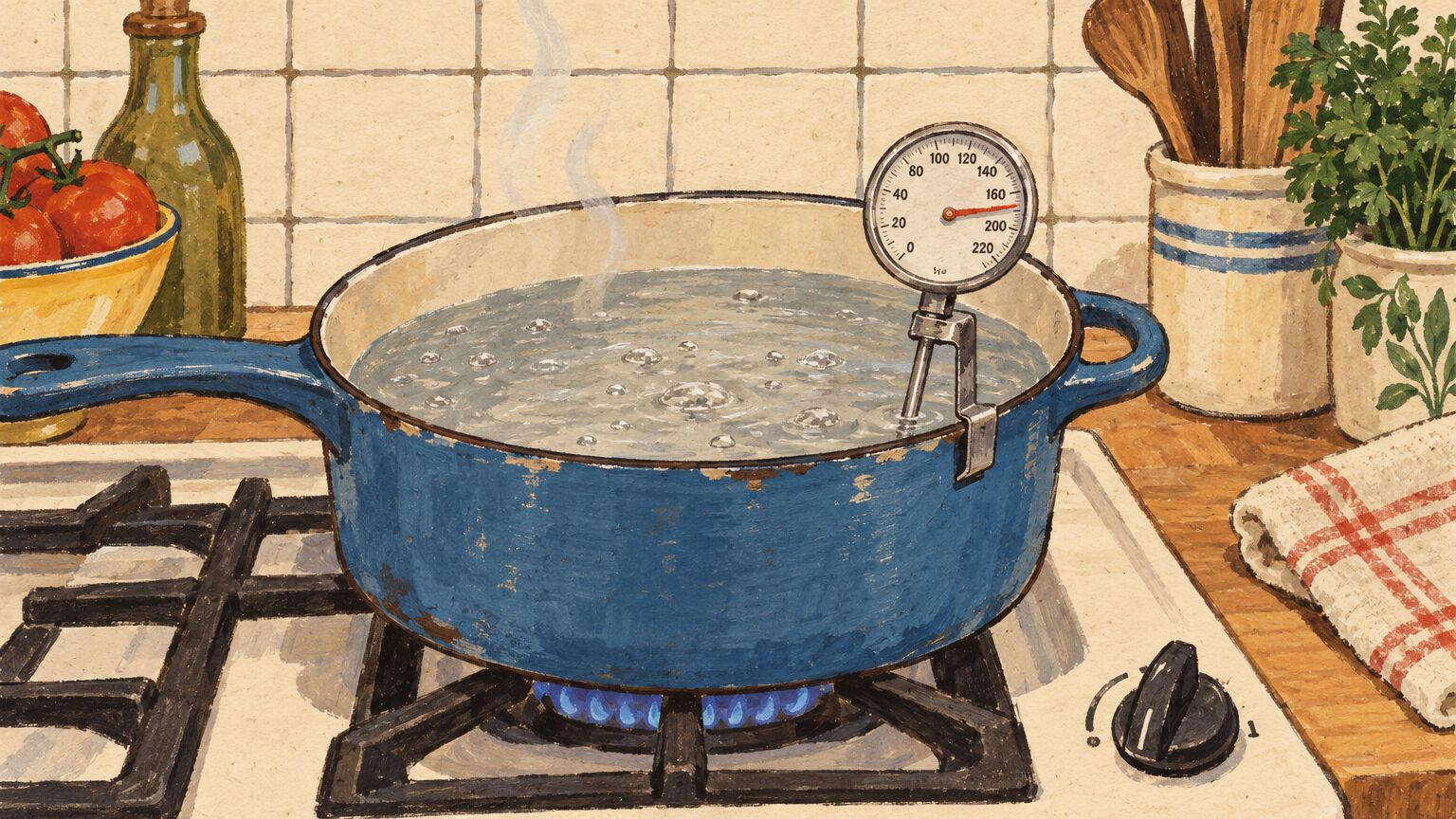
At altitude, water boils at a lower temperature, so a pot of stew can't get as hot. The USDA says meat cooked by simmering or braising may take up to a quarter longer at 5,000 feet, and that turning up the heat won't help. Our boiling point table gives the number for your altitude.
How to fix tough stew meat
- Keep cooking with the lid on. Make sure the meat is still mostly under the liquid; add a splash of broth or water if the stew has reduced. If it has thickened and needs another hour, move the covered pot to a 300°F (150°C) oven, where America's Test Kitchen says the heat surrounds the pot evenly instead of scorching the bottom.
- Check every 30 minutes on the stove or in the oven. Take out the largest piece and press a fork into it. If the fork slides in and the piece gives easily, it is done. If it springs back, keep going.
- Take the vegetables out if they are done first. Lift out soft potatoes and carrots with a slotted spoon, keep cooking the meat, then return them. America's Test Kitchen avoids the problem by adding its potatoes after the beef has had 1 1/2 hours.
- In a slow cooker, give it another hour, or switch to high. Avoid lifting the lid to check more often than that: Penn State Extension says each time the lid comes off, the temperature can drop 10 to 15°F (6 to 8°C), adding about 30 minutes of cooking time.
- In an Instant Pot, lock the lid and cook a few more minutes at high pressure. Start with 5 to 10 minutes; that is our suggestion, not a tested time. If the stew is already thick, stir in about 1 cup (240 mL) of broth or water first: Instant Pot says thicker sauces need an extra cup of thin liquid to come to pressure. Pieces larger than 1 1/2 inches (4 cm) need longer than recipe times written for that size.
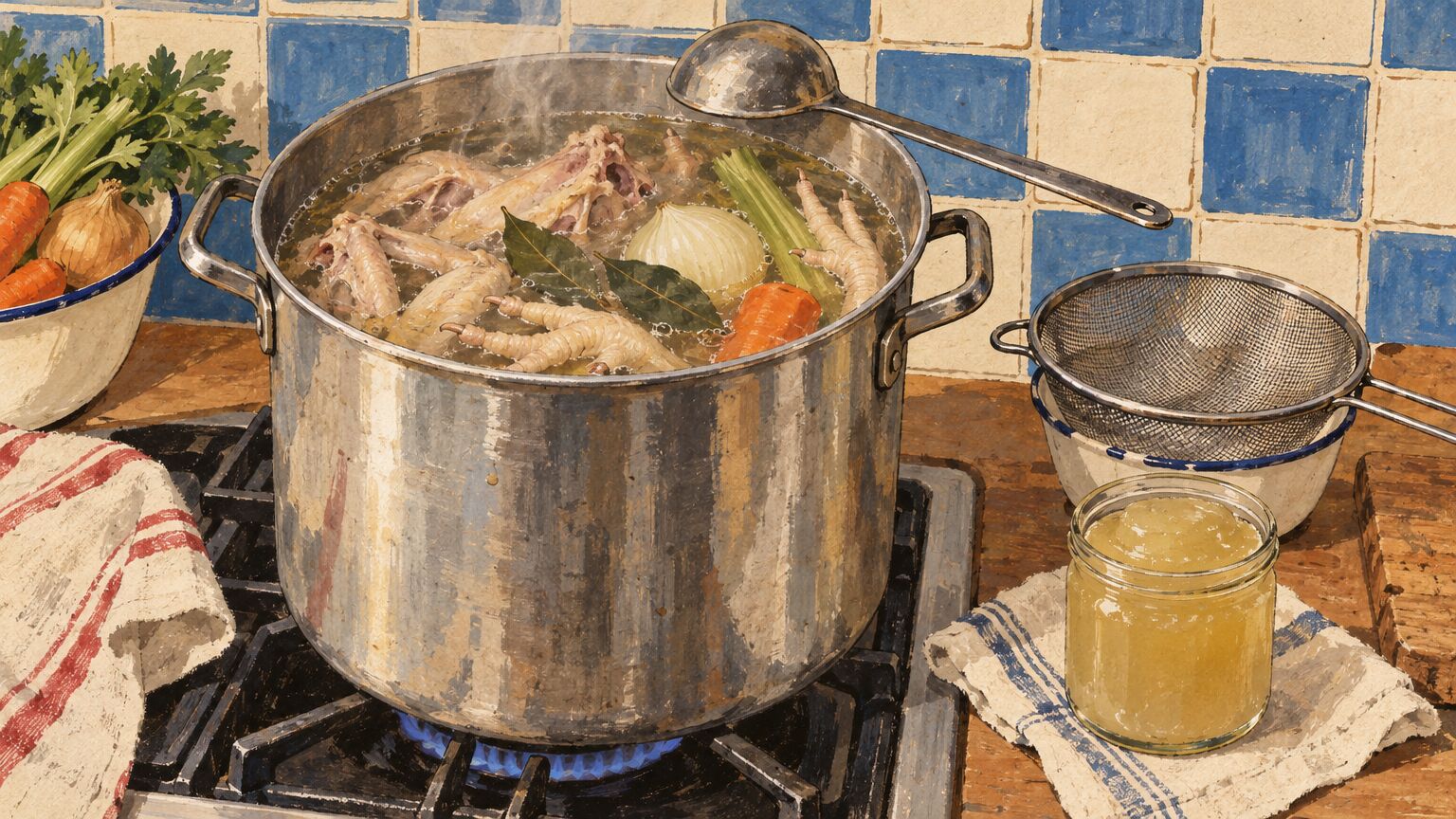
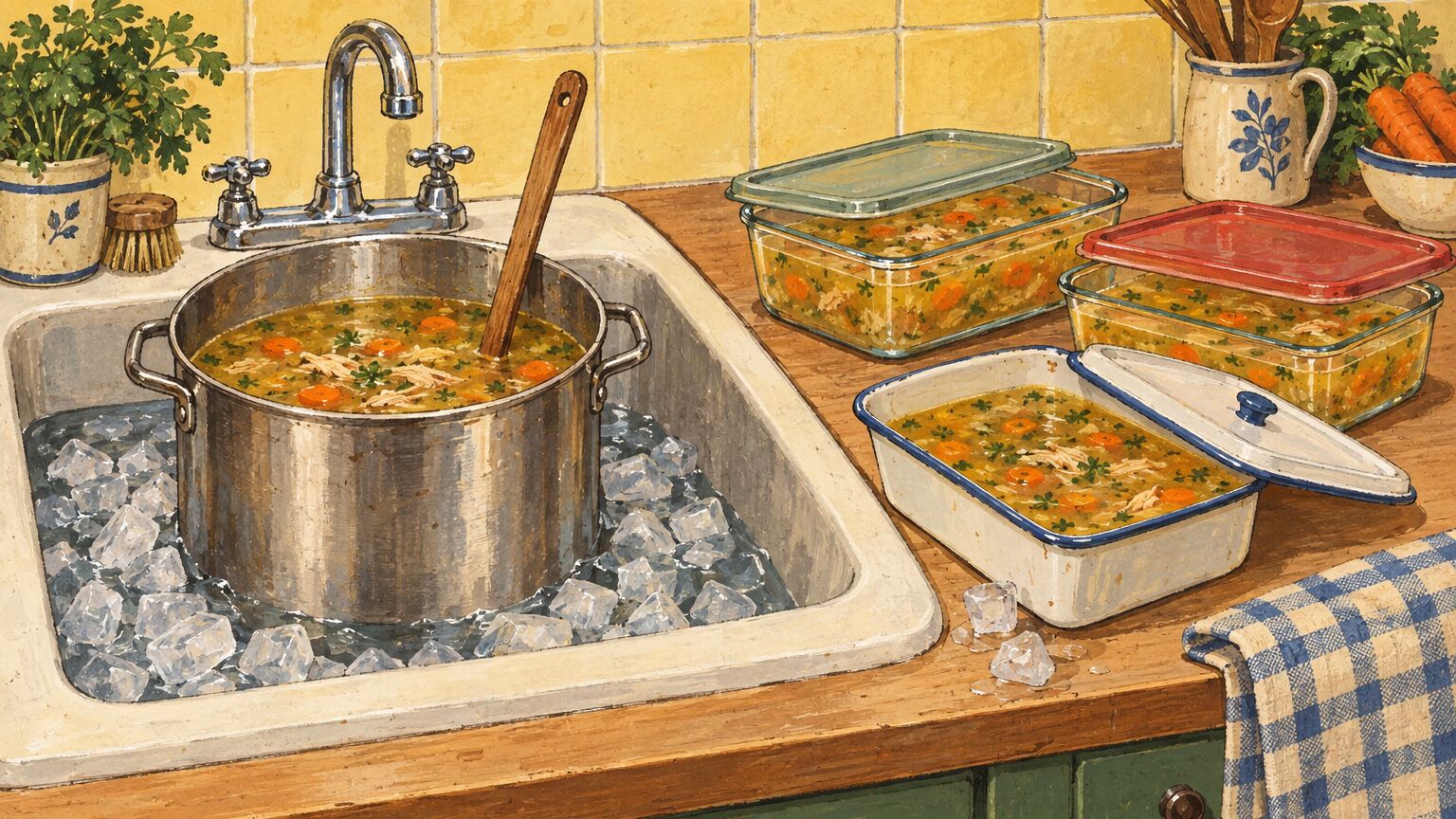
If the stew is going to be eaten another day, there is no hurry: tough stew meat goes on softening when it is back at a simmer. Get it into the fridge in containers 2 inches (5 cm) deep within 2 hours, as our answer on putting hot soup in the fridge explains. Then bring it back to a boil, which the USDA asks for with soups and gravies, before simmering it until tender.
Which cuts make tough or dry stew
A chuck-eye roast, from the shoulder, is the cut to use. When Cook's Illustrated developed its beef stew, it found tenderloin, strip and rib eye "turned mealy with prolonged cooking," and hanger and skirt steak were stringy. Blade steaks and short ribs "worked well" but were no better than a chuck-eye roast, "one of the cheapest, beefiest cuts in the supermarket."
| Cut | Fat in the raw meat (USDA) | In a stew |
|---|---|---|
| Chuck-eye roast | 12.0 percent | The test kitchen's pick; tender in about 2 1/2 hours |
| Chuck short ribs, boneless | 19.0 percent | Worked well in Cook's Illustrated's tests, but no better than chuck-eye |
| Brisket, flat | 9.9 percent | Works, but needs about twice as long |
| Bottom round | 6.6 percent | Lean; America's Test Kitchen warns that round sold as stew meat turns out "dry and tough" |
| Top round | 3.8 percent | Among the leanest cuts; expect it to dry out |
| Eye of round | 3.7 percent | Among the leanest cuts; expect it to dry out |
| Packaged "stew meat" or "beef for stew" | Varies; USDA's sample of chuck for stew had 4.8 percent | A mix of pieces that cook at different rates |
Fat figures are USDA FoodData Central values for Choice beef, lean and fat trimmed to 0 inches of outside fat, raw, except the stew meat sample.
Round is not tough because it lacks collagen. A USDA study of 11 beef muscles found that most muscles from the chuck and the round held 5.9 to 9.0 mg of collagen per gram, against 2.7 to 4.5 mg in the tender loin muscles. What round lacks is fat. Fat marbled through the muscle improves juiciness and tenderness, as a review of intramuscular fat sums up, and a trimmed chuck-eye roast has about three times as much fat as top or eye of round. When both cuts have squeezed out their juice and their collagen has melted, the chuck-eye still has its seams of fat and the round has very little.
Packaged stew meat is a gamble. Cook's Illustrated found that "the jumble of scraggly bits and large chunks was impossible to cook evenly" and called it a nonstarter. America's Test Kitchen's Texas chili warns that a pack labeled "beef for stew" could be round or boneless shoulder roast, which it says will turn out dry and tough; so "chuck" on the label is not enough on its own. If some pieces in your pot are tender and others are still chewy, that mix is the likely reason. Buying a whole chuck-eye roast and cutting it into 1 1/2 inch (4 cm) pieces yourself solves it.
Why stew meat can be dry when it is sitting in liquid
Braising doesn't put water into meat; it takes water out. America's Test Kitchen sealed beef chuck in bags with broth and held them at 190°F (88°C), a typical braising temperature, for 90 minutes. The meat lost an average of 12.5 percent of its weight and the liquid in the bags increased: the juice moved out of the meat into the broth, not the other way. The test kitchen's explanation for why braised meat still seems moist is the melted collagen, which lubricates the fibers so the soft texture reads as moist.
That is also why stew meat can be overcooked. Past the point of tender, the fibers keep losing moisture and the softened connective tissue no longer holds them together. America's Test Kitchen's advice is to cook braises just until fork-tender, then stop. Its stew is done when the meat "offers little resistance when poked with fork" but is not yet falling apart. Overcooked meat can't be fixed, but it can be shredded into the sauce, where the gravy carries it.
Why stew meat is tough in a slow cooker
A slow cooker on low is a gentle heat source, and some are gentler than others. The USDA says slow cookers cook between 170 and 280°F (77 and 138°C), but the food in one can't get hotter than boiling, 212°F (100°C) at sea level. In 2025 America's Test Kitchen tested six slow cookers, heating 4 quarts (3.8 liters) of water in each for 12 hours on low and 6 on high. Five peaked between 190 and 202°F (88 and 94°C) on low and between 205 and 212°F (96 and 100°C) on high. The sixth reached only 162°F (72°C) on low and 195°F (91°C) on high; a pot roast cooked on low in it was still pink after 7 hours.
The test kitchen also found that slow cookers often reach the same final temperature on either setting, and that low just takes longer to get there. That is why a slow cooker recipe gives 9 to 10 hours on low or 6 to 7 on high for the same stew. If the beef is tough when the time is up, it needs more time at temperature: give it another hour on low, or switch to high.
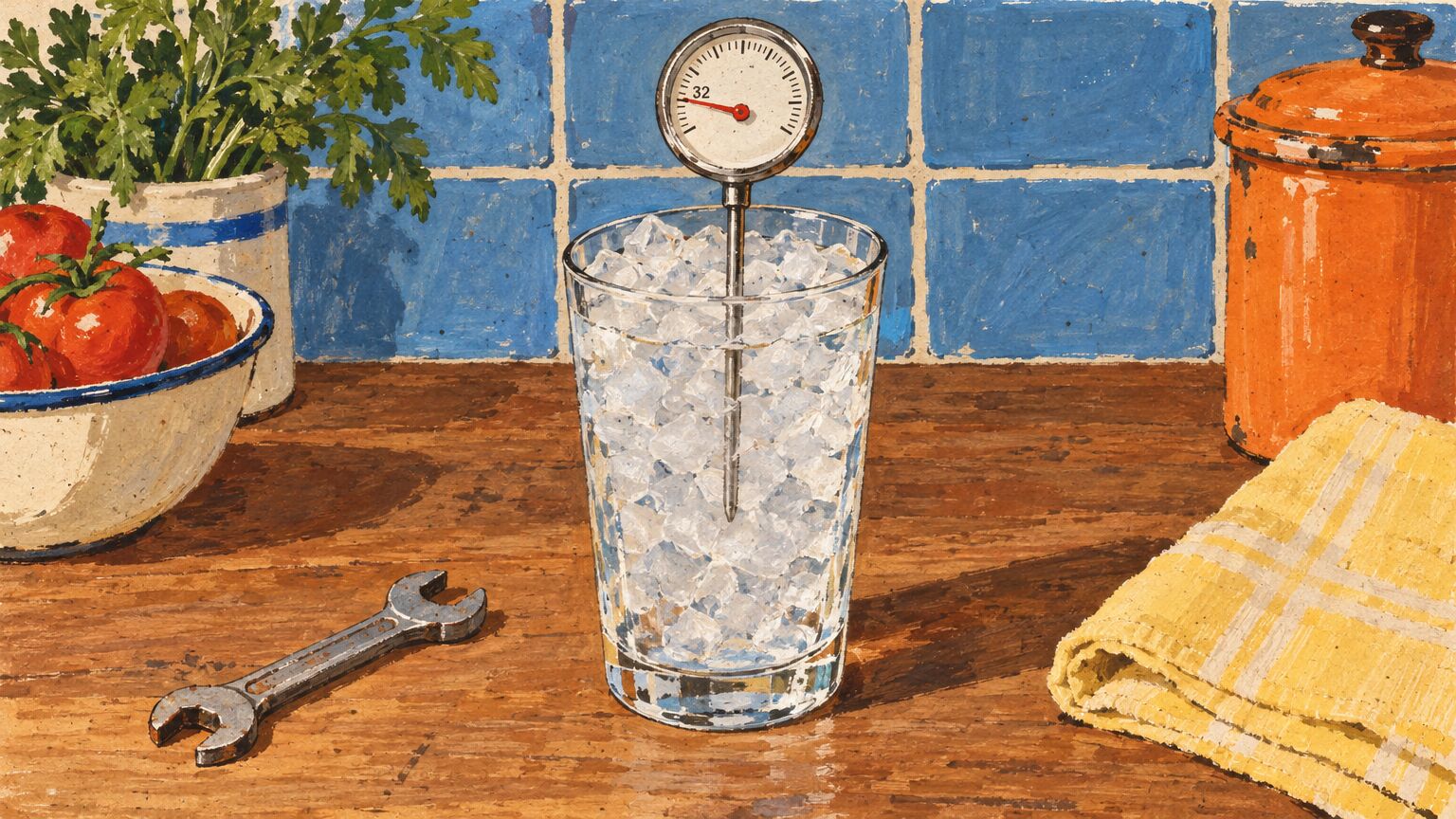
If a slow cooker always seems to undercook, test it the way Texas A&M AgriLife Extension describes. Fill it half to two-thirds with water, set it on low for 8 hours without lifting the lid, then read the water quickly with a thermometer you have checked in ice water. The water should be between 185 and 200°F (85 and 93°C). Below 185°F (85°C), the extension service says the cooker is not safe to use and should be replaced. The cooler model in America's Test Kitchen's test would have failed.
Why stew meat is tough in an Instant Pot
Tough beef from an Instant Pot almost always means too little time under pressure. The pot runs hotter than any simmer: Instant Pot gives its high pressure setting as 10.2 to 11.6 psi, with a working temperature of about 239 to 244°F (115 to 118°C). That heat melts collagen in minutes rather than hours, so a few minutes short is the difference between chewy and tender. America's Test Kitchen pressure-cooks 1 1/2 inch (4 cm) pieces of chuck-eye roast for 30 minutes, then releases the pressure at once.
Instant Pot itself advises against quick release for stews and other thick or fatty foods. If you let the pressure fall naturally instead, the stew stays above the boil while it does, so count those minutes as extra cooking. Bigger pieces, or a pack of mixed cuts, need longer.
A stovetop pressure cooker at 15 psi runs hotter still, about 250°F (121°C) by the University of California's pressure table, so expect it to need a little less time than an Instant Pot. The higher heat has the same trade as any hotter cook. In Palka and Daun's study of beef semitendinosus, cooking losses kept rising as the final temperature went up, all the way to 250°F (121°C), though most of the juice is gone by about 176°F (80°C).
Does boiling make stew meat tough?
Boiling is not what makes stew meat tough; too little time is. The common claim is that a hard boil tightens the meat and keeps the collagen from breaking down. The tightening is real, but it happens to stew meat at any cooking temperature: the fibers have shrunk and pushed out most of their juice by about 176°F (80°C), below a simmer. Across the range a stew cooks in, collagen melts faster at higher temperatures, not slower, as the Massey brisket figures above show: 8 hours to tender at 194°F (90°C) against 12 at 176°F (80°C), for 1.6 points more weight loss.
There are still good reasons to keep a stew at a simmer or in a 300°F (150°C) oven. A hard boil makes the liquid cloudy and greasy, as our guide to stock explains. A burner concentrates heat on the bottom of the pot, where a thickened stew can scorch. And a gentler cook gives more warning before the meat goes past tender. If your stew boiled and the meat is still chewy, it isn't ruined: turn it down to a simmer and keep cooking.