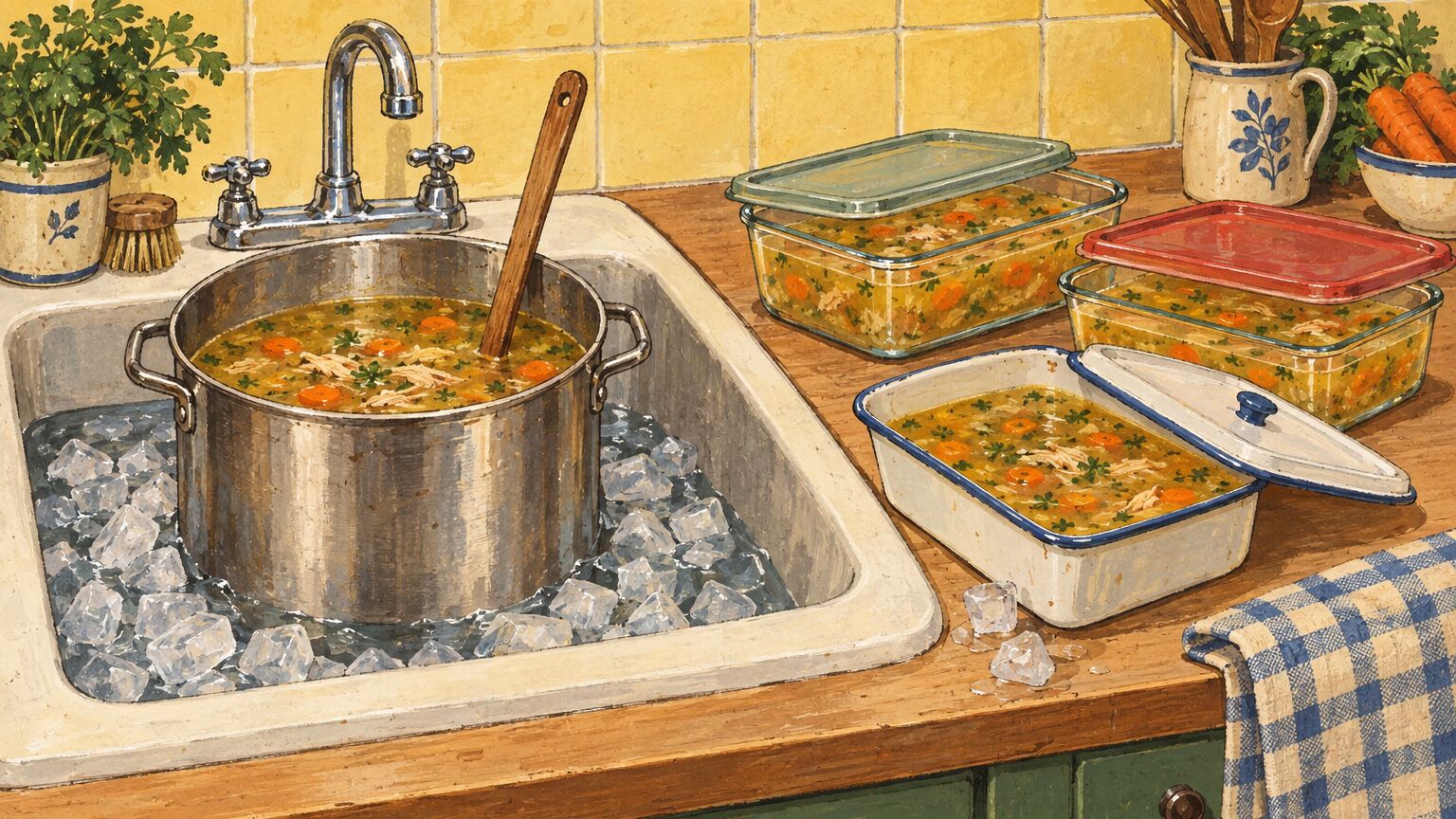
Yes, but not as a full pot: ladle the hot soup into containers 2 inches (5 cm) deep or less and get them into a 40°F (4°C) fridge within 2 hours of the heat going off. The USDA says hot food can be placed directly in the refrigerator, so there is nothing to gain by waiting on the counter first.
A full stockpot cools far too slowly to be safe, even in a fridge. In a study of chili cooled in a commercial walk-in refrigerator, a 3 gallon (11.4 liter) stockpot took more than 24 hours to cool. A pot that slow spends hours at the temperatures where bacteria grow fastest.
How to cool a pot of soup, step by step
- Start the clock when the burner goes off. The USDA wants leftovers refrigerated within 2 hours of cooking, or 1 hour if the room is above 90°F (32°C). Dinner and the washing up count against the 2 hours.
- Optional but fast: an ice bath. Plug the sink, set the pot in it and pack ice and cold water around it up to the level of the soup. Stir every few minutes and add ice as it melts. 6 quarts (5.7 liters) of soup need at least 10 pounds (4.5 kg) of ice to reach 70°F (21°C). No ice? Cold tap water does much of the work: by our calculation, about 5 gallons (19 liters) of 59°F (15°C) water around the pot, changed once, takes the soup to about 90°F (32°C) and then about 66°F (19°C).
- Portion it. Ladle the soup into containers so it sits 2 inches (5 cm) deep or less. Wide, flat containers beat tall ones.
- Refrigerate with the lids loose. Set the containers on the shelf with space around them, not stacked and not pressed against the milk. Close the lids once the soup is cold.
- Check the fridge. An appliance thermometer should read 40°F (4°C) or below, the USDA's number for home fridges (the restaurant Food Code uses 41°F (5°C)). Eat the soup within 3 to 4 days, or freeze it.
What if the soup sat out longer than 2 hours?
Throw it out. The USDA's rule is that perishable food should not be left out of refrigeration for more than 2 hours, or 1 hour above 90°F (32°C). Between 40°F and 140°F (4°C and 60°C), the USDA says, bacteria can double in number in as little as 20 minutes. A pot left on the stove overnight is well past both limits. The soup can look, smell and taste normal and still not be safe.
Why a full pot of soup is the problem
Soup loses heat through its surface, and the middle of a deep pot is a long way from any surface. Researchers at Kansas State University cooled chili in an ordinary commercial walk-in refrigerator at 39°F (4°C) and logged the temperature at the center. Their 2013 results show two things deciding the time: how deep the food is, and how cold the place it cools in.
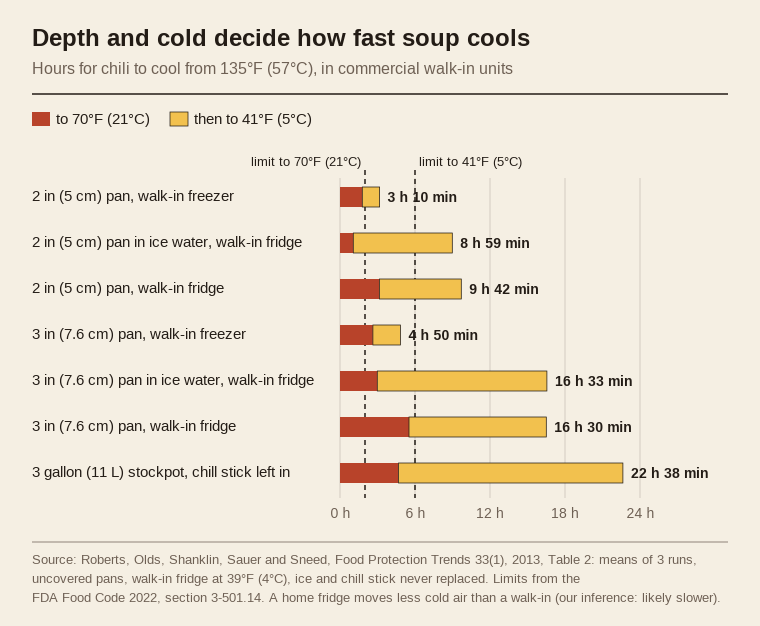
| Chili, cooled uncovered from 135°F (57°C) | To 70°F (21°C) | To 41°F (5°C) |
|---|---|---|
| 2 inch (5 cm) pan, walk-in freezer | 1 h 47 min | 3 h 10 min |
| 2 inch (5 cm) pan in ice water, walk-in fridge | 1 h 04 min | 8 h 59 min |
| 2 inch (5 cm) pan, walk-in fridge | 3 h 09 min | 9 h 42 min |
| 3 inch (7.6 cm) pan, walk-in freezer | 2 h 38 min | 4 h 50 min |
| 3 inch (7.6 cm) pan in ice water, walk-in fridge | 2 h 59 min | 16 h 33 min |
| 3 inch (7.6 cm) pan, walk-in fridge | 5 h 31 min | 16 h 30 min |
| 3 gallon (11.4 liter) stockpot, frozen chill stick left in | 4 h 41 min | 22 h 38 min |
| FDA Food Code limit for restaurants | 2 h | 6 h in total |
The slow times are not just about thick chili. The same study's meatless tomato sauce took 9 h 25 min to reach 41°F (5°C) at 2 inches (5 cm) in the walk-in fridge, and 14 h 16 min at 3 inches (7.6 cm).
Even the 2 inch (5 cm) pan in the walk-in fridge missed both Food Code limits, at 3 h 09 min and 9 h 42 min. A pot of soup at home belongs with the bottom rows of the table. The FDA explains why in its notes to the Food Code (Annex 3, page 117): commercial refrigeration "is designed to hold cold food temperatures, not cool large masses of food". A home fridge has less cold air moving through it than a walk-in, so it is unlikely to do better; that is our inference, not a measurement.
Depth is still the number a home cook can control, and 2 inches (5 cm) is the line. A separate analysis of 224 restaurant dishes measured by Minneapolis health inspectors found that food depth had a highly significant effect on cooling rate. Using predictive models of bacterial growth, its authors concluded that uncovered food cooled about 2 inches (5.1 cm) deep or less poses little risk of significant pathogen growth. That held even when it cooled more slowly than the Food Code's pace. A study by the CDC's Environmental Health Specialists Network found that food more than 3 inches (7.6 cm) deep was twice as likely to cool too slowly, and unventilated food almost twice as likely. Food that no one was actively watching was more than twice as likely to cool too slowly, which is the pot left on the stove while the cook goes to bed.
For scale: 4 liters (4.2 quarts) of soup sits about 5 inches (12.7 cm) deep in an 8 inch (20 cm) stockpot, as our guide to choosing a pot works out. A full quart deli container holds soup about 4 inches (10 cm) deep, twice the target. A 9 by 13 inch (23 by 33 cm) pan filled 2 inches (5 cm) deep holds about 4 quarts (3.8 liters).
Why the advice seems to contradict itself
The sources agree on the deadline, about 2 hours, and disagree on where the soup should spend it.
| Source | What it says | Its stated reason |
|---|---|---|
| USDA FSIS, for home cooks | Hot food can go directly in the fridge, or into an ice or cold water bath first. Divide a large pot of soup into small portions in shallow containers. Refrigerate within 2 hours. | A big pot of soup takes a long time to cool, which invites bacteria to multiply |
| FDA Food Code 2022, for restaurants | Cool from 135°F to 70°F (57°C to 21°C) in 2 hours. Reach 41°F (5°C) within 6 hours in all (section 3-501.14). | Slow cooling is a leading cause of foodborne illness |
| America's Test Kitchen (2021) | Cool soup on the stove or counter for about an hour, or to 75°F (24°C), then refrigerate it. | Hot food can warm the fridge, and the milk and meat in it, to unsafe levels |
| UK Food Standards Agency | "Don't place hot or warm food in your fridge." Cool it at room temperature and refrigerate it within 1 to 2 hours, divided into smaller portions. | None given on the page |
| Milk Street (2019) | Leave hot soup on a cooling rack for 2 hours, or speed it up with a frozen water bottle in the pot. | It cools "at about the same rate" and won't warm the fridge |
None of them tells you to leave a pot out for longer than about 2 hours. The difference is whether the first stretch happens on the counter or on a fridge shelf, and that matters less than how the soup is divided.
A short wait on the counter costs little while the soup is very hot. The bacteria that cause trouble in cooling food grow best between about 70 and 125°F (21 and 52°C), according to the Food Code's notes on cooling (Annex 3, page 113). Soup just off a simmer is well above that range. The danger is the long, slow middle of the cooling curve, and a full pot spends hours there wherever it sits.
That is also why "until it reaches 75°F (24°C)" is not something a full pot can do in an hour. In the Kansas State study, chili just 3 inches (7.6 cm) deep, sitting in ice water inside a walk-in fridge, took almost 3 hours to fall from 135°F to 70°F (57°C to 21°C). On a counter, a pot cools more and more slowly as it nears room temperature, and 75°F (24°C) is inside the band where bacteria grow best. Waiting on the counter gains nothing: portion the soup while it is hot and put it straight in.
Will hot soup warm up the rest of the fridge?
Yes, a little, and the worry behind the counter advice is real. 6 quarts (5.7 liters) of soup cooling from 200°F to 40°F (93°C to 4°C) gives up about 2,100 kilojoules of heat. That is as much heat as a 100 watt incandescent bulb gives off in about 6 hours, and the fridge has to pump all of it out.
Two things keep that heat from becoming a problem for the food around it:
- Take most of the heat out in the sink. Cooling the soup from 200°F to 70°F (93°C to 21°C) in an ice bath removes about 80 percent of its heat before it reaches the fridge.
- Give the containers room. Spread them out with air around them, away from milk and raw meat, and check that the fridge thermometer is back to 40°F (4°C) or below within a few hours.
What doesn't work is the compromise most kitchens actually use: leaving the pot on the stove until bedtime, then putting the whole pot in the fridge. That combines the counter's lost hours with the stockpot's slow cooling.
How to cool soup quickly: what works and what doesn't
Each method below is listed in the Food Code's section 3-501.15 except the frozen bottle, which is a home version of a chill stick. The quantities are Soup Letters' calculations for 6 quarts (5.7 liters) of soup starting at 200°F (93°C), treating the soup as water and ignoring heat lost to the room.
| Method | What it does | Notes |
|---|---|---|
| Shallow containers, 2 inches (5 cm) or less | The single biggest factor in every study above | A 9 by 13 inch (23 by 33 cm) pan holds about 4 quarts (3.8 liters) at that depth |
| Ice bath in the sink, stirred | Fast for the first stage. At least 10 pounds (4.5 kg) of ice takes 6 quarts to 70°F (21°C). | Top up the ice. The 2013 study's ice baths, never topped up, missed the 6 hour limit. |
| Adding ice to the pot | Hold back a third of the water and add it as ice. The pot drops from 200°F to about 90°F (93°C to 32°C), still warm enough for bacteria, so keep cooling. | Suits stock, where you choose the water. For 6 quarts, that is 4.2 pounds (1.9 kg) of ice. |
| One frozen 1 liter water bottle | Holds about 2 pounds (0.9 kg) of ice. That takes 6 quarts from 200°F to only about 155°F (93°C to 68°C). | 4 bottles hold enough cold for about 73°F (23°C), if they fit. |
| Lids loose or off while cooling | The Food Code asks for loose lids or none while food cools, so heat can leave the surface. | Covered food was among the slow coolers in the 2024 analysis. Close the lids once cold. |
| A walk-in or home freezer | The only method that met both Food Code limits in the 2013 study, at 2 inches (5 cm) deep | Use it only if there is room for the containers to stand apart |
A chill stick works when someone works it. In an earlier study by the same group, a frozen chill stick cut a stockpot's cooling time by about 18 hours. In the 2013 study, the stick was left in the pot unstirred and never replaced. It sped up the first hours, then sat there as a container of warm water once its ice had melted, and the pot took 22 h 38 min to reach 41°F (5°C). The authors recommended stirring with the stick and swapping in a fresh one once the ice melts.
Why it matters most at Thanksgiving
The usual culprit in a slowly cooling pot is Clostridium perfringens, whose spores survive cooking and multiply as a big batch cools. The CDC says its outbreaks happen most often in November and December, many linked to holiday foods such as turkey. Gravy, leftover soup and stock from the turkey carcass are the big pots of the weekend; our guide to making stock covers the rest of the batch. For the gravy itself, our answer on how much flour to thicken gravy gives the amounts, and how long Thanksgiving leftovers last goes through the rest of the fridge dish by dish.
How long cooled soup keeps
The USDA gives leftovers 3 to 4 days in the fridge at 40°F (4°C) or below. Plain stock and broth keep for less: the FDA's refrigerator storage chart gives gravy and meat broth 1 to 2 days, against 3 to 4 for soups and stews. The UK Food Standards Agency is stricter for all leftovers, at 2 days. Freeze whatever you won't eat in that time. The USDA says to reheat soups, sauces and gravies to a rolling boil; our answer on what temperature is a simmer shows how to tell a boil from a simmer.