Most home kitchens need two pots. The first is a 5.5 to 7 quart (5.2 to 6.6 liter) enameled cast iron Dutch oven for braises, soups and stews. The second is a 2 to 3 quart (1.9 to 2.8 liter) stainless steel saucepan with an aluminum or copper core for grains, sauces and small batches. Add an 8 to 12 quart (7.6 to 11.4 liter) stockpot only if you make stock or cook pasta for a crowd. A pot's material decides how evenly it heats, its size decides what fits, and its shape decides how fast liquid reduces.
The short version
| Pot | Size | Best material | What it is for |
|---|---|---|---|
| Dutch oven | 5.5 to 7 qt (5.2 to 6.6 L) | Enameled cast iron | Braising, stews, soups, bread, oven cooking |
| Saucepan | 2 to 3 qt (1.9 to 2.8 L) | Fully clad stainless steel | Rice, grains, sauces, custards, reheating |
| Stockpot | 8 to 12 qt (7.6 to 11.4 L) | Stainless steel with a thick base | Stock from a whole chicken, pasta for 6 or more |
If you cook on induction, every pot on this list must pass the magnet test described below. If a pot you already own does the job, keep it: none of these choices is worth replacing working cookware for.
What the metal does
Two properties matter. Conductivity is how fast heat spreads sideways through the base, which decides whether the middle scorches while the edges stay cool. Heat capacity is how much heat the pot stores, which decides how much it cools when cold food goes in. No single metal is best at both, which is why good pots combine them.
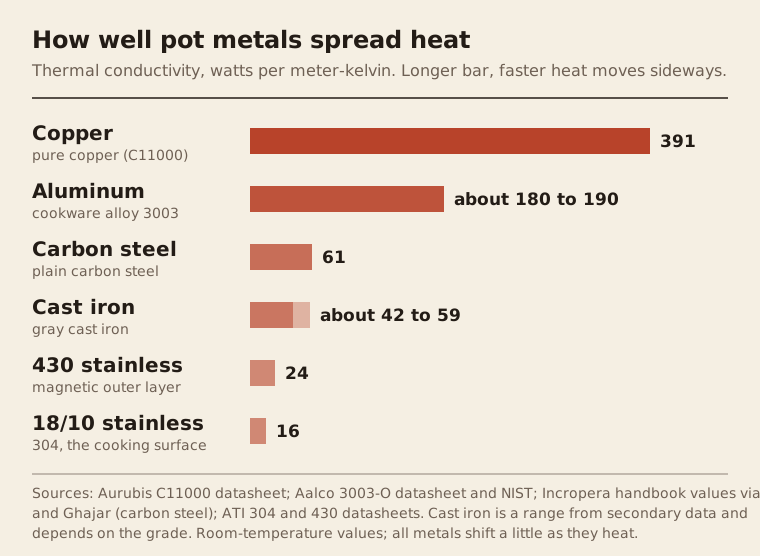
| Metal | Conductivity (W/m·K) | Spreads heat | Stores heat per pound | Reacts with acid | Works on induction |
|---|---|---|---|---|---|
| Copper | 391 | Best | Low | Yes, must be lined | No |
| Aluminum (alloy 3003) | about 180 to 190 | Very good | High | Yes, unless anodized or clad | No |
| Carbon steel | 61 | Fair | Low | Yes, until seasoned | Yes |
| Cast iron | about 42 to 59 | Poor | Low, but pots are heavy | Yes, when bare | Yes |
| 18/10 stainless steel | 16 | Very poor | Low | Barely | Not on its own |
The figures come from the Aurubis C11000 copper datasheet, the Aalco 3003 aluminum datasheet, Çengel and Ghajar's property tables (from Incropera), and the ATI 304 and 430 stainless datasheets. Cast iron varies with its grade and graphite structure, as Tupy's foundry research shows, so treat its range as approximate.
Three things follow from the chart:
- Stainless steel is a poor conductor. At about 16 W/m·K, the 18/10 steel that touches your food spreads heat roughly 25 times slower than copper. A stainless pot heats evenly only because of an aluminum or copper layer inside it.
- Cast iron spreads heat poorly but holds a lot of it. Its conductivity is a fraction of aluminum's. It earns its reputation for steady heat through sheer mass: a pot that weighs 13 pounds stores far more heat than a 4 pound one.
- Aluminum is the workhorse core. The often quoted 237 W/m·K is pure aluminum. Cookware alloys run closer to 180 to 190 W/m·K, still more than 10 times stainless steel, at a fraction of copper's price and weight.
Why a heavy pot matters less once it is full
A heavy pot stores heat, but water stores far more. Lodge lists its 6 quart enameled Dutch oven at 13.52 pounds (6.13 kg). Using a heat capacity for iron of about 450 J/kg·K, that pot takes about 2.8 kJ to warm by one degree Celsius. The 5.7 liters (6 quarts) of water or stock it holds takes about 24 kJ, roughly 9 times as much.
So once a pot is full of liquid, the liquid sets the pace and the pot's mass barely matters. Mass matters when the pot is nearly empty: searing meat, frying aromatics, or baking bread, where a preheated heavy pot keeps its surface hot when cold food lands on it. This is why the Dutch oven is the one pot where heavy cast iron earns its weight.
Fully clad or disc base
Stainless pots get their aluminum or copper core in one of two ways:
- Fully clad (sold as tri-ply, 5-ply and so on): the conductive layer runs through the base and up the walls.
- Disc base (also called encapsulated or impact-bonded): a thick conductive disc is fixed under the pot, and the walls are plain stainless steel.
A disc can be thicker than a clad layer, so the base can heat just as evenly. The walls are the difference. On a disc pot they are single-layer stainless at about 16 W/m·K, so they barely carry heat. Sauce that climbs the wall or sits where the disc ends can scorch, and a reduction cooks unevenly. For water, stock and pasta, where the liquid moves the heat around, it makes little difference.
No independent, published measurement compares the two designs in real pots, so this is an inference from the conductivity figures above. The practical rule: buy fully clad for a saucepan, where sauces and custards touch the walls, and accept a good disc base on a stockpot, where it saves money and weight.
Induction and the magnet test
Induction cooktops heat the pot itself with a fast-changing magnetic field. The EPRI's study of induction cooking explains that the coils switch between 25 and 50 kHz, a range that only couples with ferromagnetic cookware: cast iron, carbon steel and magnetic stainless steel. Copper, aluminum and nonmagnetic stainless steel do not heat.
That catches out a common label. "18/10 stainless" describes the steel that touches your food, and 18/10 steel is essentially nonmagnetic: ATI gives its magnetic permeability as about 1.005 in the annealed state, almost the same as air. Bending and drawing it into a pot shape can make it faintly magnetic, which is why a magnet may cling weakly to an 18/10 pot that still won't heat. A clad pot works on induction only if its outer layer or base is a magnetic steel, usually a 430 grade.
The test is simple. Put a fridge magnet on the outside of the base. Westinghouse's induction guidance says the pot is suitable if "a magnet pulls onto the bottom of the cookware". If it holds weakly, or only in the center, the pot has a small magnetic insert and will heat more slowly or only in the middle. Enameled cast iron always passes.
Induction is not always the most efficient way to heat a pot. In the EPRI tests, induction delivered about 75 to 78 percent of its energy to the water. An electric coil reached 83 percent with a large pot that matched the coil, but fell to about 42 percent with a small saucepan. Gas delivered about 30 to 42 percent, though EPRI tested it in a colder room, so that figure isn't directly comparable. Induction's real advantage is that it stays efficient whatever the pot size.
Which metals react with food
| Material | With acidic or salty food | What the source says |
|---|---|---|
| Bare aluminum | Avoid long contact | Health Canada: don't use aluminum cookware for foods high in acid or salt |
| Anodized aluminum | Fine while intact | Health Canada: anodizing reduces the transfer of aluminum; don't use it once scratched or worn |
| Bare copper | Never | FDA Food Code: copper may not touch food with a pH below 6, such as vinegar, fruit juice or wine |
| Lined copper | Fine | Health Canada: copper cookware sold in Canada is generally coated; don't use it if the coating is scratched |
| Bare cast iron | Short cooking only | Health Canada: don't cook or store acidic foods in it for long periods |
| Enameled cast iron | Fine | The glass enamel separates the food from the iron |
| Stainless steel | Fine for almost everyone | Releases small amounts of nickel and chromium into acidic food, mostly when new |
Aluminum migration is real but depends on time and acid. Germany's Federal Institute for Risk Assessment found that uncoated aluminum trays holding sauerkraut juice, apple sauce and tomatoes, kept warm for 2 hours, released aluminum far above the Council of Europe's guideline release limit of 5 mg per kg of food. Boiling pasta water in an aluminum pot is a different situation from holding tomato sauce in one for an afternoon.
Stainless steel is not perfectly inert. A 2013 Oregon State University study cooked tomato sauce at 185°F (85°C) in a new stainless saucepan for 20 hours and found the nickel in the sauce reached 3.84 mg per kg. In repeated tests, the release fell over the first several cooking sessions and then leveled off. The authors suggest that people with nickel or chromium sensitivity may want to avoid stainless for long acidic cooking. For everyone else, it remains the standard safe surface.
One small stainless detail from Health Canada: add salt only after water boils, which avoids the small pits undissolved salt can etch into the base.
What size to buy
- Dutch oven: Lodge's rule is to allot at least a 1 quart (about 1 liter) serving per person. That makes 5.5 to 7 quarts (5.2 to 6.6 liters) right for 2 to 6 people, with room to brown meat in batches. Above 7 quarts, weight becomes the limit: Lodge lists its bare cast iron 7 quart Dutch oven at 18.1 pounds (8.2 kg) empty, before any food.
- Saucepan: 2 to 3 quarts (1.9 to 2.8 liters) cooks a cup or two of rice or a pint of sauce without scorching a thin layer. A second, smaller 1 to 1.5 quart (0.9 to 1.4 liter) pan is useful for melting butter and warming milk, but not essential.
- Stockpot: for stock from a whole 4 pound (1.8 kg) chicken, buy at least 8 quarts (7.6 liters). The bird takes up about 2 quarts (1.9 liters), it needs 3 to 4 quarts (2.8 to 3.8 liters) of water to cover it, and the pot needs headroom for simmering and skimming. 10 to 12 quarts (9.5 to 11.4 liters) suits bigger birds or a full batch of bones, but a full 12 quart pot holds about 25 pounds (11.4 kg) of water before you add the pot. This is a calculation, not a test. A stockpot mostly boils water, so an inexpensive one with a thick base does the job.
A bigger pot also takes longer to heat. These are the minimum times to bring water from 68°F to 212°F (20°C to 100°C), ignoring the pot itself and any heat lost from the surface:
| Water | Energy needed | 1.5 kW reaching the water | 2.25 kW reaching the water |
|---|---|---|---|
| 4 L (4.2 qt) | 1,340 kJ | 15 minutes | 10 minutes |
| 6 L (6.3 qt) | 2,010 kJ | 22 minutes | 15 minutes |
| 8 L (8.5 qt) | 2,680 kJ | 30 minutes | 20 minutes |
The two columns are roughly a 2 kW and a 3 kW induction zone at the 75 percent efficiency EPRI measured. Heating a 2 to 3 kg (4.4 to 6.6 pound) stainless pot adds another 3 to 9 percent. A lid helps once the water is hot, because it cuts the heat carried away by steam. Fill a stockpot only as far as the recipe needs.
Wide or tall
For a straight-sided pot, the liquid's surface area divided by its volume equals 1 divided by its depth. In plain terms: the shallower the liquid, the faster it evaporates for its volume. 4 liters (4.2 quarts) of stock sits about 5 inches (12.7 cm) deep in an 8 inch (20 cm) stockpot, with about 49 square inches (314 cm²) of surface. The same stock in an 11 inch (28 cm) sauté pan sits about 2.6 inches (6.5 cm) deep with about 95 square inches (616 cm²) of surface, almost twice as much.
That holds at a gentle simmer, where evaporation happens at the surface. At a hard boil, the burner's power sets the evaporation rate more than the pot's shape does.
- Tall and narrow keeps liquid in, which is what you want for a long simmer like stock.
- Wide and shallow reduces sauces faster and browns meat without crowding.
- Match the base to the burner. On induction especially, a pot narrower than the zone gets only part of its power.
Oven and dishwasher limits
On enameled cast iron, the knob, lid or handle usually sets the oven limit, not the pot. Check the maker's rating for yours before a hot oven.
| Pot | Oven limit | Dishwasher | Source |
|---|---|---|---|
| Staub enameled cast iron | 482°F (250°C), which Staub rounds to 500°F; 428°F (220°C) with a glass lid; not oven safe with wooden handles, and check silicone-handled models | Not recommended for regular use | Staub care guide |
| Lodge enameled cast iron | 500°F (260°C) | Allowed, but Lodge prefers hand washing | Lodge enamel care |
| Seasoned cast iron | High | Never: it strips the seasoning and causes rust | Lodge cleaning guide |
| Nonstick (PTFE) | Under 500°F (260°C) | Check the maker | Health Canada |
| Wooden handles | Not oven safe | No | Staub care guide |
Both Staub and Lodge warn against thermal shock: heat enameled cast iron gradually on low to medium heat, never heat it empty, and don't run cold water over a hot pot, which can crack the enamel.
Do pots need to be nonstick?
Rarely. Soups, stocks, braises and boiled grains don't need a nonstick surface, and a nonstick coating limits how hot you can take a pot. Nonstick earns its place on a skillet for eggs, not on a stockpot.
If you buy one anyway, know what the labels mean. PTFE, the classic nonstick coating, is itself a PFAS, as Health Canada notes. PFOA, the chemical once used to make it, was eliminated from US production by 2015 under the EPA's stewardship program, so "PFOA-free" describes essentially all PTFE pans sold in the US. Ceramic (sol-gel) coatings avoid PTFE, but a 2022 comparison found they release food less well and wear faster. Keep any nonstick pot under 500°F (260°C) and don't preheat it empty.
Common claims that are wrong
- "Stainless steel heats evenly." It doesn't. The aluminum or copper core does the work; the stainless is there for durability and an inert surface.
- "18/10 stainless works on induction." Only if the base has a magnetic layer. Use the magnet test.
- "Heavier is always better." Mass helps searing and baking. For anything full of liquid, the liquid's heat capacity dwarfs the pot's, and a heavy pot is just harder to lift.
- "Cast iron heats evenly." It heats slowly and holds heat well. On a burner smaller than the pot, the middle gets hotter first.
- "Copper is best for everything." Copper is the most responsive metal, but it must be lined, it doesn't work on induction, and for stock or pasta water its speed makes no difference.
- "PFOA-free means chemical-free." PTFE is still a PFAS. "PFOA-free" is true of essentially all PTFE pans sold in the US.
How to check a pot in the shop
- Magnet on the base, if you cook on induction. It should pull firmly across the whole base.
- Look at the rim. On a fully clad pot you can see the layers at the cut edge. A disc pot shows a separate disc under the base and a plain wall.
- Lift it with one hand, then imagine it holding 6 quarts (5.7 liters) of stew, which adds about 13 pounds (6 kg).
- Read the knob and handle ratings for the oven, and whether the maker allows the dishwasher.
- Check the base diameter against your largest burner or induction zone.