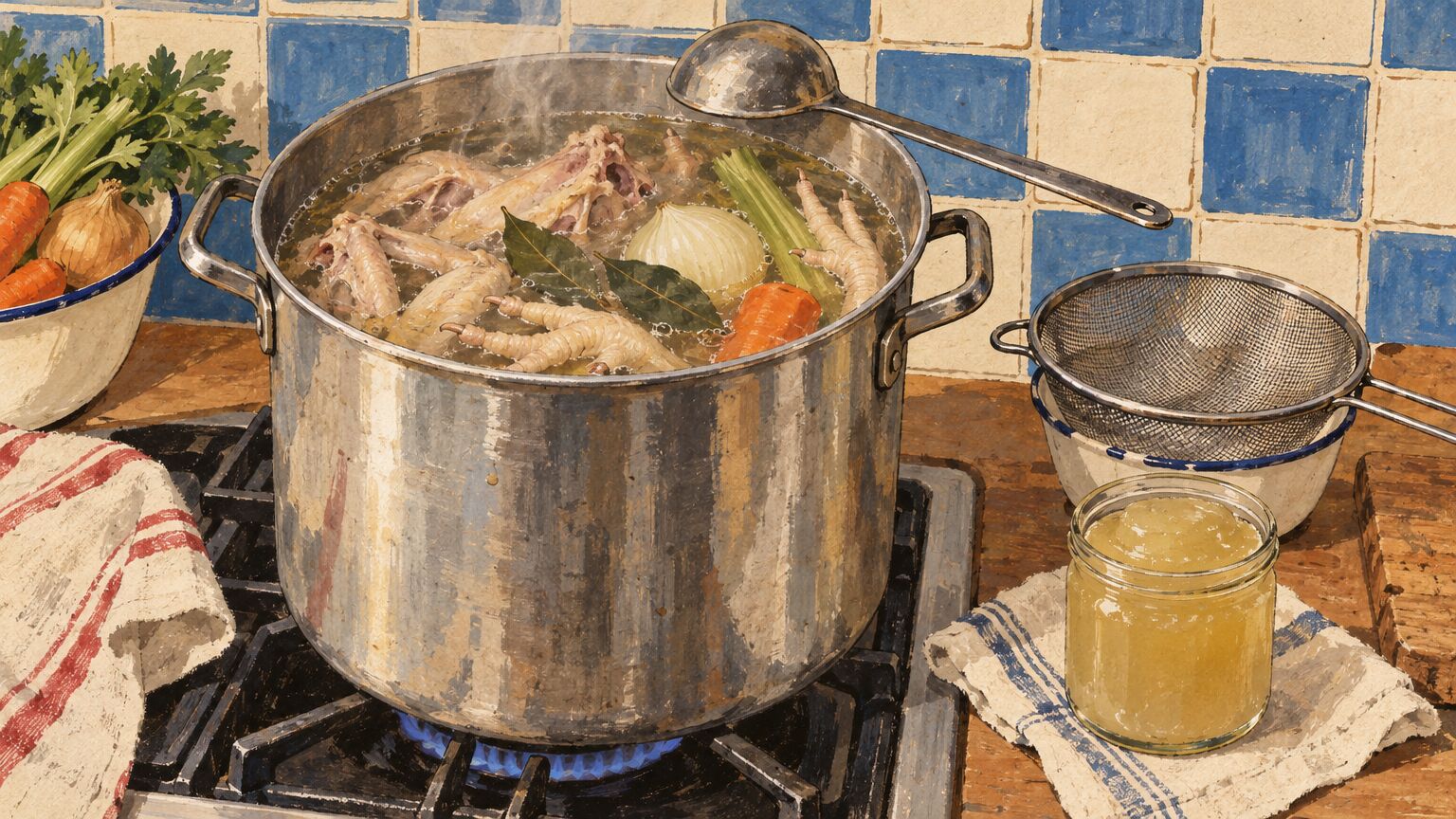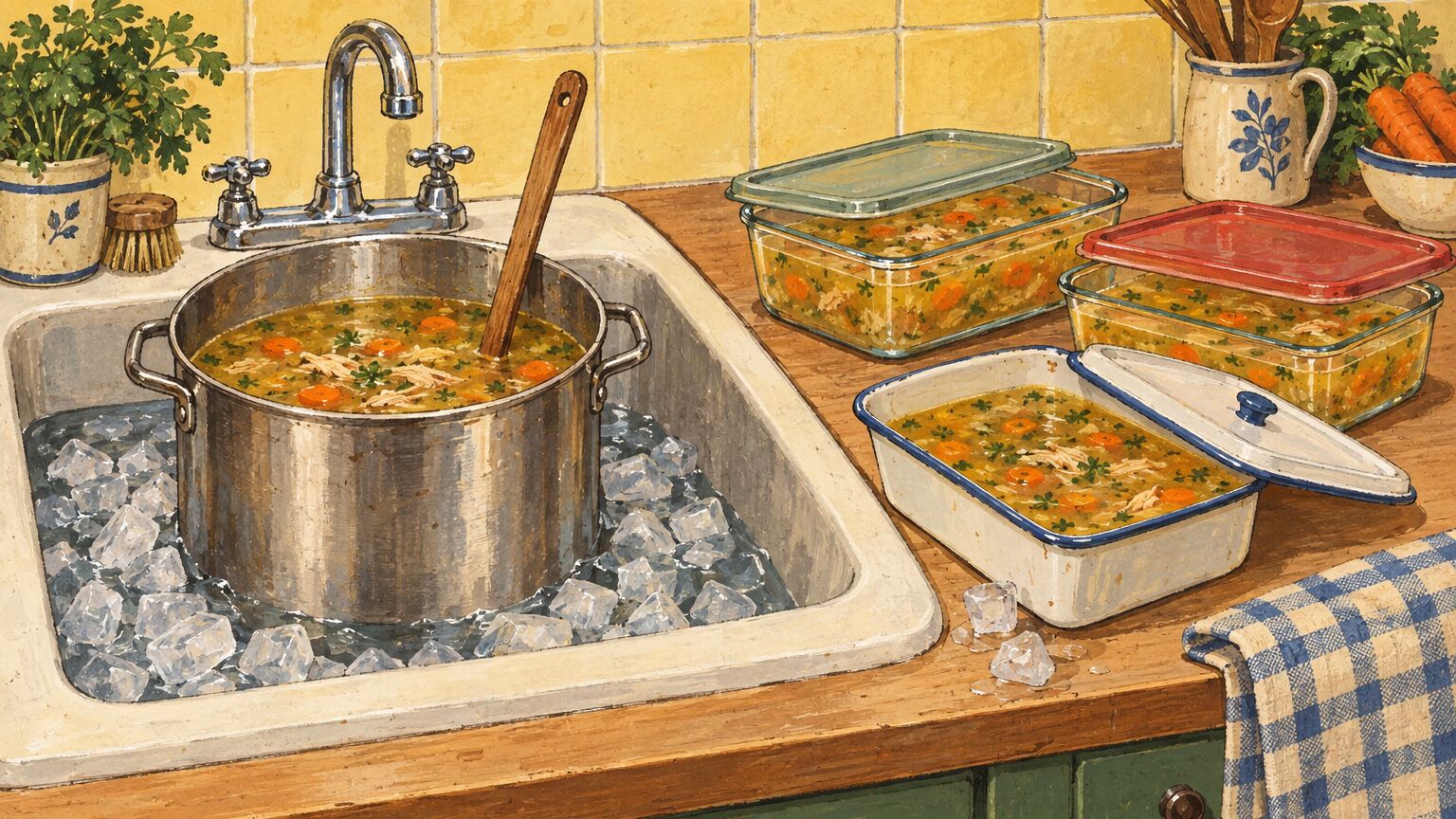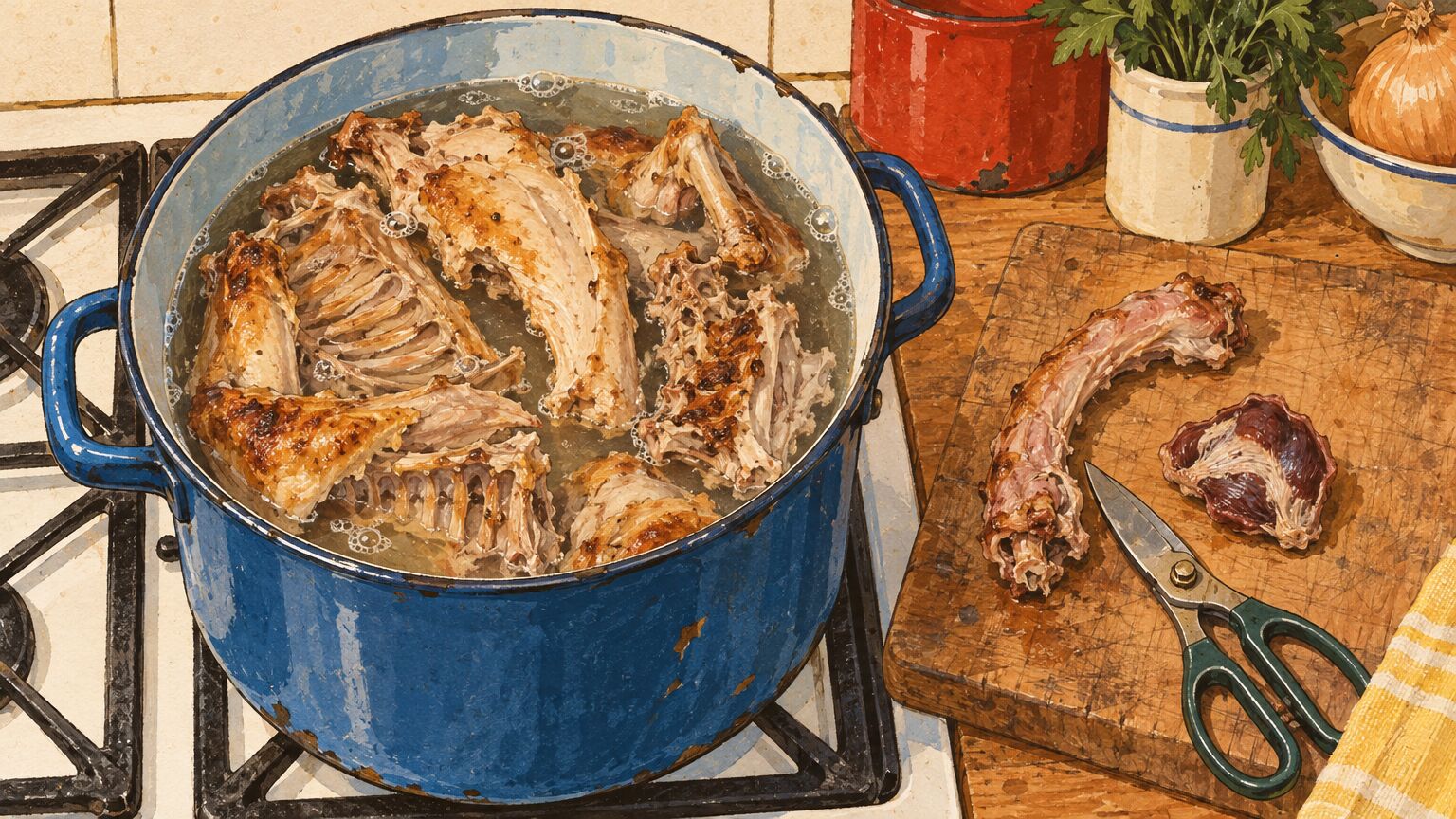
Cut the carcass into 10 to 12 pieces and pack them into a pot. For a 12 to 14 pound (5.4 to 6.4 kg) turkey, add about 10 cups (2.4 liters) of cold water and simmer it gently, covered, for 2 to 4 hours. Strain it, cool it fast and refrigerate it. Don't salt the pot; season the soup or gravy you make from it. If the carcass sat out for more than 2 hours (1 hour above 90°F (32°C)), including overnight, throw it away: boiling won't make it safe.
Turkey carcass stock at a glance
| Step | What to do |
|---|---|
| Carcass | From a 12 to 14 lb (5.4 to 6.4 kg) turkey: about 4 lb (1.8 kg) of bones with some meat and skin left on |
| Cut | 10 to 12 pieces: wings at the joints, breastbone off the backbone, backbone in 3 or 4 |
| Extras | Neck, gizzard and heart, and any leg and thigh bones from the table; leave out the liver |
| Water | 10 cups (2.4 liters), cold, enough to cover the packed pieces |
| Stovetop | Bring to a boil, then a bare simmer, covered, for 2 hours; up to 4 hours for a deeper flavor |
| Pressure cooker | About 1½ hours at high pressure, then a natural release, filled no higher than the 2/3 line |
| Yield | About 8 cups (1.9 liters) |
| Salt | None in the pot; season the soup or gravy you make with it |
| Keeps | Use within 1 to 2 days from the fridge, or freeze it |
The quantities come from America's Test Kitchen's Simple Turkey Stock, which uses nothing but the carcass and water. Onion, carrot, celery and herbs are optional; the stock is still turkey stock without them. For the general rules that apply to every stock (ratios, gel, skimming, how long is too long), see the guide to making stock.
Can you make stock from a turkey carcass left out overnight?
No. Throw it away. The USDA says to discard perishable food left at room temperature for more than 2 hours, or 1 hour above 90°F (32°C). A cooked carcass with meat and skin on it is perishable food (USDA FSIS, Leftovers and Food Safety). The USDA counts the 2 hours from the end of cooking, so dinner, carving and clearing up all count. Penn State Extension says to discard any turkey, stuffing and gravy left out longer than two hours.
Boiling the carcass for hours doesn't rescue it. Boiling kills bacteria, but some bacteria leave behind a toxin that boiling can't destroy. The FDA's Bad Bug Book, the agency's handbook of foodborne germs, names two that fit a turkey carcass:
| Germ | Why it fits a turkey carcass | What boiling does |
|---|---|---|
| Staphylococcus aureus | Carried by half or more of healthy people; the FDA says foods that take "considerable handling" are often involved | Kills the cells, but their toxin is "highly heat stable" |
| Bacillus cereus | Its vomiting toxin is linked mainly to rice and other starchy foods, such as stuffing left in the cavity | The toxin survives 30 minutes at 250°F (121°C), hotter than a boiling pot |
Staph is the one to think about. A carcass has been carved, pulled apart and picked over by hand, and then sat in the warm kitchen, which is the pattern the FDA describes. Smelling it tells you nothing: pathogens "do not generally affect the taste, smell, or appearance of a food," the USDA says (Refrigeration & Food Safety). Some cooks make stock from a carcass that sat out and are fine; that is luck, not a method.
A cold garage, porch or car trunk isn't a fridge. The USDA advises against keeping perishable food outside in winter, because "outside temperatures can vary" and animals can reach it (Keeping Food Safe During an Emergency). The sun can thaw frozen food even when the air is very cold (Freezing and Food Safety). Unless you know the spot stayed at 40°F (4°C) or below all night, treat the carcass as left out.
How long a turkey carcass keeps before you make stock
A carcass that went into the fridge within 2 hours keeps 3 to 4 days, the same as other cooked turkey (Penn State Extension; FoodSafety.gov cold storage chart). Count the stock's own fridge life from the day you make it, not from Thanksgiving. Frozen at 0°F (−18°C), it stays safe indefinitely, and the freezer times on the USDA chart, 2 to 6 months for cooked poultry, are for quality only. So if Friday is already full, freeze the carcass and make the stock in December; it goes into the pot straight from frozen.
Three things help the carcass cool fast and fit the fridge:
- Take the stuffing out first. Penn State says stuffing must come out of the carcass before it is refrigerated or frozen, because its moisture and density keep it warm and help bacteria grow.
- Pick off the meat you want to eat, and refrigerate it separately in shallow containers. Leave some meat and skin on the bones: America's Test Kitchen says the stock tastes fuller with some still attached.
- Cut the carcass up now, not tomorrow. The pieces cool faster, fit in a bag and go straight into the pot.
How much water a turkey carcass needs
Use just enough cold water to cover the pieces, about 2½ cups per pound of bones (about 1.3 liters per kg). That is America's Test Kitchen's ratio. Its recipe puts about 4 pounds (1.8 kg) of bones from a 12 to 14 pound (5.4 to 6.4 kg) bird in 10 cups (2.4 liters) of water, for about 8 cups (1.9 liters) of stock.
Cutting the carcass small is what makes that little water enough. A whole frame is mostly air: in ATK's older Basic Turkey Stock, the same size carcass in 4 or 5 rough pieces takes 4½ quarts (4.3 liters) of water in a 12 quart stockpot. In 10 to 12 pieces packed in a compact layer, ATK writes, the bones "require less water to cover them," and the stock comes out more concentrated (The Best Turkey Stock Is the Simplest). Extra water doesn't make more stock worth having; it makes thinner stock.
For a bigger bird, weigh the pieces on a kitchen scale and use the same ratio, or estimate from the bird's weight:
| Turkey | Bones, estimated | Water | Pot, at least |
|---|---|---|---|
| 10 to 12 lb (4.5 to 5.4 kg) | about 3½ lb (1.6 kg) | about 9 cups (2.1 liters) | 6 quarts (5.7 liters) |
| 12 to 14 lb (5.4 to 6.4 kg) | about 4 lb (1.8 kg) | 10 cups (2.4 liters) | 6 quarts (5.7 liters) |
| 14 to 16 lb (6.4 to 7.3 kg) | about 4½ lb (2 kg) | about 11½ cups (2.7 liters) | 6 quarts (5.7 liters) |
| 16 to 18 lb (7.3 to 8.2 kg) | about 5 lb (2.3 kg) | about 12½ cups (3 liters) | 8 quarts (7.6 liters) |
| 18 to 20 lb (8.2 to 9.1 kg) | about 6 lb (2.7 kg) | about 15 cups (3.5 liters) | 8 quarts (7.6 liters) |
| 20 to 24 lb (9.1 to 10.9 kg) | about 7 lb (3.2 kg) | about 17½ cups (4.1 liters) | 10 quarts (9.5 liters) |
The 12 to 14 pound row is ATK's; ATK makes it in "a stockpot or large Dutch oven." The other rows are a Soup Letters calculation. It takes the middle of each weight range, assumes the carcass is about 30 percent of the bird's weight as in ATK's example, rounds to the nearest half pound, and applies 2½ cups of water per pound of bones. The pot column is a rule of thumb, a pot that holds at least twice the water, so the bones fit under it with room to simmer. Weighing beats estimating. If the water doesn't quite cover the top pieces, push them down or rearrange them before adding more water.
How long to simmer turkey stock
On the stove, 2 hours at a bare simmer with the lid on is enough. America's Test Kitchen says 2 hours "extracts enough gelatin to give this stock rich homemade flavor and body," and its fuller version with wine and vegetables simmers about 4 hours. Bring the pot to a boil over medium-high heat, turn it down until only a few bubbles break the surface, and skim off the foam now and then. A hard boil churns the fat into the liquid and makes cloudy stock.
In an electric pressure cooker, about 1½ hours at high pressure does the same job; that is the time America's Test Kitchen used when it compared the two methods. Let the pressure come down on its own. The Instant Pot Duo Plus manual says a natural release "may take 10 to 40 minutes, or even more," and warns that a quick release with a large volume of liquid can spatter. Two more cautions apply to a turkey carcass:
- The fill line. The manual says not to fill the inner pot more than 2/3 full. In a 6 quart (5.7 liter) cooker that is about 4 quarts (3.8 liters) of bones and water together, which a whole carcass from a 12 to 14 pound bird plus 10 cups of water can overrun. Cut the pieces small, use an 8 quart cooker, or cook two batches. For an 18 pound (8.2 kg) bird or bigger, the water in the table above nearly reaches a 6 quart cooker's 2/3 line before any bones go in, so cook it in two batches or on the stove.
- The flavor. When America's Test Kitchen compared a pot and a pressure cooker on a chicken-wing stock (2 hours on the stove, 1½ hours under pressure), the pressure-cooked stock came out darker and meatier. The stovetop stock was cleaner and more purely chicken. Turkey should follow the same pattern, so the pot suits a clear soup and the cooker suits gravy and braises.
A slow cooker works too, but slowly. The USDA says slow cookers run at about 170 to 280°F (77 to 138°C) (Slow Cookers and Food Safety), and slow-cooker turkey stock recipes cook it on low for at least 8 hours. Strain and cool it as soon as it is done rather than leaving it on keep-warm.
What to put in the pot, and what to leave out
- In: the cut-up carcass, wing tips, leg and thigh bones from the plates, scraps of skin, and the neck, gizzard and heart from the giblet bag. America's Test Kitchen says those three add meaty flavor (turkey giblets).
- Raw giblets keep only 1 to 2 days in the fridge, against 3 to 4 for the cooked carcass (Turkey from Farm to Table). If the bag has been in the fridge since the bird thawed, freeze it or throw it out; giblets roasted with the bird follow the carcass's clock.
- Out: the liver, which gives stock a mineral, bitter taste, and any stuffing left in the cavity.
- Taste first: pan drippings and the jelly under the fat in the roasting pan add body, but they carry whatever salt went on the bird. Add them only after reading the next section.
- Optional: onion, carrot, celery, a bay leaf and peppercorns. ATK's fuller recipe uses 1 onion, 1 carrot and 1 celery rib per carcass. Leave out salt.
Why turkey stock comes out salty, and how to tell from the label
Very salty turkey stock usually has salt from more than one place: a brine or salted rub the cook used, the pan drippings and jelly from that bird, a kosher or smoked bird, salt in the pot, or reduction. A bird sold pre-brined adds to all of these, roughly doubling the salt the meat and skin start with.
Most turkey is sold with salt water already in it. In 2010, 74 percent of raw turkey sold in the United States by volume contained an added solution, by FSIS's estimate in its 2014 labeling rule. Butterball's frozen whole turkey, for example, is labeled "Whole Young Turkey Contains up to 8% of a solution of water, salt, spices and natural flavor" (Butterball specification sheet), and Butterball says all of its whole turkeys are "individually pre-brined". When that salt water soaks the meat and skin, it ends up in the stock.
USDA lab data show how much salt that adds. Per 100 grams (3.5 ounces) of roasted turkey, meat and skin together carry 103 mg of sodium from a bird with no added solution and 224 mg from a bird with one. The skin alone, which goes into the pot, shows the same gap.
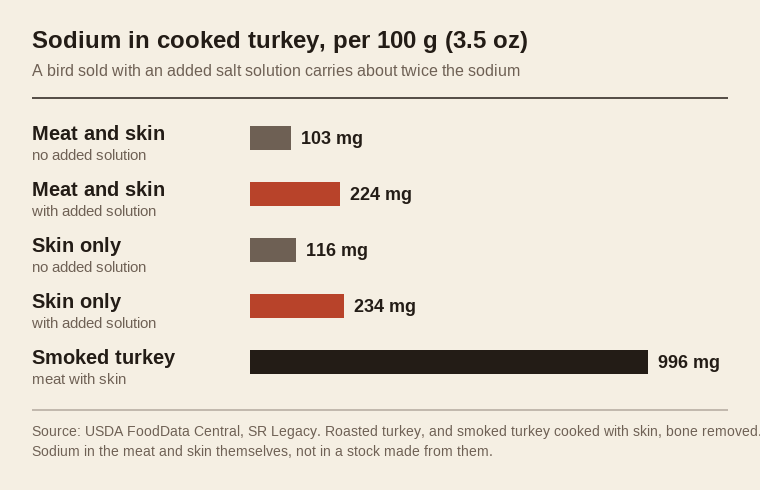
The figures come from FoodData Central, the USDA's food composition database (with added solution; smoked). No study we found measured how much of that sodium moves into the water. A Soup Letters calculation shows the most it could be. Take ATK's 4 pound (1.8 kg) carcass, pretend all of it is meat and skin at the pre-brined figure of 224 mg per 100 grams, and put every milligram into the 8 cups (1.9 liters) of stock. That comes to about 510 mg of sodium per cup. The same sum for a bird with no added solution gives about 230 mg. Both are below a cup of ready-to-serve store-bought chicken broth, about 920 mg by USDA data. The real figures are lower, because most of a carcass is bone (the USDA data don't cover bone) and not all the sodium comes out.
So a pre-brined bird alone makes stock that is saltier, not stock that tastes like seawater. Run the same sum for a smoked turkey and the ceiling is about 2,260 mg per cup. A smoked bird, a home brine, salted drippings or a hard reduction is where truly salty stock comes from.
What turkey labels tell you about salt
Since January 1, 2016, federal rules require any raw poultry with added solution to say so in the product name itself: the percentage as a number with a % sign, followed by every ingredient in the solution (9 CFR 381.117(h)). Since 2018 the lowercase letters in that name can't be smaller than one third of the largest letter, so look for the line right under "Whole Young Turkey", not on the back.
Whatever the label says, don't salt the stock. What the label changes is how careful to be with the drippings and with reducing:
| What the label says | What it means | Drippings and reducing |
|---|---|---|
| "Contains up to 8% of a solution of water, salt..." or "containing 4% added solution" | Injected with salt water before sale | Taste the drippings first; taste before reducing |
| "Basted", "self-basting" or "pre-brined" | The same: the bird carries a solution, and the percentage line says how much | Taste the drippings first; taste before reducing |
| "Kosher" | Salted during koshering: soaked, covered in coarse salt for about an hour, then rinsed (Chabad.org) | Taste the drippings first; taste before reducing |
| "All natural" or "minimally processed" | No artificial ingredients, but salt and water aren't artificial: Butterball's all-natural birds are pre-brined | Check for a "contains" line |
| "Smoked" or "fully cooked smoked" | Salted before smoking: about 10 times the sodium of plain roast turkey in the chart above | Leave out the drippings, dilute the stock and don't reduce it |
| None of the above, and you didn't brine it | No added salt | Use the drippings freely |
| You brined it yourself, wet or dry | Your salt is in the skin, the meat and the drippings | Taste the drippings first; taste before reducing |
Older guides still say a basted bird can hold only about 3 percent solution. That cap was removed: the 2014 final rule deleted it and allowed words like "basted" with any level of solution, as long as the percentage is on the label. The same rule bars the word "enhanced" from the product name, so that word on a sticker or in an ad tells you less than the percentage does.
Reducing stock concentrates the salt
Salt doesn't boil off; only water does. Reduce 8 cups (1.9 liters) of stock to 4 cups (950 ml) for gravy and every gram of salt is in half the water, so the gravy is twice as salty as the stock. Reduce it to 2 cups (475 ml) for a glaze and it is four times as salty. That is why a stock from a pre-brined bird can taste fine in the pot and ruin the gravy. Our answer on how much flour to thicken gravy covers the rest of the gravy.
If the stock is already too salty:
- Dilute it. Water or unsalted stock is the only thing that lowers the salt per spoonful.
- Don't reduce it. Use it for soup at full strength, not for gravy or a pan sauce.
- Cook it into something unsalted, such as rice, noodles or beans, and add no other salt to that dish.
- Salt last next time. Season the soup or gravy at the end, after any reducing.
Cooling and storing turkey stock
Strain the stock through a fine-mesh strainer, then get it cold quickly. Cooling is where the third germ comes in. Clostridium perfringens spores survive boiling for an hour or longer. As cooked poultry, gravy or stew cools, the FDA's Bad Bug Book says this germ "can reach levels that cause food poisoning much more quickly than can other bacteria." A tall pot of stock cools slowly.
- How fast: Penn State Extension says to get stock to room temperature within 2 hours, then refrigerate it (chicken or turkey stock). The FDA Food Code, written for restaurants, is stricter: 135 to 70°F (57 to 21°C) within 2 hours, then to 41°F (5°C) within 4 more.
- How: divide the stock into shallow containers, or set the pot in a sink of ice water and stir it often. The guide to putting hot soup in the fridge explains the timing and the fastest methods.
- The fat: once the stock is cold, lift the fat off the top; America's Test Kitchen keeps it for making soup.
Use refrigerated stock within 1 to 2 days, the figure the FDA's refrigerator and freezer chart gives for gravy and meat broth. Other sources allow longer: the USDA's Turkey from Farm to Table gives turkey broth 3 to 4 days, and Penn State says up to 3. Soup Letters goes with the shortest, and anything you won't use by then belongs in the freezer. The rest of the meal is in our answer on how long Thanksgiving leftovers last.
- Freezer: safe indefinitely at 0°F (−18°C); the FDA and USDA give 2 to 3 months for best quality. Freeze it in amounts you will use: ice cube trays for pan sauces, quart containers for soup.
- Glass jars: chill the stock in the fridge before the jars go in the freezer, never hot. Use wide-mouth jars, as Penn State suggests, whose straight sides let the stock expand upward, and keep the stock below the shoulder of any jar that narrows at the top. The National Center for Home Food Preservation's headspace table covers liquids such as juice. It asks for ½ inch (1.3 cm) in a wide-mouth pint jar, 1 inch (2.5 cm) in a wide-mouth quart and 1½ inches (3.8 cm) in a narrow-mouth jar.
- Reheating: bring soups, sauces and gravies to a rolling boil, as the USDA's leftovers guidance advises.
Thaw frozen stock in the fridge or straight in the pan, not on the counter, as Penn State Extension advises. Stock that doesn't set to a jelly when cold is still good stock; it just has less gelatin, which the guide to making stock explains.