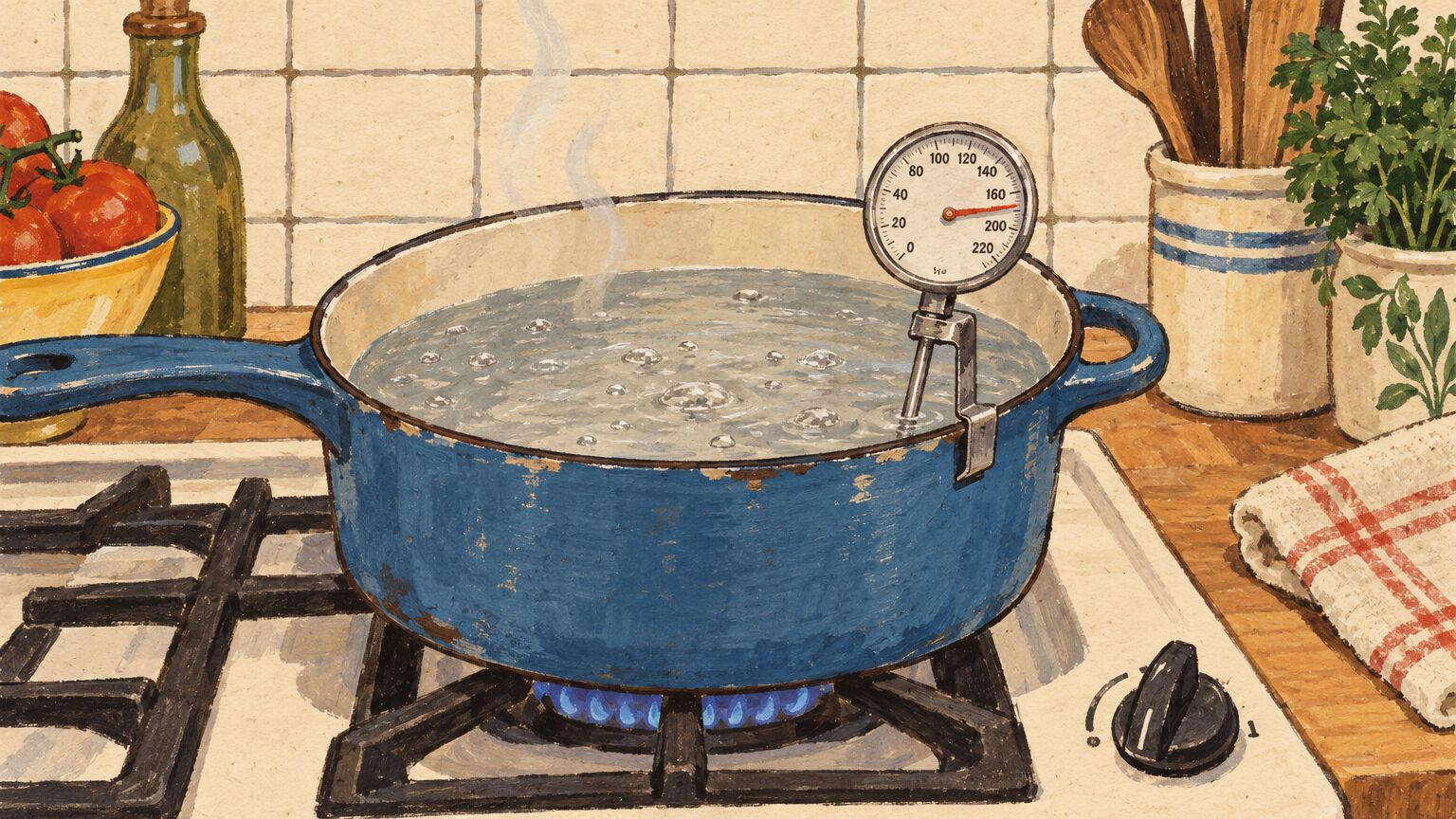
A simmer is liquid at about 185 to 200°F (85 to 93°C) at sea level: small bubbles rise from the bottom of the pot and break the surface gently, and the surface trembles without churning. Water boils at 212°F (100°C), with large bubbles breaking the surface all the time. Poaching is cooler, about 160 to 180°F (71 to 82°C) in most sources, where the liquid barely moves.
The simmer figures are from the simmering chapter of Wayne Gisslen's Professional Cooking, a standard culinary school textbook. Other sources stretch a simmer from 180 to 205°F (82 to 96°C), and every cooking source here that gives a range includes 185 to 190°F (85 to 88°C). No number on a stove dial is a simmer; you find it by turning the heat down until the bubbles look right. Above sea level the whole ladder slides down: in Denver, water boils at about 202.3°F (94.6°C).
Poach, simmer and boil: temperatures and what they look like
| Stage | °F | °C | What you see in the pot |
|---|---|---|---|
| Poach | 160 to 180 | 71 to 82 | The surface shivers; small bubbles cling to the bottom, and few if any break the surface |
| Bare simmer | 180 to 190 | 82 to 88 | Now and then a small bubble breaks the surface |
| Simmer | 185 to 200 | 85 to 93 | Small bubbles rise steadily and break the surface gently |
| Vigorous simmer | Up to about 205 | Up to about 96 | Small bubbles over most of the surface, but no large rolling bubbles |
| Boil | 212 | 100 | Large bubbles rise fast and break the surface all the time |
| Rolling boil | 212 | 100 | A boil so strong that stirring doesn't stop it |
The poach row is the range most sources give, and the simmer row is Gisslen's. "Bare simmer" and "vigorous simmer" are Soup Letters' names for the two ends of the range, not textbook terms. At the low end, America's Test Kitchen calls small bubbles that "occasionally break surface" at 180 to 190°F (82 to 88°C) a simmer. At the top, 205°F (96°C) is simply the highest figure any source here prints. The rolling boil is the jelly-making test from the National Center for Home Food Preservation: "a full rolling boil that cannot be stirred down."
All of these are sea-level figures. At altitude, go by the bubbles, as the altitude section explains.
What number on the stove dial is a simmer?
No number on the dial is a simmer. The usual advice, 2 or 3 on a dial that runs from 1 to 10, works for some pots on some stoves. A burner knob sets how much heat goes in, from a gas flame or an electric element, and the temperature the pot ends up at depends on the pot.
A pot warms until it loses heat as fast as the burner supplies it. It loses heat as steam from the surface and as warmth from its sides. A wide, full, uncovered pot loses far more than a small covered saucepan, so a setting that holds the saucepan at a simmer can leave a stockpot short of one. A lid keeps heat in, so the same pot on the same setting can creep from a simmer to a boil once it is covered.
Electric stoves add a delay. A coil or glass-top element stays hot for a while after you turn it down, and on a glass radiant cooktop the element switches itself on and off, which Whirlpool says is normal and happens even on high. If a pot keeps boiling after you turn an electric element down, slide it partly off the element for a minute, or move it to a second element already set on low.
To set a simmer on any stove:
- Bring the pot to a boil on high heat, unless the recipe says not to boil it (poaching, or soup with milk or cream already in it). Then bring it up on medium heat instead.
- Turn the heat down, starting at medium-low, until the large bubbles stop and small ones break the surface gently.
- Wait 3 to 5 minutes, then look again. A heavy pot, an electric element or a cast iron grate keeps releasing heat after you turn it down.
- Check again after you add cold food, put on a lid or take one off. Each of those changes where the pot settles.
What the bubbles tell you, and when they mislead
- The first tiny bubbles aren't a simmer. As cold water warms, small bubbles collect on the bottom and sides of the pot long before it is hot. They are air. Cold water holds more dissolved gas than warm water, so the gas comes out of solution as the water heats.
- Steam bubbles start at the hottest metal. A steam bubble can only form where the pan is hotter than the boiling point, which over a flame or a hot element is the bottom of the pot, while the water above is still cooler. In that cooler water, steam condenses on the top of the bubble until it caves in, as John Lienhard's A Heat Transfer Textbook shows for a bubble growing in water below its boiling point (Figure 9.6). As the whole pot gets closer to boiling, more of the bubbles survive the trip and break the surface. That is the change from poach to simmer to boil.
- A strong burner can fake a simmer. Because the bubbles depend on how hot the bottom is, a thin pan on high heat can send up a stream of bubbles from the hot spot while most of the water is still well short of a simmer. Turn the heat down, stir, and read the bubbles that remain. America's Test Kitchen gives the other reason to keep the heat low: a gentler burner lets heat spread from the bottom of the pan to the top, with "less risk of scorching."
- Thick liquids hide it. In chili, tomato sauce or a thick stew, bubbles can't rise freely. The surface heaves and pops in slow, spattering bursts, and the bottom can scorch before the top looks lively. Stir from the bottom and go by what you see after stirring.
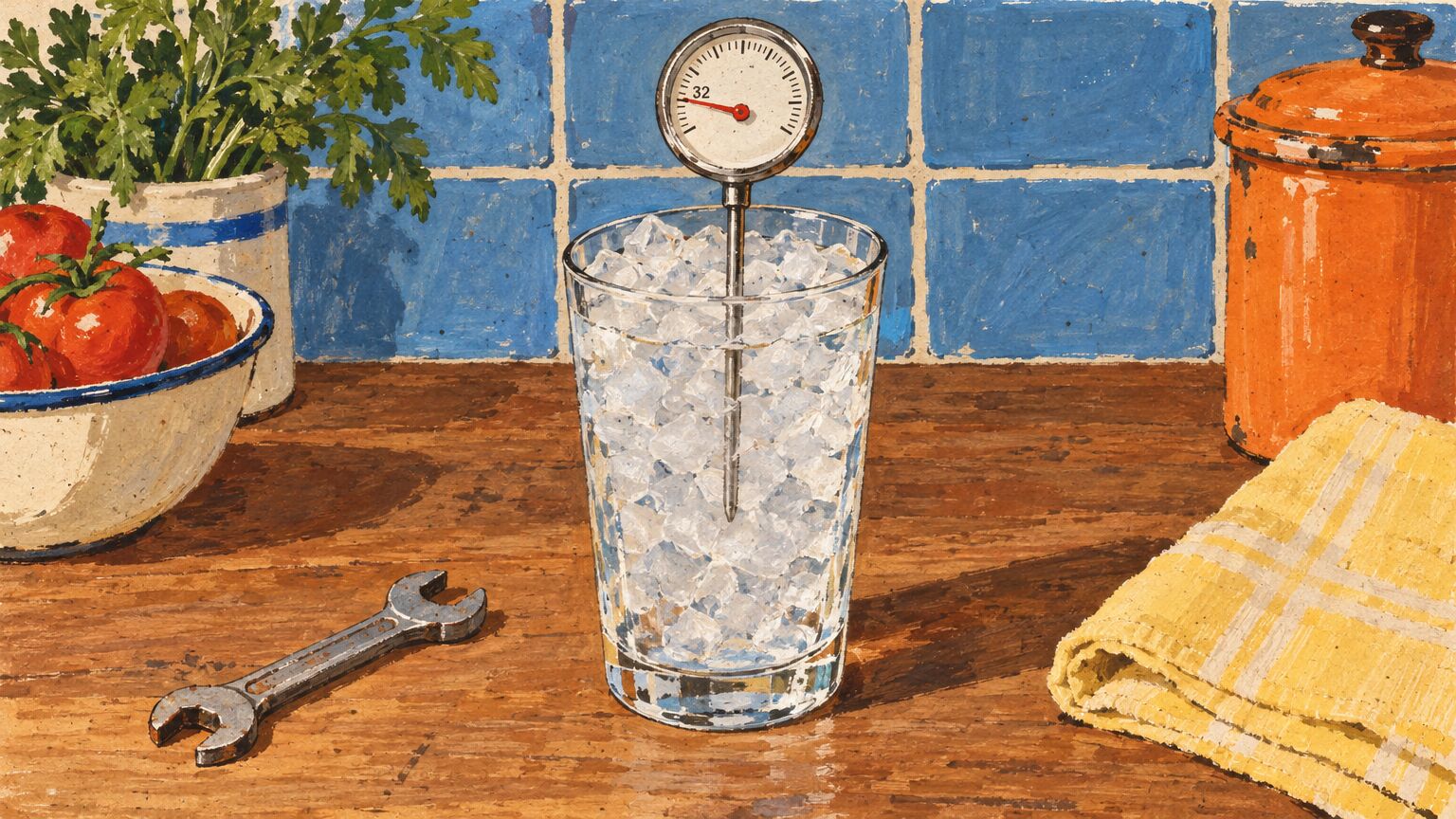
To learn what your own stove's simmer looks like, put an instant-read thermometer you have checked in the middle of the pot after a stir, once, and match the reading to the bubbles.
A rolling boil is no hotter than a boil
A rolling boil is the same temperature as a gentle boil: 212°F (100°C) at sea level. Water in an open pot can't get hotter than its boiling point. Turning up the heat under a boiling pot only turns more of the water into steam faster, which reduces the liquid but cooks the food no faster. Only a pressure cooker raises the temperature, by raising the boiling point: about 250°F (121°C) at 15 psi, as the stock guide's table shows.
A full boil still matters when a recipe or a safety rule asks for one:
- Dried red kidney beans. They contain a toxin that low cooking temperatures don't destroy, and a simmer is not the boil the FDA asks for. Its Bad Bug Book says to soak the beans for at least 5 hours, pour the water away and boil them in fresh water for at least 30 minutes. In tests, boiling for 10 minutes at 212°F (100°C) destroyed the toxin. It warns against slow cookers for these beans, because slow-cooked casseroles in studies often reached only 167°F (75°C) or less.
- Reheating leftover soup, sauce and gravy. The USDA says to bring them to a rolling boil, and to reheat other leftovers to 165°F (74°C). A boil doesn't rescue soup that was left out too long; cool it properly the first time.
- Jam and jelly. Pectin recipes need the full rolling boil that "cannot be stirred down," then a hard boil for a set time.
- Boiling water canning. The National Center for Home Food Preservation has you heat the canner until the water "boils vigorously." You may then lower the heat only "as long as a gentle but complete boil is maintained" for the whole time. If the water stops boiling at any time, the processing time starts over from the beginning, so a simmer isn't enough.
Simmering at high altitude
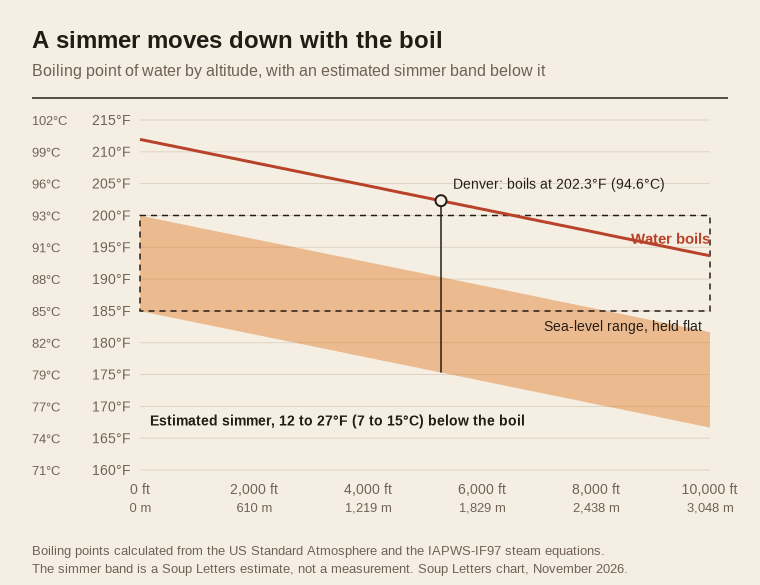
At altitude, water boils at a lower temperature, so a simmer runs cooler too. The USDA says the boiling point drops by just under 1°F (0.6°C) for every 500 feet (152 m) you climb. Above about 3,800 feet (1,160 m), water boils before it reaches 205°F (96°C), the top of the widest simmer range, and above about 6,500 feet (2,000 m) it boils before 200°F (93°C).
Bubbles survive the trip to the surface according to how far the water is below its own boiling point, not according to a fixed temperature. At sea level, Gisslen's simmer sits 12 to 27°F (7 to 15°C) below the boil. Keeping that same distance gives an estimate for higher kitchens. It is a Soup Letters estimate from the physics, not a measurement, so trust the bubbles over it.
| Altitude | Water boils at (°F) | Water boils at (°C) | Estimated simmer (°F) | Estimated simmer (°C) |
|---|---|---|---|---|
| Sea level | 212.0 | 100.0 | 185 to 200 | 85 to 93 |
| 2,000 ft (610 m) | 208.3 | 97.9 | 181 to 196 | 83 to 91 |
| 4,000 ft (1,219 m) | 204.7 | 95.9 | 178 to 193 | 81 to 89 |
| 5,280 ft (1,609 m), Denver | 202.3 | 94.6 | 175 to 190 | 80 to 88 |
| 6,000 ft (1,829 m) | 201.0 | 93.9 | 174 to 189 | 79 to 87 |
| 7,500 ft (2,286 m) | 198.2 | 92.4 | 171 to 186 | 77 to 86 |
| 10,000 ft (3,048 m) | 193.7 | 89.8 | 167 to 182 | 75 to 83 |
The boiling points use the same calculation as the boiling point table in the thermometer answer and match the USDA's 198°F (92°C) at 7,500 feet (2,286 m).
Lower temperatures also mean slower cooking. The USDA says meat and poultry cooked in liquid "may take up to one-fourth more cooking time" at 5,000 feet (1,524 m), and calls this "especially true for meat cooked by simmering or braising" in its guidance. The same page says a slow cooker simmers at a lower temperature at altitude, so it needs longer. A pressure cooker is the way around both problems.
Why sources give different temperatures for a simmer
A simmer is defined by how the pot looks, so each writer who attaches a number to it draws the edges a little differently. Gisslen's own book prints two versions. Its glossary puts a simmer at 185 to 205°F (85 to 96°C), and poaching, in liquid "hot but not actually bubbling," at 160 to 180°F (71 to 82°C). Its simmering chapter says 185 to 200°F (85 to 93°C) for a simmer and 160 to 185°F (71 to 85°C) for poaching.
Thibodeaux and Daigle's open textbook and Utah State University Extension give 180 to 205°F (82 to 96°C) and 185 to 205°F (85 to 96°C). America's Test Kitchen narrows a simmer to 180 to 190°F (82 to 88°C), the same range it gives for braising liquid. Zeringue and Thibodeaux's open stock textbook names one figure, "approximately 185°F (85°C)," the number the Soup Letters stock guide uses. Even the descriptions conflict: for poaching at 160 to 180°F (71 to 82°C), Utah State says bubbles "don't break the surface," and America's Test Kitchen says small bubbles "just begin to break the surface."
None of these is wrong. Every range sits within a few degrees of 185 to 190°F (85 to 88°C), the span all of them include. For most cooking the exact edge doesn't matter; the difference between a simmer and a boil does.
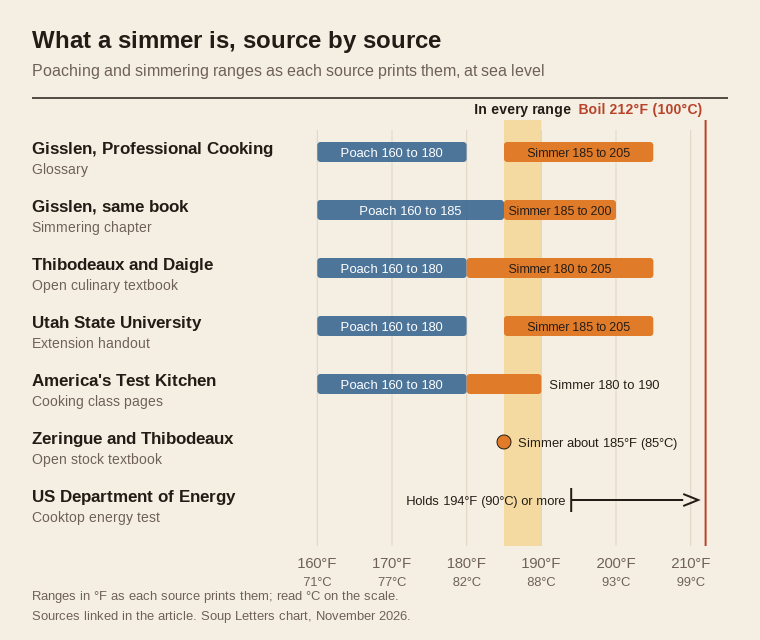
An engineering definition runs hotter. The US Department of Energy's cooktop energy test, which follows the international standard IEC 60350-2, times a 20-minute "simmering period" from the moment a test pot of water reaches 90°C (194°F). The lowest burner setting that passes the standard's test "is also referred to as the simmering setting."
Simmering soup and soup with milk or cream
Most soups and stocks want a gentle simmer around 185°F (85°C), the figure the stock guide uses, where the liquid stays clear and the bottom doesn't scorch.
Once milk or cream goes in, keep the soup below a boil. "Take care not to let soup boil after adding milk to keep it from curdling," says Utah State University Extension's corn chowder recipe. Bring the soup to a simmer before the dairy goes in, add it, and then heat it gently, stirring, until it is hot through.